




'Little red dot' now an eyesore to the Chinese
Following the disintegration of the Soviet Union nearly 20 years ago, Turkey found itself a new role on the world stage: enticing the Central Asian republics to form a sphere of influence through ethno-cultural affinity.
Following the disintegration of the Soviet Union nearly 20 years ago, Turkey found itself a new role on the world stage: enticing the Central Asian republics to form a sphere of influence through ethno-cultural affinity.
With the exception of the Persian-speaking Tajikistan, which has strong cultural and historical links with Afghanistan and Iran, the remaining newly independent states are considered members of the Turkic family ; so is Azerbaijan.
Given Turkey's relatively modern and advanced economy, Ankara had hoped to guide these fledging republics onto the path of "modernization" in the spirit of "Turkic brotherhood". There was much enthusiasm and euphoria at the time, but all the effort to create a Greater Turkic economic circle eventually came to naught due to the geo-strategic realignment among Russia, China, the United States and the European Union; Ankara's limited resources and lack of economic clouts also did not help.
As far as these Turkic republics are concerned, "modernization" means the US and the EU, not a middle-income Turkey.
Today, any attempt to revive this Turkic dream only meets with a cold shoulder, and Turkey's only semblance of ethno-cultural leadership manifests in its moral support for the oppressed Uighurs in China. Even there, the voice is feeble at its best.
As any student of international relations knows, economic interests, security concerns and strategic considerations almost always trump ethno-cultural affinity in world politics. Too bad, that Chinese netizens appear to be ignorant of this harsh reality.
Claim its rightful place on world stage
Thanks to years of indoctrination (best exemplified by the pompous, bombastic and propagandistic celebration of the 60th anniversary of the founding of the People's Republic), the Chinese are now convinced the time has come for their great nation to claim its rightful place on the world stage, and assume a greater position.
Nationalistic sentiments are at their strongest since perhaps the dying years of the Qing Dynasty more than a century ago, something that even the ruling Chinese Communist Party (CCP) finds hard to control.
Chinese netizens also believe he/she who is of Chinese origin must identify with China and Chinese culture, and any failure to do so will render the person an ingrate or, worse, traitor to the Chinese nation (similar to a pengkhianat Melayu in Umno's Weltanschauung).
Should one fully embrace China without necessarily possessing even a rudimentary knowledge of Chinese culture, he/she will still be regarded
 as a good Chinese - including those foreign-born, English-speaking Chinese who sing praises of the "great" Chinese civilization merely to gain a foothold in the vast and lucrative Chinese market.
The keyword is therefore Chinese, Chinese and Chinese; anything else is secondary or even irrelevant.
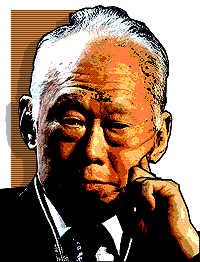
Lee Kuan Yew, the "founding father" of modern Singapore (whose Singapore Story only begins with the arrival of Thomas Stamford Raffles) had gained strong affinity with the mainland Chinese because of his Chinese blood; but also because this man has sort of established the island state as a modern and prosperous economy through his own sheer will and determination.
Like it or not, the "little red dot" today boasts strategic, financial, political and economic influence that is totally disproportionate to its size and population, making it a "success story" of the Chinese diaspora.
Ought to be pro-China
Since Lee is Chinese, he ought to be pro-China, and this misperception has obscured the mainland Chinese from a proper perspective in understanding Singapore as an independent state in the sea of sharks.
Last week at the US-Asean Business Council gala dinner in Washington, Lee reportedly urged the US to either "retain role in Asia to balance China" or risk "losing its global leadership position".
More tellingly, Lee also warned that China's "blue-water fleet with aircraft carriers cannot just be to deter foreign intervention in a conflict between Taiwan and the mainland", stopping short of saying the Beijing leadership could harbour ambitions beyond recapturing the "renegade province".
Such remarks are a shocker for the Chinese, especially when they were made by a prominent "overseas Chinese" leader who has long been regarded as "a good friend of China". Lee's candid advice is now taken as an insult to the Chinese nation, and his act akin to a lowly Chinese sucking up to his western master.
If you are well-versed in the " Century of Humiliation ", you know what a running dog means in the mainland Chinese context.
Despite his effort in the recent years to encourage greater use of Mandarin as a lingua franca for Chinese Singaporeans, and various incentives to attract professionals from the Chinese-speaking world, Lee's view of Singapore's strategic outlook has remained overwhelmingly consistent.
A small nation sandwiched between Indonesia and Malaysia, Singapore's long-term survival depends on maintaining a stable and cordial relationship with the two mercurial and sometimes hostile countries, as well as on substantive ties with the outside forces, especially the US.
When talks between Washington and Manila on American use of Philippine military bases were faltering in November 1990, Singapore gave Washington timely leverage by offering itself as an alternative base.
When Mahathir Mohammad vigorously promoted an Asian trade block without the US in 1992, Singapore went on to sign a series of trade deals with Washington, assuring the latter of "a place in Southeast Asia".
Reminding the major powers of its strategic values
When the rise of China as an economy seemed to be unstoppable in the late 1990s, Singapore began to proactively engage Beijing as a major economic partner, even opening up the job market for mainland Chinese whose command of the Chinese language is far superior to that of the Chinese diaspora, to the chagrin of the Chinese Singaporeans no doubt.
More importantly, Singapore being a small fish has to make its presence felt. How? By reminding the major powers of its strategic values.
Lee has tried shuttling between China and Taiwan in an attempt to work out a peace plan between the two countries, to no avail. He was subsequently snubbed by the independence-inclined Lee
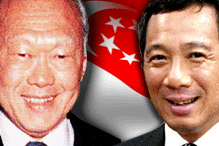 Teng-hui of Taiwan and the two hardly talk these days. He has also adroitly exploited the differences between China and Japan by touting Singapore as a stable and reliable investment destination for the Japanese.
Within Asean, Singapore's ties with bigger economies such as Indonesia, Malaysia and Thailand, while touchy at times, are predominantly guided by pragmatic considerations. It is interesting to note that the island republic stood above the fray when Jakarta and Kuala Lumpur mired in the funny tug-of-war over cultural heritage recently.
Lee understands perfectly well that only by highlighting the potential conflicts between China and the Asean countries - from energy competition to the disputed Spratly Islands - can he ensure a permanent presence of the US in this part of the world, thereby securing Singapore a significant role to play in the years to come.
'keeping a low profile and biding time'
But in speaking his mind so frankly, Lee may also underestimate the Chinese leadership. While it is generally true that Beijing adheres to the tao guang yang hui principle (keeping a low profile and biding one's time) in view of China's massive domestic challenges, the anger of the Chinese netizens cannot be easily dismissed as merely a fringe group of blinded nationalists.
They are not.
In 2005, the CCP had wanted to contain the outpouring wrath and hatred against Japan over historical issues, but forced to allow massive public protests unseen since the 1989 uprising in order to maintain its "legitimacy".
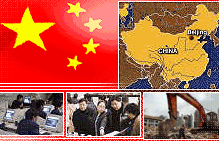 Preventing the Chinese from expressing their nationalistic feelings amounts to acquiescing in anti-Chinese rhetoric, and the CCP has learned the hard lesson that nationalism is a double-edged sword that cuts both ways.
Much of the anti-Japanese sentiment had been generated through the internet, and Lee will do well to keep this in mind and refrain from testing the tolerance of the Chinese leadership too much.
As for the Chinese, they should be taught a thing or two about realpolitik in international relations, and shred whatever remnants of romantic imagination of a "universal Chinese nationhood". Had they known how Lee had persecuted the leftists and betrayed the socialists in the 1960s, and rooted out Chinese education gradually through his policy that was heavily in favour of the English language, they would not have wasted their time condemning Lee for his "anti-Chinese" behaviour.
Lee, after all, is a pragmatist par excellence.


