




Citizenship: A new paradigm needed
It was a short taxi ride that I will never forget. I was waiting for a feeder bus at an LRT station to attend an opposition function in Petaling Jaya, when it rained cats and dogs.
It was a short taxi ride that I will never forget. I was waiting for a feeder bus at an LRT station to attend an opposition function in Petaling Jaya, when it rained cats and dogs.
Fed up with the long queue and the downpour, I found myself sharing a taxi with a young Malay man.
To break the awkwardness, we started talking. It went rather well until I told him I would not hesitate to vote any opposition party - including PAS.
And he suddenly changed the topic to the unrest in southern Thailand.
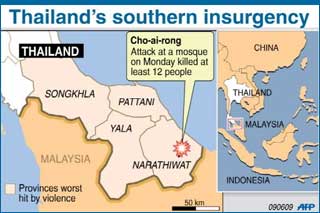 It was sometime in 2005 - way before the political tsunami of March 2008 - when the insurgency in the Muslim-majority provinces made headlines every now and then, a particular concern of the Malay press in Malaysia.
"How would you describe those Malays who rise up against the Thai government?", he asked.
"I certainly do not condone the violence exacted by both sides; but I do think the Muslim population has the right to make its voices heard." My reply was short and simple.
"I think differently. These people are Thai nationals in a Buddhist country. They should respect the largest community and abide by Thai law because the Buddhists have allowed them to stay and live as citizens. Just like here. Your forefathers came to Malaysia to look for opportunities. The Malays hosted them and treated them well. Now, you Chinese are law-abiding and respect the Malays. I think the Malays in southern Thailand should do the same."
It was a thought-provoking chat cut short by my arrival at the venue. We shook hands and he wished me well. But his words lingered in my mind for a rather long time.
Why did he bring up this issue on hearing that I was inclined towards the opposition? Was he saying that by supporting the opposition and not Umno, I showed myself to be an ingrate? (I forgot to tell him my late parents voted for PAS nearly all their lives!)
Recently, a Malaysiakini reader wrote to say that "citizenship is a privilege , not a right". The argument was so shallow and disorganised that it did not deserve much rebuttal, although some did bother to pen their critical replies.
This letter reminded me of the encounter that I had with the Malay man in the taxi, for they both touched on the issue of citizenship especially in the context of Malaysia.
What is citizenship?
While nationality is considered an essential attribute of a person's material and moral well-being, international law allows individual states broad discretion in deciding who shall be citizens. The paramount guiding principle however lies in Article 15 of the 1948 Universal Declaration of Human Rights: "Everyone has the right to a nationality... No one shall be arbitrarily deprived of his nationality, nor be denied the right to change his nationality."
It follows that a person will not be able to avail himself of state protection without citizenship; being stateless also means that he or she will not be able to gain employment, obtain public services especially in the areas of health care and education, participate in political processes, move about freely, avoid labour exploitation, or have access to courts. In other words, the right to citizenship is the right to have other rights.
Malaysia's constitutional arrangements at independence have been so distorted and abused by the ruling elite that many now find access to citizenship almost an insurmountable challenge. Over the years, Umno has successfully brainwashed a large segment of Malaysian society into believing that we must vet and screen these people with the most stringent criteria before granting them citizenship.
I have no problems with strict rules and regulations. Only if they are fair, consistent, transparent and morally justifiable. But they are not.
Yao Tuo, a prolific writer well known to the Chinese community, died last month a stateless man. Born in China in 1922, he came to then Malaya in 1957, and lived here until the day he breathed his last breath.
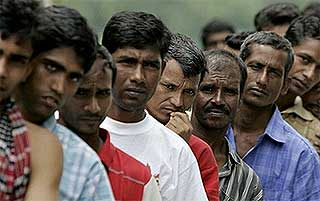 Despite having spent more than half his life in Malaysia than in his country of birth, he died a stateless man. Various attempts to acquire Malaysian citizenship were simply futile.
Meanwhile, Era Consumer, an empowerment-oriented non-government organisation, estimated in 2006 that there could be as many as 20,000 Indian Malaysians without identification documents, prompting the human rights commission to call on the government to look into the issue seriously.
In these cases, we are not talking about foreign spouses married to Malaysians and hence awaiting naturalisation, but people who for one reason or another are denied citizenship even though they may fulfil the requirements of residence or birth. Thanks to bureaucratic discrimination, they have been made to feel inferior to other Malaysians.
Even if they may quality for Malaysian citizenship, there is still a test of loyalty to pass. Yet loyalty is something so subjective that it almost always amounts to nothing but one more excuse for the powers-that-be to exercise their discretion arbitrarily.
Do you really believe that by putting the hand over the heart while singing the ‘Star-Spangled Banner' will prove one's faithfulness to the United States?
Or, Queen Elizabeth II is genuinely pleased whenever a citizenship ceremony takes place before her majesty's picture?
'... do nothing for the triumph of evil'
Those with talent who naturalise today can easily leave the country of adoption for greener pasture tomorrow; it is what these developed countries do to keep them there that really matters.
Between the hard-working stateless man who has spent much of his life toiling on Malaysian soil and the corrupt Malaysian politician who continues to squander our national wealth, it does not take a genius to distinguish who is the real patriot.
And this brings me to two important concepts of citizenship.
The very notion of citizen remains a contested area. The emergence of strong and centralised nation states in 19th century Europe did not necessarily lead to recognition of all persons in a given territory as equal and empowered citizens, and it took two world wars for the European states to realise citizenship is more than just an arrangement to produce mere passive recipients of state's aid and services within legal boundaries and, more importantly, subjects of authority. It is known as passive citizenship.
And passiveness is precisely how the Umno-led government understands the issue of citizenship: leave the definition to the authorities, while you behave and be thankful for the bowl of rice today.
What the Barisan Nasional coalition has yet to realise is the voluntary capacity of citizens and communities working directly together, or through elected representatives, to exercise economic, social and political power in pursuit of shared goals. When politicians are failing our expectations, it is our duty to speak out.
Malaysians are nowadays gravely concerned with the collusion of politics and business. One important factor why cronyism (be it in the Barisan Nasional or Pakatan Rakyat or else) thrives in Malaysia is because many are simply happy to turn a blind eye so long as their livelihood is assured. This client-patron (voter-politician) relationship is perhaps the best embodiment of passive citizenship in this country.
 Didn't English philosopher Edmund Burke warn that "all that is necessary for the triumph of evil is for good men to do nothing"?
My grandparents were indeed ordinary men and women - law-abiding and grateful like anyone else. But we live in a different time and age, when the challenges and the issues confronting the country and the world are vastly different. A new debate on citizenship is long overdue.
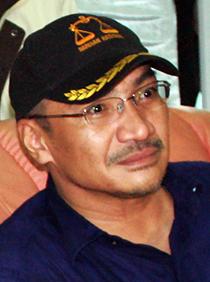
As for Hishammuddin Hussein Onn (left) , a new mindset is badly needed if he is earnest in resolving the issue of statelessness among potential Malaysians. With the number running into tens of thousands, the Minister of Home Affairs cannot hope to kiss and hug each and every one of them for publicity's purposes.


