




A new Japan rises?
For two decades, Mahathir Mohammad through his Look East Policy (LEP) made great efforts to turn the country into an efficient, modern economy modelled on Japan.
For two decades, Mahathir Mohammad through his Look East Policy (LEP) made great efforts to turn the country into an efficient, modern economy modelled on Japan.
Now ‘retired' but still feeling bitter, the old man can only lament his successors have not been as keen as he was in cultivating closer ties with Japan. At least not in a manner that he desires.
Mahathir's knowledge of Japan remains superficial at best, and the LEP has failed to produce Japan-watchers in Malaysia who would take a holistic approach in understanding Asia's biggest economy.
Our Japanophilia seldom goes beyond Japanese cars, consumer electronics and food. In fact, very few Malaysians - including those in government - are genuinely interested in studying Japanese ethos, literature, history and culture in greater depth.
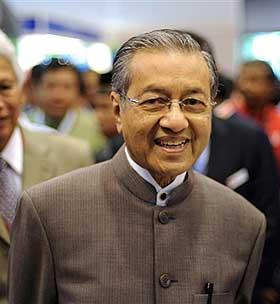 A practical politician disdainful of polemics, Mahathir (
right
) had no time for the "soft aspects" of the Japanese nation; he was too preoccupied with finding a fastest way to technological transformation.
A practical politician disdainful of polemics, Mahathir (
right
) had no time for the "soft aspects" of the Japanese nation; he was too preoccupied with finding a fastest way to technological transformation.
In the course of doing so, the crux of the contemporary Malaysia-Japan relations has almost always been nothing more than economic and technological cooperation. And we only ended up with Japan graduates, not Japan experts.
Mahathir has on many occasions expressed his displeasure that Japan is not forceful and independent enough in the area of foreign affairs, as the country appears to be beholden to the United States at all times.
Is he not aware of the vicissitudes of the US-Japan relations over the last 150 years, during which Japan evolved from being a rival and later an enemy to become a protectorate after World War II?
In reconstructing a post-war Japan that would subject itself to US tutelage, Washington decided that Japan must surrender authority to manage external relations - especially in the area of military arrangements - to the US.
In return, the protectorate retained a degree of control of its internal affairs, while being granted unrestricted access to the American market.
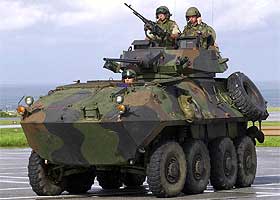 In the 1950s through to the 1960s, Japan was not even permitted to trade with China - its biggest trade partner for more than a millennium - for political and ideological reasons.
The two Asian giants finally "normalised' their relations in 1972 with the blessings of Richard Nixon and Henry Kissinger, who saw it fit to drive a wedge between the Soviet Union and China.
Under these arrangements, leftists were barred from running the government in Japan, and trade unions and student movements were not encouraged for fear that this could induce ‘left-leaning' sentiments in Japanese society. The most trusted lieutenant to oversee the post-war transition was none other than the Liberal Democratic Party (LDP).
Fall and rise of LDP
The LDP is a unique product in a highly extraordinary phase of Japanese history, when the nation was struggling to rebuild its economy and to regain a sense of purpose and pride after the destructive war foolishly started by the militarists and sanctioned by Emperor Hirohito.
Strictly speaking, the LDP is not a political party in the sense of the Tories in Britain or the Republicans in the US. Rather, it was a loose confederation of interest groups that was created to ensure the interests of the pre-war and inter-war industrialists and ruling elite were safeguarded.
This explains why the bigwigs of conglomerates such as Mitsubishi, Mitsui and Sumitomo were also heads of the various factions within the LDP, despite their corporations' deep involvement in WWII (their equivalents in Germany would have been purged and even jailed!).
As power brokers, their major task was to negotiate deals and adjudicate conflicts among the fiefdoms that constitute Japan's political economy. One distinct feature of the decades-long dominance of the LDP has been the rapid succession of Japanese prime ministers, as the various "fiefdoms" demanded their share of the political leadership.
The only LDP prime minister that was not particularly affiliated with any faction and was hence a maverick of sorts was the controversial Junichiro Koizumi, who was instrumental in shattering the bedrock of Japan's political stability and contributed to the fall of the LDP in the last general election.
Therefore, the LDP is more of a well-oiled machine that channels business interests and dishes out fat contracts than a political party rooted in ideology. After three decades of dazzling boom, the bubble economy burst in 1990, followed by the so-called decade of loss.
Still, the LDP found transformation or reinvention an insurmountable task, with the hoard of savings largely wasted on the construction of roads, airports and other white elephants. The shrewd Japanese began to tighten up their belts, and refused to spend despite all the incentives by LDP leaders.
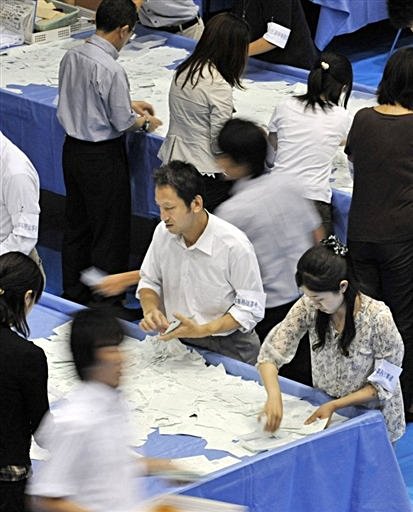 The Japanese electorate had grown tired of the LDP's factional conflicts and hence been looking beyond asset bubbles.
On 30 August this year, voters boldly voted for the Democratic Party of Japan (DPJ) in the hope of breaking the old reins of power and ushering in new paradigms.
But the DPJ does not just set its eye on renewing Japan's internal politics; it seeks readjustments and re-orientation of foreign policy as well.
Last month in Singapore, Prime Minister Yukio Hatoyama unveiled the idea of an ‘ East Asia Community '*, in which he recognised the changed geopolitical landscape in East Asia as well as the new realities within Japan.
In a clear departure from the LDP, the DPJ president had in May this year publicly argued for a closer East Asia that bound South Korea, Japan and China together. He even toyed with a common security mechanism and a single currency in the region.
This aside, Hatoyama foresaw a decreasing role of the US in East Asia, and conceded US economic and political influence in this part of the world should be reduced. He also hoped that East Asian countries would do more to encourage China to expand its economy while keeping its military posture to a "reasonable" extent.
A new East Asia?
Quite clearly, instead of counting on the US to counterbalance the rise of a potentially ambitious China, Hatoyama places more hope on a closer and mutually beneficial East Asia community to foster greater trust. This would also give Japan a chance to design foreign policy goals that would be more independent of the US.
In Hatoyama's understanding, Japan deserves to be a more equal partner to not only China, but also the US. The country must stop serving merely as a convenient pit stop for refuelling planes and a military base. The current stalemate over the relocation* of US soldiers on Okinawa is a case in point.
Cashing on the voters' sentiments, Foreign Minister Katsuya Okada told the press that ‘the will of the people of Okinawa and the will of the people of Japan was expressed in the elections... I don't think we will act simply by accepting what the US tells us'. It was perhaps the bravest statement made by a Japanese foreign minister in 50 years.
The US is certainly not pleased with this development, but President Barack Obama and his administration will most probably go along with it for now given the challenges at home.
Mahathir's shallow view of Japan is embodied in his past calls for Tokyo to walk out of the US shadow, not knowing that any such move would be tantamount to hara-kiri for LDP politicians.
He however did see the LDP as an immensely rich and amazingly effective political machinery, and started to emulate it by transforming his own party - Umno - in this direction.
Throughout the 1980s and 1990s, Malaysians witnessed staggering economic growth and the emergence of state-of-the-art buildings, but also roads and bridges to nowhere. More and more gigantic projects were being studied and even underway that failed to generate jobs, while the outcome of these projects could never justify the costs.
Pretty much like the Japanese in the last two decades, we are now experiencing stagnant growth and disillusionment with grandiose visions. If the LDP can fall in such a dramatic manner, so can Umno. The only thing is, Mahathir may no longer be around to pen his elegy for a party that has given him a racist platform.
JOSH HONG studied politics at London Metropolitan University and the School of Oriental and African Studies, University of London. A keen watcher of domestic and international politics, he longs for a day when Malaysians will learn and master the art of self-mockery, and enjoy life to the full in spite of politicians.


