




One Agoraphobic Malaysia
I read in the news that the Penang state government had fenced off the public space right in front of Dewan Sri Pinang , which is just a stone’s throw away from the state assembly building.
Some refer to the square as “democracy corner”, which is bemusing to me, to say the least.
Did Malaysians ever have an open space where one could express his/her political views without the fear of reprisals? Not when it is not sanctioned by the powers-that-be.
I read in the news that the Penang state government had fenced off the public space right in front of Dewan Sri Pinang , which is just a stone’s throw away from the state assembly building.
Some refer to the square as “democracy corner”, which is bemusing to me, to say the least.
Did Malaysians ever have an open space where one could express his/her political views without the fear of reprisals? Not when it is not sanctioned by the powers-that-be.
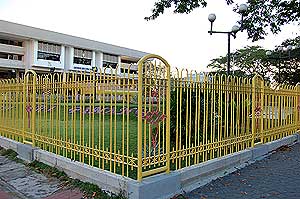 I then learned from Oh Tong Keong, a Gerakan youth leader, that it used to be a place where people gathered and candle-light vigils were held, including a rally to protest against the BN’s government wanton use of the Internal Security Act in September 2008, attended by several Pakatan Rakyat’s bigwigs.
That it is now off-limits to the public does not augur well for the future of democracy despite the change in state government nearly two years ago.
Penang state secretary Zainal Rahim Seman explained the space was closed to protect the lawn and the plants from being trampled.
Whatever the real reasons, this latest violation of PR’s promises to enlarge democratic space only casts further doubts on their commitment for change. Prior to that, the PR leaders had failed to convince the public why now was not the right time to bring back local election.
Khalid Ibrahim, the Selangor Menteri Besar, said sometime ago that protestors should gather indoors so that disruption to business communities and the general public could be kept to a minimum, which did make him sound like a “poor-man’s” Umno leader, to quote from Zaid Ibrahim.
When a group of Umno members burned a poster of Lim Guan Eng last December, the Penang Chief Minister questioned publicly why the police had tolerated it, conveniently forgetting that his own party members too had verbally abused some BN or “BN-friendly” politicians.
I am not sure the decision by the Penang state government to fence off the “democracy corner” was politically motivated, but its proposal for an alternative site, “a permanent stage at the Esplanade for candle light vigils, open forums and demonstrations ”, while welcome, is less than ideal.
A vitally important societal function
Multi-use spaces, such as Sri Dewan Pinang, serve a vitally important societal function in that they make it possible for a plurality of people to exercise their cherished rights of speech and assembly. Politics aside, these places also manifest democratic values by allowing street musicians, punks, skateboarders and the homeless to meet one another. They are nothing less than an agent of democracy.
London’s Hyde Park is one such place. The Speaker’s Corner is best known as the cradle of free speech, although one may find those who gather there these days are mostly religious bigots (both Muslims and Christians, plus pockets of others such as Falun Gong followers and Scientologists) or ardent republicans calling for the Queen and her family to pack up and move, rather than die-hard socialists warning against a return of Thatcherism.
Jürgen Habermas, the celebrated German sociologist, argues in his monumental work The Structural Transformation of the Public Sphere that for an opinion to enter into the public space (Öffentlichkeit), it has to be meaningful and able to generate debate. He later elaborated on this with the concept of das Publikum, the public space where the speaker and the listener interact to gauge each other’s views.
 With the advent of new technologies in the 1990s, the public space (or public sphere) has been increasingly taken by many to refer to the media and the internet, as well as networks of citizens such as non-government organizations.
But what about a physical forum where people can meet to discuss and deliberate on public issues? No matter how vigorous and vibrant the “virtually public” space is, it needs a physical theatre for actual communication and – one may disagree – discursive dramatisation.
Like it or not, politics is also a spectacle that requires a stage for the performance to be carried out, and it would be utterly futile for movements such as Saya Anak Malaysia to merely meet indoors and then channel their views privately to the authorities without organising roadshows to also engergise and mobilize the public behind them.
Pakatan leaders need to be taught that democratic life gains its energy, vibrancy and relevancy from innumerable decentred, random and small-scale participatory moments in various locations at various times. As Thomas Carlyle, the Scottish satirist/writer, once famously asked:
“But does not, though the name of Parliament subsists, the parliamentary debate go on now, everywhere and at all times, in a far more comprehensive way, out of Parliament altogether?... Whoever can speak, speaking now to a whole nation, becomes a power, a branch of government, with an inalienable weight in law-making, in all acts of authority”. ( On Heroes, Hero-Worship, and the Heroic in History )
It is, therefore, legitimate for Penangites to demand their right for a space to demonstrate the sheer physical presence and scale of popular displeasure peacefully within the sight of the Dewan Undangan Negeri.
Responsibly Bold
I would even go a step further by stating that Malaysians should be bold – in a responsible way – enough to claim back our public spaces so that we all can express our pleasure or resentment with decision-makers regardless of their political persuasions. A space as such would be ideally close to the power centre, usually the assembly buildings, party offices or government headquarters.
Even MCA leaders who had fallen out with Ong Tee Kiat were smart enough to gather outside the party’s headquarters in Jalan Ampang to mourn the “death of intra-party democracy” and to maximize the dramatic effects, for they knew full well it would be pointless to call for Ong’s resignation at, say, Dataran Merdeka!
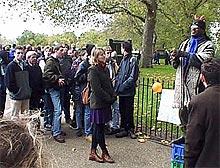 In this regard, Dr Mahathir Mohamad should ask why the Americans can freely meet on Pennsylvania Avenue in front of the White House while Londoners were able to shout at Tony Blair just outside Downing Street, all done without the fear of arrest, while the former prime minister of Malaysia and himself a well-known critic of the West hardly tolerated his detractors at home?
I personally admire deeply the Germans for the renovated Reichstag building in Berlin. On top of a spacious square where people congregate to protest against the action or inaction of the powerful, it also conveys a more egalitarian message when visitors express their symbolic dominance over the law-makers by walking over the latter’s heads. Yes, one can physically climb up the glass dome and monitor the on-goings in the debating chamber! Now, compare this to our Parliament Building that is not only aloof but arrogant.
Our politicians often cite security when they make public spaces inaccessible, thereby limiting our right to assembly. But I often wonder if these leaders are in fact agoraphobic living in constant fear of public protests right before their eyes, which reflects nothing but deep anxieties over dissenting voices that may hurt their ego, rather than potential for violence. And it is indeed sadder to know the so-called new breed of politicians do not differ too much from their BN counterparts on this.
JOSH HONG studied politics at London Metropolitan University and the School of Oriental and African Studies, University of London. A keen watcher of domestic and international politics, he longs for a day when Malaysians will learn and master the art of self-mockery, and enjoy life to the full in spite of politicians.


Are you sure you want to delete this comment?
This action cannot be undone.