




Flagellation as a mechanism of gender control
With the revelation by Home Minister Hishamuddin Hussein Onn of three Muslim women having been caned for having illicit sex, the country is again under severe international scrutiny.
With the revelation by Home Minister Hishamuddin Hussein Onn of three Muslim women having been caned for having illicit sex, the country is again under severe international scrutiny.
Granted, it would not have sparked an uproar of this scale had the punished been of the other sex.
After all, countless men have been whipped in Malaysia for all kinds of offences and no one has made an issue out of it.
Yet the perception of Muslim women enjoying social status that is far less than their male counterparts is so pervasive, that any further erosion will only strengthen the negative impression that the world has of Muslim countries as a whole.
In Saudi Arabia, women are in general barred from driving. Some Muslim clerics have justified the ban by claiming that once a woman gets behind the wheel, there is no way to ensure she would not drive across the border to "meet other men".
They also believe liberalising the law could raise "unnecessary emotions".
Furthermore, women only make up just 5% of the workforce in Saudi Arabia, making it the lowest proportion in the world.
This is in spite of the fact that as much as 70% of university students in the country are women.
But how many actually know that Prophet Muhammad was a earnest champion of women's rights of his time?
Having baby girls - especially female firstborns - was once a sign of disgrace in the Arab Peninsula, and girls were often buried alive in the desert to cover the "shame".
Fine examples left in cold storage
Prophet Muhammad, who had four girls from his marriage to Khadija, set an example by raising all of them and later abolishing the inhumane practice.
He also enacted laws that allowed women to be educated and to inherit their husbands' property.
While Muslim women in Malaysia have made significant progress in the areas of education and health, they are yet to make headway in terms of religious and political empowerment.
The fervent call to embrace Malaysian history notwithstanding, not many in the country are aware that Kelantan was once ruled by a female chief by the name of Che Siti Wan Kembang .
I am quite certain Hamidah Osman, a Barisan Nasional assemblyperson, was blind to this historical fact when she recently opined that female politicians could not become menteris besar.
Meanwhile, Muslim women dominated Malayan political scene in the period leading up to national independence in 1957, such as Shamsiah Fakeh of the Angkatan Wanita Sedar, as well as Khatijah Sidek, Ibu Zain and Fatimah Hashim, all prominent female figures in Umno at that time.
Caning foretaste of what's to come
 Fatimah Hashim (
right
), who passed away last month, was the first woman to become a minister in independent Malaya.
Fatimah Hashim (
right
), who passed away last month, was the first woman to become a minister in independent Malaya.
It is therefore sad to notice the decline of Muslim women's position in Malaysia despite their amazing advancement in education and health.
Today, female students outnumber males in most of our public universities, while women's representation in the public service is disproportionate to their national population.
However, a closer look at the picture shows that the gap between men and women's representation in the decision-making level of the public service is widening as they move into higher grades.
In other words, most of the women found in the public service are in the support groups, rather than holding high-ranking positions.
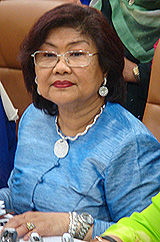 This aside, glass ceilings remain intact in the cabinet. Women are often given roles that seemingly "correspond" to their gender, such as portfolios of family affairs, culture and tourism, with Rafidah Aziz (
left
) being the only exception as minister of international trade and industry for nearly two decades.
This aside, glass ceilings remain intact in the cabinet. Women are often given roles that seemingly "correspond" to their gender, such as portfolios of family affairs, culture and tourism, with Rafidah Aziz (
left
) being the only exception as minister of international trade and industry for nearly two decades.
Even in the comparatively more liberal Indonesia, the world's largest Muslim country, voices for more religio-social codes on women are getting louder.
Just last month, the Indonesian Council of Ulama suggested a fatwa banning chemical hair straightening for single women, which it claims is in breach of Islamic law.
The council also states married women should only do so with the permission of their husband. Naturally, dreadlocks, punk do's and funky hairstyles are not welcome also.
Malaysia and Indonesia share at least one glaring similarity: in both countries, Muslim women are generally better educated than their male counterparts, and now take up significant positions in both private and public spheres.
Yet their voices are muted when it comes to religion,conspicuous by the absence of female representation in the Islamic clergy.
The election of Megawati Sukarnoputri as president in the early 2000s did nothing to change that.
This, in my view, is the single most important reason why more and more religious edicts are made to regulate the social behaviour of Muslim women.
As the latter continue to outperform Muslim men in many ways, religion becomes the sole and powerful tool for the male-dominated religious authority to ensure women remain subordinate to men.
The flogging of the three women is only a harbinger of worse things to come in a country that once profusely promoted its religious tolerance and diversity.
JOSH HONG studied politics at London Metropolitan University and the School of Oriental and African Studies, University of London. A keen watcher of domestic and international politics, he longs for a day when Malaysians will learn and master the art of self-mockery, and enjoy life to the full in spite of politicians.


Are you sure you want to delete this comment?
This action cannot be undone.