




Fluency in BM should be the rule not the exception
There is a mutual admiration society of sorts going on between P Kamalanathan and Ibrahim Ali.
There is a mutual admiration society of sorts going on between P Kamalanathan and Ibrahim Ali.
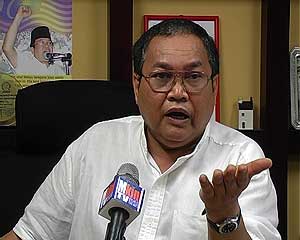 The Perkasa president (
left
) has gone on record to say that the MIC candidate for the Hulu Selangor by-election “bercakap pun fasih Bahasa Melayu, saya cukup kagum” (is fluent in speaking BM, I’m indeed impressed).
The Perkasa president (
left
) has gone on record to say that the MIC candidate for the Hulu Selangor by-election “bercakap pun fasih Bahasa Melayu, saya cukup kagum” (is fluent in speaking BM, I’m indeed impressed).
The Malay supremacist movement is, needless to say, pushing the agenda of ethnic interests which among other aspects cover the privileges, language and religion of their race.
Kamalanathan himself brought up his language competency in his interview with this news portal where he said: “I read on Twitter , and one posting said that, ‘I’m surprised Kamalanathan speaks better Malay than Zaid...’ and this was not said by an Indian or Chinese but a Malay.”
It’s true that he does not display hesitancy or awkwardness when speaking Malay. An adequate command of the language is after all a must for Malaysian politicians; it’s a job requirement similar to how certain Asian airlines specify that their stewardesses must be tall and slim.
The knee-jerk reaction by some opposition supporters is, however, to deride Kamalanathan’s claim. They scoff at the notion as something outlandish and brush it off as an 'insult' to Zaid – “just like another Malay telling [an Indian] that he speaks better Tamil than him”.
Not preposterous
We should not hold the idea to be as preposterous as his detractors make it out to be. My reasons below.
 Some of our politicians, whose mother tongue is not Malay, do indeed speak the language well. Deputy Education Minister Wee Ka Siong (
right
) comes easily to mind. Former MCA president Ong Ka Ting speaks better Malay than he does English.
Some of our politicians, whose mother tongue is not Malay, do indeed speak the language well. Deputy Education Minister Wee Ka Siong (
right
) comes easily to mind. Former MCA president Ong Ka Ting speaks better Malay than he does English.
Need a Malay necessarily have a sound command of BM? The answer is no. Here’s one example.
In a news portal discussion on the Perak constitutional crisis, Jacqueline Ann Surin had written: “Hampa dan duga kerana keputusan sultan.” A reader wrote in to correct her error: “Sepatutnya duka dan bukannya duga. (It should be ‘duka’/grieved and not ‘duga’).
In a note from the editor, Shanon Shah replied: “‘Duga’ juga bermaksud ‘bertanding’ atau ‘bersaing’. Ruangan Six Words On ... bukan hanya menguji kemahiran penulis, malah menguji kreativiti pembaca. [‘Duga’ also means ‘to contest’ or ‘compete’. The Six Words On column … not only tests the writer’s skill but also the reader’s creativity.] This is a clear-cut case of a Malay, Shanon, showing how inexpert he is in his word use.
Furthermore, Zaid is Kelantanese. The dialect spoken in Kelantan is not easily comprehensible to outsiders. Here’s a sample of some common words and phrases: Ambo (saya), mung (awak), demo (mereka), kecek (cakap), kelik (balik), tubik (keluar), (dennu) situ, dek pong gak eh (kalau ya pun). Doesn’t sound like Malay as the baku speakers know it, right?
Even their money is ‘different’ – seemingly like another country’s currency; in Kelantan, duit is ‘pitis’. But Chinese, Indians and other minorities native to the state are attuned to speaking the lingo. When non-Malays form only five percent of the population, they naturally have to adapt, especially when the Kelantanese can speak very fast and lay on the accent real thick.
Different context
The comparison that a Malay doesn’t normally speak good Tamil is a wholly different situational context. In the first place, it’s rare that non-Indians take up Tamil as an optional subject in school. On the other hand, BM is compulsory for everyone. By the time a student finishes Form 5, he would have 11 years of immersion in the language.
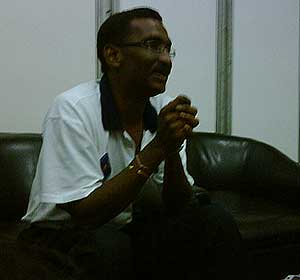 Hence Kamalanathan (
left
) speaking good BM really should not be the exception but rather the rule.
Hence Kamalanathan (
left
) speaking good BM really should not be the exception but rather the rule.
If we compare with our neighbours, their Chinese speak the national language as a matter of course. For instance, Alan Budi Kusuma and Susi Susanti, who won Indonesia its first ever Olympic gold medals at the Barcelona Games, are ethnic Chinese. Yet you wouldn’t question that the badminton golden couple speak Bahasa Indonesia less capably than their fellow players of ‘Malay’ stock such as Joko Suprianto.
Then there are the Thai Prime Ministers of Chinese descent – Abhisit Vejjajiva presently, and Chuan Leekpai and Thaksin Shinawatra previously. Dare anyone suggest that they don’t speak Thai well?
Malaysia1st hypocrisy
Should our representatives in the legislature therefore speak good BM? The answer is of course, yes.
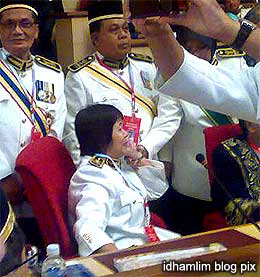 Take this commentary on Jelapang state assemblywoman Hee Yit Foong (l
eft, centre
) being awarded a datukship recently. Martin Jalleh writes in
Aliran
: “How has Hee performed in the state assembly? Has she contributed significantly to the debates (considering her halting Bahasa Malaysia) and to policy making? The answer is very obvious.”
Take this commentary on Jelapang state assemblywoman Hee Yit Foong (l
eft, centre
) being awarded a datukship recently. Martin Jalleh writes in
Aliran
: “How has Hee performed in the state assembly? Has she contributed significantly to the debates (considering her halting Bahasa Malaysia) and to policy making? The answer is very obvious.”
Implicit in Jalleh’s appraisal of Hee’s halting BM is that her lack of facility in the language does not put her in good stead.
Let’s examine the ‘Malaysian First’ virus infecting swathes of Pakatan supporters. They appear to be putting forward their own arbitrary criteria as to what makes them more Malaysian than Muhyiddin Yassin.
One idiosyncratic criterion I’ve come across is: “For me if I were watching a Chinese from China playing with our talented Hafiz, I will without a doubt cheer for our Malaysian player.”
Now imagine this scenario. Say a foreigner named Akello Ndereba wants to apply for Malaysian citizenship. Ndereba is queried as to what might make him a deserving Malaysian passport holder. He responds: “Even though the talented badminton player Mohd Hafiz is not of my religion or skin colour, I will nonetheless clap wildly when he plays because I support the Malaysian national team without reservation.”
Since when does being a sports fan of patriotic persuasion help one get through a citizenship test? In the Western European countries, it is the language proficiency exam you’d have to pass.
If we’re asked to select the most prominent feature that defines Malaysian-ness, it should be the ability to speak the language of the land. As such, anyone proclaiming that he is Malaysian First should laud Kamalanathan for his apparent ease with the national language.
Personally, I find Kamalanathan’s validation of Perkasa – he sees nothing wrong in supporting the movement – quite appalling. But nonetheless, I can anticipate how Perkasa might turn the negativity of Pakatan supporters with respect to Kamalanathan’s BM mastery to the advantage of Barisan Nasional.
It simply presents a tailor-made opportunity for Perkasa to point out the self-contradiction of the ‘Malaysian First, Chinese/Indian Second’ credo being popularised by DAP.
Perkasa would only have to highlight the anomaly of championing Malaysian First and yet at the same time so strangely unappreciative of Kamalanathan’s embrace of the national language.
So please give credit where credit is due – the man ought to be praised on this score alone even if there’s nothing else to commend him.


Are you sure you want to delete this comment?
This action cannot be undone.