




Malaysia's paltry intellect
An international conference, entitled World War II and the Rise of Multilateralism, was held in KL yesterday. It passed without much fanfare, and its website is apparently not updated frequently enough to arouse more excitement.
An international conference, entitled World War II and the Rise of Multilateralism, was held in KL yesterday. It passed without much fanfare, and its website is apparently not updated frequently enough to arouse more excitement.
And that is pathetic. The organiser, one World Future , a Malaysia-based online political Islam portal, should have a bit of explaining to do why such an important event failed to attract the level of attention that it rightly deserved.
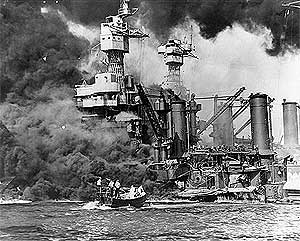 WWII is not a trivial issue. Last week across Europe, celebrations were held and parades conducted to commemorate the end of the catastrophic war. But designating 8 May as the end of WWII is misleading. The specific date is in fact the Victory in
Europe Day
(V-E Day), yet we all know the atrocities committed by the Japanese army in much of Asia did not end until 15 August 1945.
WWII is not a trivial issue. Last week across Europe, celebrations were held and parades conducted to commemorate the end of the catastrophic war. But designating 8 May as the end of WWII is misleading. The specific date is in fact the Victory in
Europe Day
(V-E Day), yet we all know the atrocities committed by the Japanese army in much of Asia did not end until 15 August 1945.
Hence, I cannot quite comprehend why World Future should have held the conference - the enormous significance of which I do not dispute - this month, instead of August this year. Is it not yet another case of self-imposed colonialism that one has to hang on the coattails of a triumphant Europe even when it comes to war commemoration?
A major topic of the said conference is, no doubt, Japanese war crimes. While it is generally argued WWII began after the United States entered the fray in the wake of the Pearl Harbour (above) attacks in early December 1941, military conflicts had started in Europe when Adolf Hitler launched the Blitzkrieg on Poland. In Asia, the invasion of China in late 1937 by the Japanese military regime was the defining moment.
Lives were lost
In the following years, millions of innocent lives were lost. In Asia alone, countless of Chinese, Indonesians, Malayans, Borneans, Koreans, Taiwanese, Filipinos, Indochinese and western civilians were brutally murdered by insane Japanese soldiers. For concrete details, please see here .
Meanwhile, various sadistic torture techniques were employed to strike fear into the local populaces, including pumping water incessantly into a victim's body till it burst and the shocking beheading competition by Japanese soldiers in Nanjing.
As for western prisoners of war, a common method saw victims placed on bamboo shoots, awaiting them to die eventually from the sharpened bamboo tips that pierced their body bit by bit.
This aside, numerous adolescent girls were forced into sex slavery, having to endure humiliation and exploitation as "comfort women" (below) , and satisfy the insatiable Japanese soldiers. Needless to say, the trauma experienced in sexual assault often do not go away easily, with many Asian women suffering from Post Traumatic Stress Disorder in silence due to fear, guilt, shame and overwhelming sense of helplessness.
 Ian Buruma's Wages of Guilt, is by far the most excellent work on comparing the attitudes toward WWII between modern Germany and Japan. In his foreword to the latest edition,
Buruma
contends his arguments in the 1990s remain largely valid today because Japan seems as intransigent as ever in facing up to its responsibility, unlike the Germans.
Ian Buruma's Wages of Guilt, is by far the most excellent work on comparing the attitudes toward WWII between modern Germany and Japan. In his foreword to the latest edition,
Buruma
contends his arguments in the 1990s remain largely valid today because Japan seems as intransigent as ever in facing up to its responsibility, unlike the Germans.
(He also notices the book is more popular in Japan than in German, as Japanese are generally pleased to be compared with Germans, while the same cannot be said of the latter vis à vis Japanese!)
Still, all this appears to have escaped the attention of the conferees yesterday.
I read in an advertorial some days ago about the heroism of one Adnan Saidi, a lieutenant of the Malay Regiment's 1st Battalion who sacrificed his life in Singapore fighting against the Japanese in 1942.
Heroic deeds
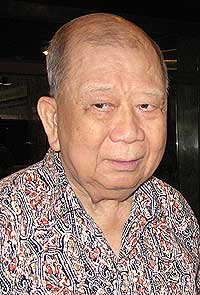 Information such as this is extremely helpful in reminding us of the contribution of the generations past. But it would seem that the conference was least interested in cherishing the equally, if not more, heroic deeds of the ‘non-mainstream' freedom fighters, such as Chin Peng
(left)
, the late Rashid Maidin and Abdullah CD, perhaps because these people later turned against Umno and the MCA, close allies of the colonialists.
Information such as this is extremely helpful in reminding us of the contribution of the generations past. But it would seem that the conference was least interested in cherishing the equally, if not more, heroic deeds of the ‘non-mainstream' freedom fighters, such as Chin Peng
(left)
, the late Rashid Maidin and Abdullah CD, perhaps because these people later turned against Umno and the MCA, close allies of the colonialists.
Mahathir Mohamad relishes in talking about the evils of war. But he, as always, has no concerns for those innocent lives lost in the hands of the Japanese army. In the message delivered at the conference (albeit read by a representation not himself), he chastised the neo-colonialists of today in a classic manner, but failed to delve deeper into the subject for greater understanding.
What can we expect? Mahathir is no polemic, but a populist. He detests dissent, especially on the issues of race and history, which is why he did much to distort the nation's past and enslave the mind of the public (and the Malays in particular) so that they would not be in a position to talk back to him!
Malaysia needs more debate on history, and not least WWII. But we may have all the impressive modern infrastructure to hold conferences of international significance, our intellectual capacity is only paltry at best. Thanks, again, to the paranoid powers-that-be who rule in constant fear of being rebutted with opposite argument.
JOSH HONG studied politics at London Metropolitan University and the School of Oriental and African Studies, University of London. A keen watcher of domestic and international politics, he longs for a day when Malaysians will learn and master the art of self-mockery, and enjoy life to the full in spite of politicians.


Are you sure you want to delete this comment?
This action cannot be undone.