




Parliament and security sector governance
Back in 2003, Asean countries adopted a framework for the creation of a community based on free trade, common democratic ideals (tough task, to say the least), and shared social goals by 2015.
Back in 2003, Asean countries adopted a framework for the creation of a community based on free trade, common democratic ideals (tough task, to say the least), and shared social goals by 2015.
In particular, a political security community was envisaged to serve as regional institution to address serious challenges ranging from preventing and fighting terrorism, transnational crimes, non-proliferation of weapons etc.
In short, it is an ambitious effort to bring Asean's political and security cooperation to a higher plane.
 Several regional powers, the United States in particular, will be watching the development very closely. When Kevin Rudd (
left
) first assumed the office as prime minister, he put forward an Australian vision for the region called the Asia-Pacific Community, which did not go down well with other key players such as China.
Several regional powers, the United States in particular, will be watching the development very closely. When Kevin Rudd (
left
) first assumed the office as prime minister, he put forward an Australian vision for the region called the Asia-Pacific Community, which did not go down well with other key players such as China.
Even Indonesia was sceptical as to whether it, if materialised, would be nothing more than another "western project" that could sideline Jakarta's influence.
16th Summit
At the 16th Summit in Hanoi in April two months ago, Asean leaders re-affirmed their commitment to realising the envisioned community by launching roadmaps to it. Of greater interest is the leaders' unequivocal support for the Asean Political-Security Community (ASPC), the blueprint of which states that Asean's existing tools and mechanisms such as the Treaty of Amity and Cooperation (TAC), the Southeast Asia Nuclear Weapon-Freezone (SEANWFZ), the Declaration of Parties in the South China Sea (DOC), the Asean Regional Forum (ARF), and the Asean Convention on Terrorism must be fully utilised .
In other words, Asean leaders have made it clear regional institutions must prevail over any other ideas mooted by external partners, be it the US, China or Australia.
A main thrust of the ASPC concerns security sector governance.
Looking back, the emergence of Asean in 1967, the signing of the Five Powers Defence Arrangements in 1971, and the reliance of certain member countries such as Thailand and the Philippines on bilateral alliance with the US indicated that the regional states valued economic cooperation over confrontation, sovereignty over regionalisation (along the lines of the European Union for instance), and informal mechanisms over legalistic institutions.
The vital roles played by extra-regional partners were, however, duly recognised and well appreciated.
As far as Malaysia is concerned, security sector governance (SSG) has never figured large in public discourse. Given the nature of Malaysian politics which is semi-authoritarian, highly centralised and lacking in transparency, SSG has always been rigid in that the state is least willing to allow external players to take part in the process.
This, no doubt, is owing to the history of fighting communist insurgency and suppressing leftist and unionist movements in the 1950s through 1970s, but also because monopolising the discourse on SSG helps sustain the Alliance/BN regime.
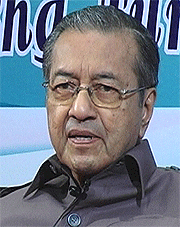 This tendency was most conspicuous during the Mahathir (
right
) era, which valued peace, economic development, ethnic/religious harmony, ‘stable communal tension' over pluralistic democracy, political freedoms and ‘riots'.
This tendency was most conspicuous during the Mahathir (
right
) era, which valued peace, economic development, ethnic/religious harmony, ‘stable communal tension' over pluralistic democracy, political freedoms and ‘riots'.
But the excesses of the Mahathir government were also responsible for the erosion of the police force, the confrontational relationship between security forces and the populace (especially the non-Malays due to the ethnicisation of the security sector over the years), and the blatant violations of human rights committed in the name of draconian laws such as the Internal Security Act.
Severely weakened Parliament
A vastly empowered executive headed by the Prime Minister's Office, started by Mahathir and continued by his two successors, has severely weakened Parliament as an instrument of checks and balances.
Many parliamentarians, especially those from the ruling coalition, are ill equipped to understand, let alone participate in meaningful debate on complex issues such as SSG and the ASPC, because they all that they have to do is vote yes to please the government!
Sadly, many of the parliamentarians in the opposition rank too appear to relish in grandstanding and at times excessive confrontation, instead of engaging in serious issues.
The absence of parliamentary select committees is one important reason why these so-called Yang Berhormats have nothing better to do than shouting at each other or making fun of the weaker sex.
Power struggles between the government and the opposition, as well as within either coalition, has undermined the integrity of Malaysian politics, and both sides need to devote more time and resources to cultivating genuine parliamentary culture of debate and deliberation especially on security sector governance.
Unaddressed challenge
Although more and more cases involving police brutality, from deaths custody to wanton shootings, have produced a citizenry that is braver to take the authorities to task with the help of parliamentarians, how to strengthen Malaysian SSC in anticipation of the formation of the ASPC remains a challenge unaddressed.
The opposition must be more proactive on the issue of SSG by putting in place alternative policies as well as plans to turn itself into a more serious and responsible government-in-waiting, instead of ad-hoc reactions to government failures.
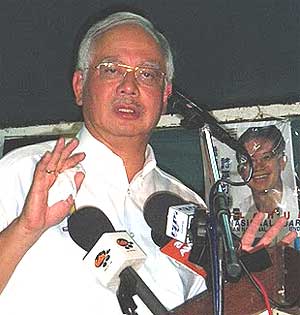 If the government is serious about playing an important role within Asean and in realising the vision of the ASPC, it must engender active dialogue and information sharing with Parliament, and make plans, data and statistics widely and readily available to the public and NGOs.
Prime Minister Najib Abdul Razak once said the days when the government knew best were over. To match words with deeds, he must prove to us that he as the chief executive has ditched the decide-then-inform mentality.
Decentralisation of executive powers must take place before the government can be transformed. It will also be more in line with the democratic ideals expressed by the Asean leaders in Hanoi.


