




All that the doctor needs is love
Having observed Mahathir Mohamad's firebrand politics for nearly three decades, I came to the conclusion some years ago that the "Malay ultra" never appreciates any individual or community, not even the Malays, but himself.
Having observed Mahathir Mohamad's firebrand politics for nearly three decades, I came to the conclusion some years ago that the "Malay ultra" never appreciates any individual or community, not even the Malays, but himself.
Though a man of Indian-Malay heritage, Mahathir has consistently refused to be labelled as such, but sees himself "constitutionally Malay".
What if one day the Indians managed to "subvert" the state and turn it into a Hindu-dominated kingdom, just as the Majapahit Empire five hundred years ago? Would he suddenly feel proud of his part-Indian origin?
I
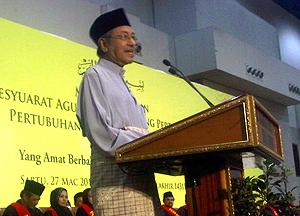 t is a matter of conjecture of course, but since Mahathir (
left
) clearly relishes in all the privileges that come with being "a constitutional Malay", chances are, he would opt to be in the mainstream in a changed circumstance.
t is a matter of conjecture of course, but since Mahathir (
left
) clearly relishes in all the privileges that come with being "a constitutional Malay", chances are, he would opt to be in the mainstream in a changed circumstance.
In making this conscious and instrumentalist choice, the former prime minister admits Malays as an ethnic group are indeed a socio-political construct, with a view to evoking "primordial ties" - real or imagined - just to create a sense of belonging among them.
Yes, the keywords here are "a sense of belonging", something that has been missing from Mahathir's life.
Teasing's deep wound
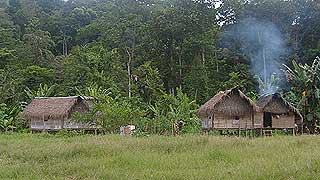 At the height of the
reformasi
movement, I often sat down with Malay student activists and oppositionists who rose against the iron man, and was introduced to the gossipy nature of Malay politics. A joke that made it rounds among us was that Mahathir could never bring himself to say his paternal grandfather had come from India because his Malay peers back in the village used to tease him with the Tamil word ‘
thambi
' (younger brother).
At the height of the
reformasi
movement, I often sat down with Malay student activists and oppositionists who rose against the iron man, and was introduced to the gossipy nature of Malay politics. A joke that made it rounds among us was that Mahathir could never bring himself to say his paternal grandfather had come from India because his Malay peers back in the village used to tease him with the Tamil word ‘
thambi
' (younger brother).
It was, allegedly, childish mockery like this that made him more determined to succeed academically and professionally so that he could stand tall. To compensate for his inferiority complex as a child, Mahathir would in the latter part of his political career publicly chastise the Malays as ‘ haprak ' (useless), especially when they deserted Umno under his leadership.
As we all know, Mahathir was the first non-aristocrat to ascend to the prime ministership, which explains to some extent why he was audacious enough to challenge the Malay monarchs not once, but twice. And the way in which he did it was defying all the Malay customs and norms.
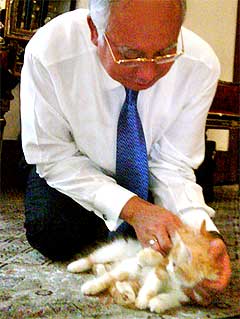 (On the contrary, Najib Abdul Razak, (
left
) the current prime minister of much diluted royal lineage, constantly resorts to the art of compromise, something Mahathir is quietly disdainful of.)
(On the contrary, Najib Abdul Razak, (
left
) the current prime minister of much diluted royal lineage, constantly resorts to the art of compromise, something Mahathir is quietly disdainful of.)
Mahathir was also the first prime minister who had not pursued tertiary education overseas. While the Tunku, Abdul Razak Hussein and Hussein Onn all received legal training in England, Mahathir had to make do with some form of state assistance to study medicine in Singapore.
According to Barry Wain, author of Malaysian Maverick , Mahathir's application for a scholarship to study law in England simply went unnoticed due to the unsettled post-WWII condition.
A man of intelligence and of pride, Mahathir does not take slight easily. The oversight by the colonial administration left a deep imprint on his psyche, and, together with the earlier defeat of the British by the Japanese, fostered his anti-colonial thinking. Philip Bowring, a prolific columnist, once described Mahathir's politics as ‘sub-continental' rather than Malaysian, for his rhetoric and style were more in line with the anti-colonial tradition of Indian politicians.
How first seed was sown
The missed opportunity later turned out to be a blessing in disguise, when Mahathir exploited it adroitly to position himself as the first home-grown Malay leader. Still, his experience as a medical student in Singapore had a profound - if negative - impact on his future understanding of ethnic politics.
From a rural, predominantly Malay area of Kedah, he suddenly found himself in a largely Chinese environment and a prestige educational institution, where the cream of the crop competed vehemently against each other.
Mahathir worked hard and performed well, but still felt out of place. His sense of alienation was aggravated when a taxi driver (presumably Chinese) dropped him to the servants' quarters of his friend's house. Having seen his own dignity flouted, Mahathir would later in his life employ a Chinese driver just to make a point.
Singapore was where Mahathir received his medical training and met his wife Siti Hasmah, and one would assume plenty of fond memories to go with it. How ironic, that the man's impression of the island state remains nothing more than an epitome of Malay marginalization. His regular jibes against the ‘Modern Middle Kingdom' are therefore a way to make himself feel better.
In fact, Singapore means a lot more than just an annoying ‘little red dot' to Mahathir. As prime minister, he was not able to openly and freely criticise Chinese Malaysians for fear of losing their votes, as happened in the 1986 and 1990 general elections. Since he needed to rally the Malays behind him with populist sentiments to stay in the game, Singapore became a convenient bogeyman.
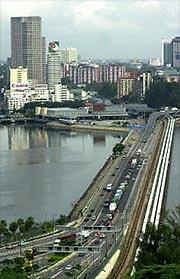 Judging from his most recent comments, it is clear that the doctor's resentment of Singapore remains intact. Worse, his choice of words is becoming outwardly racist and provocative now that he is no longer the prime minister who had to ‘kowtow' to non-Malay voters.
All this should not obscure us from the home truth that Mahathir, a man whose process of growth has been strewn with emotional wounds and rejections, needs genuine love. Yes, he is perpetually suspicious of others, but it is, most probably, because he has been hurt enough in his life. What he now needs is unconditional affirmation, and nothing less.
So for those who admire or even worship Mahathir, ask yourself this question: minus all the mega-projects, glittering Twin Towers and other state-of-the-art skyscrapers and, most importantly, lucrative contracts and plum jobs that he created for you during his 22 years' rein, would you still hail him like no others?
Mahathir, is a seasoned politician and a calculative strategist, and he knows full well that his followers could easily turn their backs on him once all the goodies are gone. In other words, they love him not for who he is, but for what he could (and can) offer. And herein lies the biggest pain and sorrow that this seemingly strong man has been wrestling with throughout his life: love and acceptance, warts and all. But it is nowhere to be found.
As this mundane life of his comes to an end, the man can only become more bitter and vengeful.
So people, next time when you see a poor chap next door, don't make fun of him. Every slight that you show unto him may cause him could have serious consequences. Instead of jokes and taunts (innocent or malicious), receive him with a moderate measure of encouragement and acknowledgement that could make him a more wholesome person, or he may end up searching for affirmation in the most drastic manner.
It is fine if you and the man never meet again in life, but what if he went on to become your prime minister and unleashed all the racist venom just to get his own back?
JOSH HONG studied politics at London Metropolitan University and the School of Oriental and African Studies, University of London. A keen watcher of domestic and international politics, he longs for a day when Malaysians will learn and master the art of self-mockery, and enjoy life to the full in spite of politicians.


