




Intra-ethnic disparities and social poverty
Two years ago, Anwar Ibrahim, the de facto leader of Parti Keadilan Rakyat (PKR), came up with the concept of people-centric economic development for Malaysia (merakyatkan ekonomi Malaysia) while fighting the Permatang Pauh by-election. It was a catch-all slogan that went down well with the populace of all races.
Two years ago, Anwar Ibrahim, the de facto leader of Parti Keadilan Rakyat (PKR), came up with the concept of people-centric economic development for Malaysia (merakyatkan ekonomi Malaysia) while fighting the Permatang Pauh by-election. It was a catch-all slogan that went down well with the populace of all races.
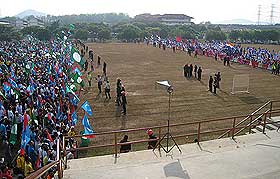 Walking to the counting centre on polling day, I was amazed by cars triple-parked along the main road, many of which also had the Ketuanan Rakyat (people first) sticker on their windscreens. The PKR supremo had time and again pronounced it was time for Malaysia to champion a new political paradigm, instead of the much-abused and hegemonic Ketuanan Melayu (Malay supremacy). That, too, received overwhelming support from the Malay electorate. Or in Penang at least.
Two years on, one hardly hears of either of these in a vastly changed political landscape. PKR is still reeling from the effects of infighting, defections and betrayals. Meanwhile, Umno has upped the ante by appealing to populist sentiments in the hope of regaining Malay ground.
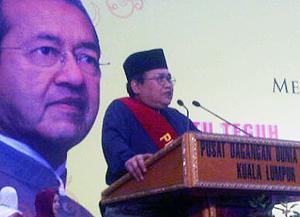 Both Ibrahim Ali and Mahathir Mohamad have lashed out at the non-Malay communities for being demanding, with the latter going as far as to suggest the Malays were at the risk of losing their dominant position if they continued to support the opposition. The former prime minister has a point, for he now lives in constant fear of regime change in Malaysia in his lifetime, after which all his past secrets and abuses would be laid bare under the Malaysian sun.
He knows fear-mongering may provoke a siege mentality among the Malays, and prompt them to rally behind Umno. Mahathir cares not that such a tactic is only detrimental to ethnic relations. After all, he only has his own vested interests in mind.
Under more than five decades of Umno rule, Ketuanan Melayu and the New Economic Policy have been "sanctified" beyond reproach, resulting in a bizarre phenomenon in Malaysia in that poverty becomes "exclusively" a Malay problem. It is even quite impossible for other component parties in Barisan Nasional to overtly speak about predicaments faced by the non-Malays, let alone study social poverty in depth. To do so could be met with strong backlash from Umno.
BN power sharing delusion
The MIC failed pathetically to address the Indian dilemma, while Gerakan swept the stagnant economic growth and widening income gap in Penang under the carpet. The SUPP may have escaped the wrath brought by the political tsunami in 2008, its downfall is nevertheless only a matter of time.
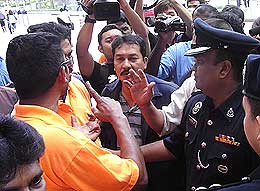 It is this unique political framework - euphemistically called "power-sharing" - carefully designed by Umno that managed to emasculate the BN partners, rendering them impotent in taking care of their "adopted communities". When tens of thousands of Indians took to the streets in Kuala Lumpur in November 2007, many Malays were shocked and caught by surprise, seeing it as a challenge to Malay leadership.
Who can blame them? Thanks to the years of brainwashing by Umno, the majority of the Malays simply do not know abject poverty still exists in the Indian and the indigenous communities. Even Dr Mohd. Asri Zainul Abidin, profusely championed by many as a "liberal mufti" and fervently courted by both Umno and PAS, once openly chastised the caste system in Hinduism and hence argued that the fate of the Indians in Malaysia was "not quite as bad" as portrayed by Hindraf.
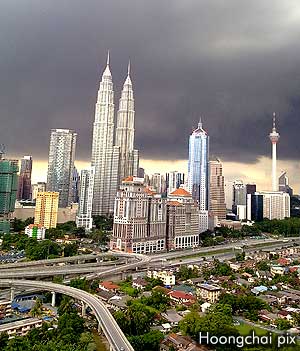 According to Khoo Boo Teik, a Penang-based political scholar, a symbiotic relationship developed between Umno, the predominantly Malay bureaucracy and the Malay capitalist class following the promulgation of the NEP. In the subsequent years, every power struggle within Umno would invariably spill over to the public and the business sectors, while the fortunes of many a stakeholder waxed and waned. There is no greater irony than the fact that the NEP, for all its noble intents, eventually became the impetus for the unstable symbiosis that caused the national wealth to be heavily concentrated in the hands of the select few, i.e. the political and business elites of all races.
Seen in this light, every ‘restructuring' has proven to be nothing more than a realignment exercise involving the real stakeholders. The so-called New Economic Model proposed by Najib Abdul Razak is no different. Or many who had sung praises of him when he took over as prime minister would not have been so bitterly dismayed by the lack of innovative measures in the Tenth Malaysia Plan unveiled last month.
But Mahathir remains the chief culprit because on his watch, intra-ethnic income disparities worsened as never before. Like Abdul Razak before him, Mahathir believes wealth equality among races is key to social stability and prosperity. However, he has been least willing to face up to the widening income gap between the rich and the poor, especially among the Malays.
In Proton's service
His national car project, for one, enriched a small group of Umno cronies beyond their dreams, but most Malaysians are made to bear the unjustified high costs. Today, supporting the national car is still our "national service".
In fact, ever since the Second Outline Perspective Plan 1991 - 2000 in 1991, the successive governments have stopped highlighting intra-ethnic income disparities. The reason cannot be more plain, for to do so is akin to shooting one's own foot.
Mahathir was (and still is) dying to see bumiputera billionaires and entrepreneurs walk tall among others (again it only reflects his inferiority complex), but he would not tell the Malays their wealth dwindled throughout his administration. It would only put his credentials as a Malay champion under severe scrutiny the moment he touched on income disparities among the Malays.
Of course, all ethnic groups are beset with the same challenge. Yet in the illogical understanding of those like Mahathir and Ibrahim Ali, both Vincent Tan and Ananda Krishnan symbolise the "economic clout" of the Chinese and the Indian communities respectively. And they conveniently overlook the bulks who struggle to eke out a living on a daily basis.
However, they would tell you the "success" of one Mukhriz Mahathir is not representative of the Malays, who continue to need all the help that Umno and the government can extend. While we know how Tan and Ananda became Umno's darling tycoons, Mahathir would certainly not explain to us in full how his son has made it to the rich-list in Malaysia.
Therefore, putting the discourse on social development in an inter-ethnic rather than intra-ethnic context blinds the Malay community to general social poverty; it also helps Umno to divert public attention from real policy issues.
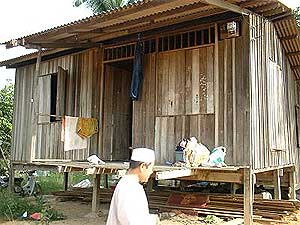 Furthermore, the income disparities among the Malays and the drastically altered social structure have given rise to differing interests and intents, as more and more Malays begin to express their political allegiance beyond Umno. This trend is irreversible and in sync with the global development. Still, the likes of Mahathir, Ibrahim Ali and even Deputy Prime Minister Muhyiddin Yassin simply reduce it to Malay disunity with dire consequences, and I can no longer put up with their populist approach.
Worse, two PKR youth leaders, Khairul Anuar and Shamsul Iskandar, recently called for a specific platform to deal with Malay poverty. It would seem that even the party that is founded on the premise of reform and projects itself as synonymous with new politics has failed to rise above Umno's racist antics.
Have they completely forgotten the promises of people-centric development and leadership by the people? Why would some of them choose to dance with the wolves at this critical juncture, and make the party look like an Umno copycat (Zaid Ibrahim calls it a poor man's Umno).
More importantly, it is really such an uphill challenge for politicians on both sides of the political divide to look at poverty as a national issue?
JOSH HONG studied politics at London Metropolitan University and the School of Oriental and African Studies, University of London. A keen watcher of domestic and international politics, he longs for a day when Malaysians will learn and master the art of self-mockery, and enjoy life to the full in spite of politicians.


Are you sure you want to delete this comment?
This action cannot be undone.