




Three cheers for Chile
Or maybe that should be 33 cheers. Because since the near death and safe return of the crew of the crippled Apollo 13 mission back in 1970, I've never felt such intense suspense and eventual euphoric relief than during last week's rescue of the 33 miners from 69 days of entombment 622 metres deep in Chile's San Jose copper mine.
Or maybe that should be 33 cheers. Because since the near death and safe return of the crew of the crippled Apollo 13 mission back in 1970, I've never felt such intense suspense and eventual euphoric relief than during last week's rescue of the 33 miners from 69 days of entombment 622 metres deep in Chile's San Jose copper mine.
This triumph even echoed the Apollo 13 achievement in its employment of the rocket-shaped capsule, Phoenix 2, purpose-designed by engineers of the Chilean Navy for the extraction of the miners from their entombment.
But the San Jose mine rescue was even more remarkable in many ways than that of the Apollo crew by Nasa forty years ago.
The miners were in mortal danger far longer, and thus their surviving being buried alive was, if possible, even greater testament to the strength of the human spirit than that of the three astronauts who faced slow deaths in space.
Months of waiting
Similarly, the families and friends of the Chilean miners endured not just days but months of agonised waiting before their menfolk finally emerged to safety.
And as first Florencio Avalos, then Mario Sepulveda and their other workmates in turn reached the surface to be greeted by their immediate loved-ones and Chilean President Sebastian Pinera, I started to see this rescue as not just the human-interest story that had attracted a 1000-strong media circus from all over the world, but part of a much bigger picture.
I started to wonder, for example, how sincere the president was in his humanitarian concern for the miners, compared with his craving for political popularity. It was a golden opportunity, let's face it, for the billionaire head of a country as poor as Chile to present himself as a man of the people.
And indeed the president, accompanied by his wife, did appear to be relishing his chance to share if not hog the limelight. But he also made some comments that gave me some hope of his sincerity and thus somewhat curtailed my cynicism.
He said, for example, that this rescue would change Chile; that the mine collapse had inspired him to enact legislation to prevent further accidents, and to greatly expand the number of government inspectors charged with enforcing safety standards.
Though he stopped short, I noted, of declaring that he would crack down on the kind of official corruption that doubtlessly permits death-traps like the San Jose mine to operate despite regulations already in force.
He has since, however, continued to expound and expand on his intentions to ensure the safety and recognise the dignity and worth of mining and other manual labour in Chile, and also to do everything in his power to lift the people of his nation out of poverty.
Disposal of despots
But however well-intentioned or otherwise President Pinera may be, his very presence at the mine and his stated aims to protect and better support his country's workers reminded me how far Chile has progressed in the past 20 years.
Just as the 33 miners were rescued from 69 days under the earth last week, Chile itself emerged back into the light in the 1990s after almost two dark decades of shafting by the Pinochet regime.
General Augusto Pinochet was declared president in 1974 following a military coup, allegedly aided by then US President Nixon and Secretary of State Kissinger, against the democratically-elected socialist government of Salvador Allende.
Under Pinochet's military dictatorship, thousands of critics and opponents were jailed, tortured or murdered.
The crimes over which he presided went largely unpunished until he was finally stripped of immunity in 2004, and charged with over 300 offences including not only murder and violation of human rights, but also tax evasion and embezzlement to the tune of an estimated US$28 million.
Unfortunately, however, he was ruled medically and mentally unfit to stand trial, and was held under house arrest until his death in 2006.
But if Pinochet himself largely escaped justice, a good many of his
 henchmen were tried and condemned to heavy jail terms. So, just as present-day Chile's dedication to the rescue of the 33 trapped miners is a rebuke to those regimes that fail to care for their people, like the generals in Burma following
Cyclone Nargis
in 2008, or respond as poorly as the Bush (
above
) administration did to the devastation of New Orleans by
Hurricane Katrina
in 2005, it's also an inspiration to those of us who long to see despots deposed.
henchmen were tried and condemned to heavy jail terms. So, just as present-day Chile's dedication to the rescue of the 33 trapped miners is a rebuke to those regimes that fail to care for their people, like the generals in Burma following
Cyclone Nargis
in 2008, or respond as poorly as the Bush (
above
) administration did to the devastation of New Orleans by
Hurricane Katrina
in 2005, it's also an inspiration to those of us who long to see despots deposed.
Decades to repair damage
Not that ridding nations of their dictators is as immediately rewarding as disinterring trapped miners or saving survivors of other accidents or natural disasters. Dictatorships are deliberate, deeply-entrenched and desperately defended by those who are complicit in their crimes and dependent on them for their illegitimate power, spurious status and ill-gotten gains.
So that even when its ring-leaders are removed, it can take years or even generations to get rid of the residue they leave behind and repair the damage they've done.
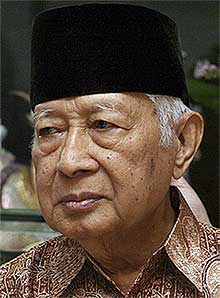 Witness the Philippines, still crippled by Marcos-style corruption and violence so many years after his departure and death; Indonesia still plagued by the poisonous legacy of the late President Suharto (
right
); and Cambodia still infested with so many former followers of Pol Pot that it's taken 30 years to bring a few token Khmer Rouge to trial.
Witness the Philippines, still crippled by Marcos-style corruption and violence so many years after his departure and death; Indonesia still plagued by the poisonous legacy of the late President Suharto (
right
); and Cambodia still infested with so many former followers of Pol Pot that it's taken 30 years to bring a few token Khmer Rouge to trial.
And let's not forget Malaysia, where the ostensibly retired Mahathir is still living high on the proceeds of his premiership, denying his misdeeds, stirring-up racial strife, slandering his critics and opponents, mouthing his customary pack of pernicious lies and generally fighting tooth and nail to keep his name before the public and his BN regime in power.
So that even when he's finally gone, Malaysia could take as long to shake-off his baleful influence as Chile, even with the morale boost of the San Jose mine rescue, is taking to recover from Pinochet.
But however long in coming the post-Mahathir/BN era proves to be, at least it's a cheery prospect for the younger of us to look forward to.
DEAN JOHNS, after many years in Asia, currently lives with his Malaysian-born wife and daughter in Sydney, where he mentors creative writing groups. Already published in Kuala Lumpur is a third book of his columns for Malaysiakini , following earlier collections ‘Mad about Malaysia’ and ‘Even Madder about Malaysia’.


