




The treacherous South seas
Was it out of rare valour or sheer naivety, that US secretary of state Hillary Clinton actually suggested a trilateral platform for China and Japan to address territorial disputes between the two countries, with the United States being a mediator?
Was it out of rare valour or sheer naivety, that US secretary of state Hillary Clinton ( below ) actually suggested a trilateral platform for China and Japan to address territorial disputes between the two countries, with the United States being a mediator?
 It was almost as good as proposing a venue for Washington to talk to Havana, that would certainly be met with flat rejection by both sides.
Ma Chaoxu, a spokesperson at China’s Ministry of Foreign Affairs, lost no time in reiterating Beijing's position on the contentious Diaoyu/Senkaku issue, which China believes involves Chinese sovereignty and is none of the concern of a third party. Clinton was also urged to conduct herself in a manner that would pose no harm to regional security.
Disputes that beset Sino-Japanese relations are many, but the recent standoff between Beijing and Tokyo over the contested islets again pushed the tricky issue to the forefront. The Japanese government's initial plan to send troops to the areas to safeguards its interests may have seemed legitimate given its effective control at present, but it would be least likely to improve the increasingly tense situation.
The irony, however, lies in the fact that while the Chinese leadership could have won some sympathy at the international level since a Chinese fishing captain was being unduly detained (who has since been released by the Japanese), Beijing's reckless reactions – ranging from jingoistic remarks to bringing the even more controversial Spratly Islands into the picture – have raised alarms across Asia.
Lee Kuan Yew, for one, opined that someone must be able to lance the boil before the spat got out of hand. He meant no other power but the US.
Lee is quite right. After all, a powerful reason why Clinton has been rather audacious to make the suggestion is the US-Japan Security Treaty that has been amended and updated twice since the 1960s, that allows Washington to intervene should things turn sour in Japan's surroundings. The treaty is no doubt perceived to be a thorn in China's side.
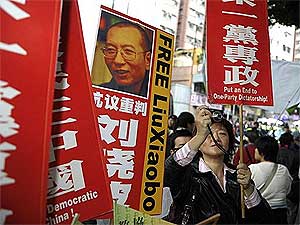 Immediately after Liu Xiaobo was awarded with the Nobel Peace Prize, thousands of Chinese were mobilised to take to the streets against Japan. The timing could not have been more appropriate as Beijing's human rights records were again put under the spotlight.
Showing the world a wrathful populace would again remind its critics that a large segment of Chinese society may not agree with the way the peace prize is handed out, and it surely does not tolerate a Japan that constantly stirs up the emotions of the Chinese people.
A US comeback
Early this year, Clinton made it clear to the Chinese that Washington's legitimate interests in the South China Sea region must be protected at all costs.
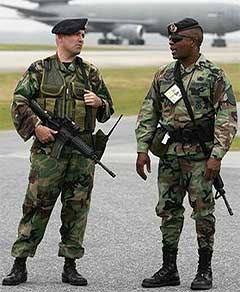 Later, the US government called for some form of an international mechanism to resolve the Spratly Islands dispute. China was outraged as it would be tantamount to internationalising the issue and adding more advantage to other parties involved, including Vietnam, the Philippines and Malaysia.
All these phenomena are a result of two developments: a China bent on assuming its rightful role in East and South-East Asia, and a US seeking to return to a region that it has practically ignored for a good part of the last decade.
As far as Malaysia is concerned, very little is made known by Wisma Putra in regard to how the government would deal with a more assertive China when it comes to Spratly Islands. We share a common dilemma with our neighbours, that China's economic prowess is now crucial to Malaysia, but the region is also becoming highly unstable because of the imminent competition over natural resources and energies, while several key Asean countries are embroiled in territorial claims amongst one another and with China.
Too weak a presence by the US could render Asean vulnerable to China's hard power, but a stronger US will complicate the already tumultous regional ties, especially when Washington is bound by the US-Japan Security Treaty to come to Tokyo's aid under unforeseen circumstances.
This is one aspect that Asean must not lose sight of. While individual member states may find it a daunting task to advise the three major economies on the pressing need to avoid unnecessary confrontation, together they can send the message loud and clear. Navigating between various powers has been a norm in South-East Asia for centuries, but the stakes of failure are now much higher simply because our interests have never been more intertwined.
JOSH HONG studied politics at London Metropolitan University and the School of Oriental and African Studies, University of London. A keen watcher of domestic and international politics, he longs for a day when Malaysians will learn and master the art of self-mockery, and enjoy life to the full in spite of politicians.


Are you sure you want to delete this comment?
This action cannot be undone.