




What does jasmine smell like?
In early 2004, the George W Bush administration unveiled a plan for the Middle East that would include across-the-board reforms in Israel, Turkey, Iran, Afghanistan, Pakistan, Egypt, Libya, Tunisia, Algeria, Saudi Arabia as well as other smaller Arab states.
It is often taken for granted that higher standards of living and education would reduce the risk of radicalism. Named The Middle East Initiative , it was part of Washington’s grand strategy to fight global terrorism root and branch by creating a Middle East that would be economically vibrant and politically stable.
In early 2004, the George W Bush administration unveiled a plan for the Middle East that would include across-the-board reforms in Israel, Turkey, Iran, Afghanistan, Pakistan, Egypt, Libya, Tunisia, Algeria, Saudi Arabia as well as other smaller Arab states.
It is often taken for granted that higher standards of living and education would reduce the risk of radicalism. Named The Middle East Initiative , it was part of Washington’s grand strategy to fight global terrorism root and branch by creating a Middle East that would be economically vibrant and politically stable.
To that end, the White House was ready to splash cash on economic and educational reform, and also on sponsoring independent media, all with a view to fostering a new generation that would be more exposed to democratic ideals.
Response to the initiative was lukewarm at best and hostile at worst. Hosni Mubarak was adamant that no-one should seek to impose an ‘alien’ system in the Middle East, while other were dismayed that little was mentioned in the initiative to improve the deteriorating situations in Iraq and Afghanistan at the time.
The whole idea became stillborn. But it now seems that Barack Obama is reaping what his predecessor had sown.
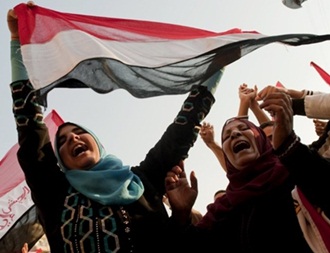 In the Arab world, two dictators were gone within a short span of two months. Zine El Abidine Ben Ali is now in hiding in Saudi Arabia with an Interpol arrest warrant on his head, while Mubarak is utterly disgraced, most probably still reeling from the swift disposal. Although Colonel Muammar Gaddafi remains defiant, his days are apparently numbered now that
Operation Odyssey Dawn
is in full force.
In the Arab world, two dictators were gone within a short span of two months. Zine El Abidine Ben Ali is now in hiding in Saudi Arabia with an Interpol arrest warrant on his head, while Mubarak is utterly disgraced, most probably still reeling from the swift disposal. Although Colonel Muammar Gaddafi remains defiant, his days are apparently numbered now that
Operation Odyssey Dawn
is in full force.
Pundits had ruled out US-led military intervention in Libya on the grounds that the West could not afford to antagonise the Muslim world further with a third war against a Muslim country in less than a decade. They were wrong.
Overwhelming support from the Arab League
It is true that the senseless killings by Gaddafi have been worrying other Arab autocrats who fear spillover effects in their own backyards, which was why a no-fly-zone resolution (1973) received overwhelming support from the Arab League - with the exception of Algeria, Syria and Yemen.
Obama, Nicholas Sarkozy and David Cameron, however, went a step further by making it clear that the colonel must go. Not only that regime change is not an objective laid down in Resolution 1973, the West also had not been as firm with Mubarak - ‘our own trustworthy bastard’ until he outstayed his welcome - as is the case with Gaddafi.
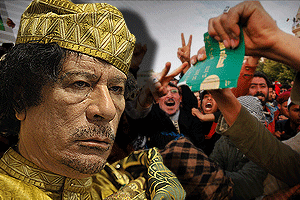 To those who are concerned about yet another ‘imperialist agenda’,
Odyssey Dawn
is not plain and simple a good vs evil episode. There is ample evidence that insurgency in eastern Libya was instigated by foreign powers to coincide with the peaceful protests in Tunisia and Egypt.
To those who are concerned about yet another ‘imperialist agenda’,
Odyssey Dawn
is not plain and simple a good vs evil episode. There is ample evidence that insurgency in eastern Libya was instigated by foreign powers to coincide with the peaceful protests in Tunisia and Egypt.
On Feb 27, Secretary of State Hillary Clinton stated unequivocally that Washington “stands ready to offer any type of assistance to Libyan seeking to oust Gaddafi”, while “hundreds of US, British and French military advisers have arrived in Cyrenaica, Libya’s eastern breakaway province”, according to DEBKAfile .
Moreover, Bahrain too has experienced violent protests, yet no calls for military intervention have been made. Perhaps it has something to do with the fact the Fifth Fleet of the US Navy is headquartered at Manama?
Interestingly, Brazil, Russia, India and China (BRIC) - the four emerging economic powers - have opted to abstain from the resolution, prompting Gaddafi to threaten that he would from now on only ensure the so-called BRIC countries benefit from Libyan oil. The problem is, the colonel may not stay in power long enough to repay his friends’ kindness.
The abstention by Russia, India and China was not only economically driven, although they have certainly grown more dependent on Middle Eastern oil over the years to spur growth at home. These countries are all confronted with the challenge of terrorism by separatists masquerading as Muslim fighters, and the world sees them in Chechnya and Dagestan of Russia, Xinjiang of China, and Kashmir of India.
Hence, any military adventure against a predominantly Muslim country may serve as a heaven-sent opportunity for al-Qaeda and other terrorist networks to wreak havoc. With their comparatively loose counter-terrorism mechanisms and weak security apparatus in the ethnic minority areas, it would be most prudent for these governments to appear ‘neutral’ on Libya.
It is premature to come to the conclusion that military intervention will definitely radicalise an already complicated and precarious situation (especially in Iraq and Afghanistan), but it is also rather arbitrary to argue this is the only way to get rid of a tyrant like Gaddafi.
Surely other options should have been explored but it was clear from the beginning that some drastic action had to be exacted in order to gradually realize the goals set out in the near-forgotten Greater Middle Initiative. So far, there is no hard evidence to suggest that the grassroots sentiments across the Arab world are in favour of foreign intervention, however much the people hate their autocrats.
And only time will tell if the so-called Jasmine Revolution will smell as good ten years from now.
JOSH HONG studied politics at London Metropolitan University and the School of Oriental and African Studies, University of London. A keen watcher of domestic and international politics, he longs for a day when Malaysians will learn and master the art of self-mockery, and enjoy life to the full in spite of politicians.


Are you sure you want to delete this comment?
This action cannot be undone.