




Arms trade: lucrative but deadly
Some conspiracy must be brewing in the highest echelons of the Umno leadership. At a time when the party should be focused on responding to economic challenges and rapidly rising costs of living in preparation for the upcoming general elections, a scandal that once haunted Najib Abdul Razak is back in the limelight for public scrutiny.
The prime minister had hoped to bury the potentially explosive issue for good, but the billion-dollar purchase of French submarines he approved when he was defence minister refused to die a quiet death. It also involved the shocking and tragic murder of Altantuya Shaariibuu, whose trial concluded with the death penalty for the two accused, though no motive was ever found.
Some conspiracy must be brewing in the highest echelons of the Umno leadership. At a time when the party should be focused on responding to economic challenges and rapidly rising costs of living in preparation for the upcoming general elections, a scandal that once haunted Najib Abdul Razak is back in the limelight for public scrutiny.
The prime minister had hoped to bury the potentially explosive issue for good, but the billion-dollar purchase of French submarines he approved when he was defence minister refused to die a quiet death. It also involved the shocking and tragic murder of Altantuya Shaariibuu, whose trial concluded with the death penalty for the two accused, though no motive was ever found.
How very odd, for in committing a crime, one must have a reason. The verdict clearly marks a new low for the Malaysian judiciary, which continues to be a laughing stock in the Commonwealth.
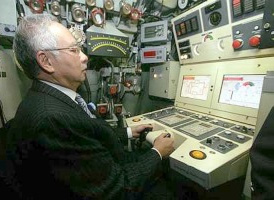 Now, the case is blowing hot again on all those who were implicated in it, not least so Najib himself. Last weekend, he called on the nation's youths to defend Putrajaya. But against whom? Pakatan Rakyat, perhaps, but also from the forces who are seeking to oust him should he fail to regain two-thirds majority in Parliament.
Najib's calls for the party to stop infighting and close ranks are no less intriguing, but even more staggering is Ahmad Zahid Hamidi's consent to testify over the case, subject to cabinet approval. Things are certainly not looking good for Najib. Yes, something is rotten in Umno.
Should the public be surprised by the curious return of the submarine issue? I am not. After all, US Embassy cables released by WikiLeaks recently confirm that leaders in Washington - and I am pretty certain other foreign capitals as well - were gravely concerned that the entire judicial process was fraught with political interference and manipulations.
All eyes are now on who actually was the third person on the same trips with the deceased Altantuya and Najib's (former?) confidant Abdul Razak Baginda to negotiate the submarine deal with the French.
And kudos to Suaram - and Cynthia Gabriel in particular - for their unyielding quest to ensure that no stone is left unturned in this vitally important issue.
Entering murky waters
The French authorities have never quite been an upright and honest counterpart when it comes to defence procurement. For reasons unknown to others, Najib and his team decided on Armaris, a subsidiary of France's state-owned shipbuilder DCN, which produces Scorpene-class diesel submarines.
In 2005, DCN merged with Thales, an electronics company. Back in 1991, Thales paid unauthorized kickbacks to Taiwan to secure the latter's agreement to purchase six Lafayette-class warships. The controversy forced then-French foreign minister Roland Dumas to resign.
A Taiwanese navy captain by the name of Yin Ching-feng later died under most mysterious circumstances. After nearly 20 years, a French court finally ruled that Thales had violated the 1991 contract. But Yin's death remains unsolved , while Altantuya's bereaved father is still crying for justice.
Malaysia is in no short supply of scandals concerning ministry of defence, and this has a lot to do with our ballooning military spending in the past decade.
According to the Stockholm International Peace Research Institute's Arms Transfers Database, arms deliveries to Southeast Asia increased astoundingly from 2005 to 2009, as compared to the early 2000s.
Among them, weapons deliveries to Malaysia jumped by 722 percent, surpassing Singapore (146 percent) and Indonesia (84 percent) by leaps and bounds.
Meanwhile, the Daily Telegraph reveals that the US led in global defence spending, at US$630 billion, or 4.3 percent of its GDP, followed by China and Great Britain. However, Malaysia set the record by being the country with the fastest growing military expenditure in 2010, experiencing a rise of 34.6 percent as compared to the previous year.
Asean neighbours beef up defence
In the regional context, an arms race now appears to be looming - Asean's oft-repeated rhetoric to create a community of peace notwithstanding.
Thailand is actively looking for new sources of arms, including Sweden (a country that promulgates world peace), which is ready to sell 12 JAS Gripen fighter jets to Bangkok. Vietnam has (again) started a courtship with the US aimed at keeping China at a "healthy' distance, while at the same time exploring the opportunities for arms purchases from Russia.
 Confronted with what it perceives to be an increasingly hostile "neighbourhood", Beijing's incoming leadership under Xi Jinping is prepared to beef up its defence. China is now a top importer of arms, and General Liu Yuan of the People's Liberation Army has raised eyebrows by urging the ruling Communist Party to
rediscover
its ‘military culture'.
Confronted with what it perceives to be an increasingly hostile "neighbourhood", Beijing's incoming leadership under Xi Jinping is prepared to beef up its defence. China is now a top importer of arms, and General Liu Yuan of the People's Liberation Army has raised eyebrows by urging the ruling Communist Party to
rediscover
its ‘military culture'.
The burgeoning arms trade therefore represents a confluence where greed, ambitions and power meet, but it also comes with the huge risk of undermining Asean's relative stability, once buttressed by member states' restraint in chasing state-of-the art weapons. Should the trend be left unchecked with no effective confidence-building mechanism, the consequences could be catastrophic for the region.
Nur Jaslan, Member of Parliament for Pulai, argues that Malaysia's defence budget is relatively modest, but he has failed to inform the public that our country has been going on a spending spree to procure the most prized military technology, with most of the deals often shrouded in secrecy.
He and other lawmakers from both sides of the political divide must therefore do more to not only compel the government to be accountable and come clean on the death of Altantuya but also to arouse greater public awareness regarding future defence budgeting .
Only an informed Malaysian populace can make all defence deals subject to parliamentary and public scrutiny, while ensuring that innocent lives are not sacrificed to cover up someone's avarice. Transparency and justice will then be a true cornerstone of the Malaysian state, and a legacy as such will survive beyond the ugly politicking of the present age.
JOSH HONG studied politics at London Metropolitan University and the School of Oriental and African Studies, University of London. A keen watcher of domestic and international politics, he longs for a day when Malaysians will learn and master the art of self-mockery, and enjoy life to the fullest in spite of politicians.


