




PAS looking rosy to the Chinese
Never did it ever occur to any MCA leader that a significant segment of the Chinese Malaysian electorate - the party’s “natural constituency” - would one day toy with voting for PAS. For decades, the MCA took it for granted that its contest for electoral representation would always be with the DAP, and no more.
Never did it ever occur to any MCA leader that a significant segment of the Chinese Malaysian electorate - the party’s “natural constituency” - would one day toy with voting for PAS. For decades, the MCA took it for granted that its contest for electoral representation would always be with the DAP, and no more.
When the merciless sacking of Anwar Ibrahim provoked the vociferous reformasi movement , Ling Liong Sik and Ong Ka Ting worked untiringly to sell the idea that a vote for the DAP would be tantamount to voting in a “cruel Islamic state” by the backdoor. Meanwhile, Ng Yen Yen put in her best effort in scaremongering that all women - Muslim or not - would be forced to cover up their heads and barred from working.
Even Ong Tee Kiat - who still relishes in portraying himself as a sort of “righteous maverick” although he is only popularly seen as a noisy pariah in the party - lost no time in deriding the DAP for being willing to work with PAS while failing to initiate concrete policy debate. He also refused to criticise the way in which the police and the judiciary became beholden to Mahathir Mohamad’s executive powers. So much for a “reformist”.
The outcome of the 1999 general election remained the sweetest victory for the MCA thus far. Both Karpal Singh and Lim Kit Siang were rejected by Chinese Malaysian voters who were genuinely afraid of - if misguided about - a pristine and ultra-conservative Islamic society. Confronted with an unprecedented rebellion by the Malays, Mahathir would not have saved his own skin if not for the splendid support on the part of the Chinese and Indians.
The decline of the MCA’s fortunes
For the first time, Ling and Ka Ting could walk with their heads held high before their Umno counterparts. But it also marked the decline of the MCA’s fortunes.
Instead of using their increased bargaining power to correct all that was wrong with Malaysian politics, the MCA leadership voted to buy over the relatively more critical Nanyang Press Holdings.
Mahathir had formed the opinion that Quek Leng Chan - until then the owner of Nanyang - was a close confidant of Anwar, and held the Chinese daily responsible for the BN’s surprise defeat in the Lunas by-election in late 2000. Always eager to please their political master, Ling and Ka Ting managed to coerce Quek into releasing Nanyang into the hands of Huaren Holdings, a flagship investment arm of the MCA.
 The move enraged the Chinese community and contributed to the sharp fall in
Nanyang
’s circulation. It was eventually sold to Tiong Hew King, thereby expanding the press baron’s media empire in Malaysia and Hong Kong. The heavy concentration of media ownership in the hands of a select few with privileged access to the ruling elite is never a healthy phenomenon in any democracy.
The move enraged the Chinese community and contributed to the sharp fall in
Nanyang
’s circulation. It was eventually sold to Tiong Hew King, thereby expanding the press baron’s media empire in Malaysia and Hong Kong. The heavy concentration of media ownership in the hands of a select few with privileged access to the ruling elite is never a healthy phenomenon in any democracy.
Chinese Malaysians saw their rights eroded further in the coming years despite the MCA’s electoral improvements. While it is true that Chinese tycoons with intimate links to Umno continued to benefit under Abdullah Ahmad Badawi and later Najib Abdul Razak, the ordinary folks felt otherwise.
Of greater concern are the deteriorating public security and the unbridled corruption within the civil service. In a country where the culture of impunity reigns supreme, deaths in custody and police brutality almost always go unpunished. Unruly bureaucrats and racist politicians in Umno only serve to heighten a sense of helpless and bitterness, and the series of mega-project scandals that implicated MCA leaders have added fuel to the fire.
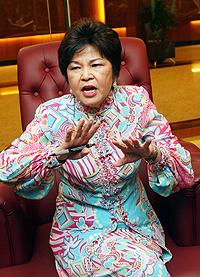 Ng (
right
) may pride herself as the first female Chinese politician to make it to the cabinet, but at what price? The public now only perceives her as an inept tourism minister who excels at incurring unnecessarily costs whenever she travels abroad or comes up with a new idea. A Chinese female friend of mine was once impressed with Ng’s “unyielding spirit” in fighting against religious conservatism, but has now no qualms voting for PAS.
Ng (
right
) may pride herself as the first female Chinese politician to make it to the cabinet, but at what price? The public now only perceives her as an inept tourism minister who excels at incurring unnecessarily costs whenever she travels abroad or comes up with a new idea. A Chinese female friend of mine was once impressed with Ng’s “unyielding spirit” in fighting against religious conservatism, but has now no qualms voting for PAS.
“Even a female prime minister with a tudung would be fine with me so long as she is upright and principled.” She cannot have sounded firmer.
Yes, the chickens have come home to roost. In the past decade, both Umno and the MCA have done nothing other than seeking to deny the opposition and civil society a rightful place in Malaysian politics, enriching themselves along the way. Worse, the Chinese are convinced that while the MCA is sipping the soup, it is Umno that is savouring the meat, evidenced by the charges against Ling and Chan Kong Choy over the PKFZ fiasco.
Would the duo have been so reckless and audacious to approve the deal without a nod from Umno? Chua Soi Lek may hope the pending court cases will give the Chinese electorate a semblance of renewal in the party; unbeknownst to him is that it only goes to show that the MCA is expendable.
Episode reeks of window dressing
The entire episode simply reeks of window dressing ahead of the upcoming polls.
With BN coalition partners reduced to token representation, more hopes are pinned on a new alliance that is based on equity rather than servility.
 The new leadership line-up in PAS has no doubt enhanced the positive sentiments among non-Muslims yearning for change. Even the generally pro-BN
Sin Chew Daily
agrees with the direction that PAS is now taking. Who knows?
Sin Chew
may have to deal directly with PAS at the federal level in the not too distant future.
The new leadership line-up in PAS has no doubt enhanced the positive sentiments among non-Muslims yearning for change. Even the generally pro-BN
Sin Chew Daily
agrees with the direction that PAS is now taking. Who knows?
Sin Chew
may have to deal directly with PAS at the federal level in the not too distant future.
I am not here to argue a federal government consisting of PAS will definitely auger well for political reform, but merely to dissect as to why a good number of Chinese Malaysians are so fed up with the BN that they are ready to take the risk. Judging from the MCA leadership’s refusal to come to grips with the changed realities, I can safely say their days are numbered because their negative campaign tactics can no longer work in a rapidly evolving political landscape.
JOSH HONG studied politics at London Metropolitan University and the School of Oriental and African Studies, University of London. A keen watcher of domestic and international politics, he longs for a day when Malaysians will learn and master the art of self-mockery, and enjoy life to the full in spite of politicians.


