




Post-Bersih, the real trek begins
I knew the yellow wave was irreversible, and it was just a matter of scale.
Just one week before the Bersih 2.0 rally, I started to see more yellow: shoes, shirts, ties, and even earrings.
I knew the yellow wave was irreversible, and it was just a matter of scale.
Just one week before the Bersih 2.0 rally, I started to see more yellow: shoes, shirts, ties, and even earrings.
Following the edict by the King, Ambiga conceded the planned event could be called off. There was outrage and fury among us, and I received more calls from friends asking desperately if it was still on, for they were really keen.
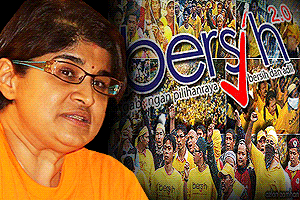 Thanks goodness, Ambiga stood firm, albeit with a compromise to move it to Stadium Merdeka. But Najib Abdul Razak’s flip-flop on his stadium offer was met with a barrage of umbrage from the public, and people who were still dithering suddenly became determined to stand up and be counted.
Those who had been engaging fervently and even bitterly in the polemics on whether an indoor demonstration would serve the purpose of sending a strong message to the powers-that-be quickly patched up and closed ranks. Their means might be different, but their common and foremost target had always been clear.
The uprising was now unstoppable, the fear tactics and the city lockdown notwithstanding.
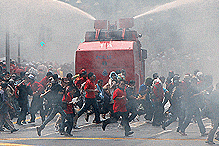 As it transpired, tens of thousands of brave and civic-minded Malaysians turned up for the rally in defiance of the high-handedness of the authorities. It also transcended race, religion, gender and social class. I saw Muslims praying in front of FRU trucks, while pastors and monks were clapping and chanting in joy next to each other.
Having been dispersed by the first rounds of teargas, tudung-clad Muslim women were handing out pinches of salt to young Indian and Chinese girls, and everyone was shouting for everyone else to jaga orang tua dulu (take care of the old folks first), not to mention the unbearable pains on my face that were soothed by a bottle of water pushed into my hand by an Indian man.
There was chaos, but not mayhem. No act of violence was committed on our side.
Yet the police continued to fire teargas and water cannon despite that the crowds were struggling to climb up a slope to get to Jalan Pudu Lama. The pakcik and makcik were cursing: Polis ni ganas macam anjing! (The police are brutal like dogs).
I was pleased to help one of them to safety against the odds.
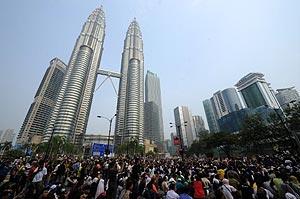 The participants later regrouped and pressed on, converging in different spots in the heart of KL: Pasar Seni, Jalan Sultan, Puduraya and KLCC. In pouring rain, young Malaysians were busy calling or sending smses to friends and mates, greeting one another and waiting to gather again. They were simply reluctant to leave the scene.
I initially refused to believe rumours of tear gas being fired into Tung Shin Hospital and the maternity hospital next to it, but the sheer volumes of video clips and scores of eyewitnesses now make Liow Tiong Lai, the Health Minister, a lousy and pathetic liar.
The MCA has been threatening Chinese Malaysians with zero representation in the cabinet. With the party leadership stuffed with gormless characters, their absence in government will at least mitigate the damage, if not saving the nation.
And kudos to those doctors who have chosen to speak truth to power.
Volte-face turns out to be a blessing
As we look back, Najib’s volte-face has turned out to be a blessing. Had we all gathered in Stadium Merdeka, we could well get the desired numbers - perhaps up to a hundred thousand - but not necessarily the effect.
In a stadium, the participants would have been segregated: Chinese with the DAP, Malays with PAS, non-governmental individuals (NGIs) with NGOs, and the neither-here-nor-there with PKR. Contact between the races would have been minimal at best, and we would all have missed the precious opportunity to experience a more tangible Malaysian identity.
It was in facing the brute force of the state collectively that people were prompted to help each other regardless of race, gender and religion. The solidarity - initially hazy - is now buttressed with real experience.
For the first-timers - many of whom were non-Malays - it was a baptism of water and fire, literally.
Suffering is halved while joy is doubled when shared. It is even more meaningful when the people - long under the shadow of racial riot - can now start to put the past behind them.
And we should thank Najib for it. The day after the rally, the apprentice prime minister lost his cool and spoke like a scoundrel. Siapa milik bumi ni? (Who owns this land?) The rabid reaction only mocks Najib’s portrayal of himself as a “moderate” and “reformist”.
Really, a pure hand needs no glove to cover it. That Najib has been getting all the mainstream media and PR companies to drum up the case for “transformation” is telling of his true nature.
In the months to come, Najib can only behave more irrationally as he comes to terms with losing public support. He is now forced into a corner, with Rais Yatim, Ahmad Zahid Hamidi and even his cousin Hishammuddin Hussein ready to ditch him should his position become untenable.
It would be difficult to explain Najib’s clumsy handling of the rally without taking into account that there are factions within Umno snagging his leg. His continued failure to rein in these forces will eventually cripple his authority, and he should not expect Muhyiddin Yassin and Mukhriz Mahathir to lend a helping hand.
 I, of course, shall have no sympathy for a man who doesn’t even have the guts to keep Ibrahim Ali the Damp Squib at bay.
With the Bersih 2.0 rally over, a door to exorcising the ghost of May 13 is now flung open wide. That one participant after another cannot wait to share their experiences publicly and in writing is a testament that young Malaysians are slowly overcoming the politics of fear, yearning to take charge of their own fate in a country that they dearly love.
Uneasy realities will set in
But the sentiments of joy will eventually subside and uneasy realities set in. On July 9, 2011, tens of thousands of Malaysians took to the streets in one mind and with a view to expressing their anger at the BN government. Still, one must not lose sight of the fact that these crowds were made up of groups of people with various goals, some being in complete opposition to others.
Many a time, it is easier to fight a common enemy but hard to articulate assorted aspirations.
Handling our differences peaceably and rationally is no easy task, but at least the biggest obstacle - the domineering and arrogant BN - is being removed. The real test, therefore, lies in whether Malaysians will nurture the equanimity, sensibility and generosity necessary for a paradigm change.
With the Bersih 2.0 rally behind us, the real journey has just begun.
JOSH HONG studied politics at London Metropolitan University and the School of Oriental and African Studies, University of London. A keen watcher of domestic and international politics, he longs for a day when Malaysians will learn and master the art of self-mockery, and enjoy life to the full in spite of politicians.


Are you sure you want to delete this comment?
This action cannot be undone.