




Putin's second tryst with power
Why should everyone seem surprised when Dmitry Medvedev openly invited Vladimir Putin to run for president next year? Towards the end of his second term as Russian president in 2007, the strongman already made it clear he would not rule out a comeback for the top job in 2012 or the sake of national security.
Why should everyone seem surprised when Dmitry Medvedev openly invited Vladimir Putin to run for president next year? Towards the end of his second term as Russian president in 2007, the strongman already made it clear he would not rule out a comeback for the top job in 2012 or the sake of national security.
And that he was stating his intention to a senior researcher at the National Endowment for Democracy (NED) was telling. The NED, as we know, is often a gadfly to a host of countries, ranging from authoritarian China, semi-autocratic Malaysia to the emerging democracies in Central Asia.
One may remember the Barisan Nasional government, too, accused the Bersih movement for clean and fair elections of being infiltrated by foreign groups, with the US-based NED being prominently implicated.
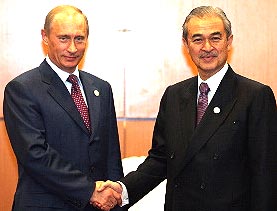 But this is what Putin (
shaking hands with ex-premier Abdullah Ahmad Badawi
) - although much loathed by some quarters within Russia - is admired for: a man with mental toughness and a sharp mind who always enjoys tackling his detractors head-on, much like Mahathir Mohamad is ‘fondly' missed for his fighting spirit (albeit often used for the wrong reasons).
But this is what Putin (
shaking hands with ex-premier Abdullah Ahmad Badawi
) - although much loathed by some quarters within Russia - is admired for: a man with mental toughness and a sharp mind who always enjoys tackling his detractors head-on, much like Mahathir Mohamad is ‘fondly' missed for his fighting spirit (albeit often used for the wrong reasons).
Putin's no-nonsense stance set tongues waggling that he was yet to accomplish his mission. His later assumption of the job as prime minister only lent credence to the rumour that Medvedev was no more than a seat-warmer.
It is indeed a powerful sense of mission that has been driving the man who has dominated Russian politics for over a decade to continue to do so.
It is worth remembering that, with the fall of the former Soviet Union and the cession of huge chunks of territories - the initial acquisitions of which no doubt remain disputed and controversial - post-communist Russians were utterly demoralized by a horrible sense of loss.
The collapse of Soviet power and the birth pangs of economic reforms gave rise to the resurgence of nationalism and an unquenchable yearning for erstwhile glories.
It was once unfathomable to me that young Russians - now globetrotting and ambitious like any of their European counterparts - should harbour misgivings over the lost empire.
Nurturing rise of Russian citizen
But when one seeks to understand how lowly the world considered their beloved country in the 1990s, all the desire to see Russia great again begins to make sense.
Putin stepped in and in some way put things right for ordinary Russians. More importantly, he instilled in the Russian populace a new doctrine of nationalism buttressed by hard power and self-confidence.
 This - needless to say - worried the west and to some extent quasi-powers such as India and China, but one ignores at one's peril the overwhelming endorsement of his fusion of populism and pragmatism by the Russian public.
Like China and India, Russia is confronted with severe challenges, not least so the threat of terrorism and separatism.
The world's perception of Russia's institutional capacity may have improved, but doubts still linger over Moscow's abilities to rein in extremist forces and also to represent itself internationally.
In 2012, Russia will for the first time play host to Apec, which will culminate in a summit on Russky Island of Vladivostok at the end of the year.
It will serve as an opportunity to prove to the region that Russia is a stable and key partner in the global economy, not to mention the country's rich natural resources, advanced sciences, human capital and market potentials that can benefit the world at large.
Testing time ahead for Moscow
On the agenda will also be the proposal of the Free Trade Area of the Asia-Pacific, while the summit will be a platform to discuss the territorial disputes involving China, Japan, Russia and other South-East Asian nations including Malaysia, Vietnam and the Philippines.
As a major stakeholder, Moscow would naturally hope also to move the tricky issue of the Korean Peninsula forward.
In short, Apec 2012 - with numerous regional meetings set to take place that will test Russian capacity to the full - presents the Russian leadership with a clear challenge, a mission that must be achieved to signal the return of a former power.
Putin certainly would not want to be absent from it, just like Mahathir would have been ushered into retirement with much pomp and fanfare following the success of the Commonwealth Games and the Apec Summit in 1998 if not for the political crisis triggered by Anwar Ibrahim's sacking.
Putin's concerns for Russia's place in the world are legitimate. He would not be satisfied with Russia being a second-rate power, but one that can stand tall next to the US and China.
The chaos and disorder of the late-Gorbachev period and throughout the Yeltsin era will always haunt the Russians, but it is a scenario that no Russian wants to revisit.
Be so as it may, Putin has to be shrewd enough to know any country's rehabilitation cannot be based on one man's charisma alone. If he does return as president, the onus is on him to prove that institutional capacity building will last long after he is gone. On this, the jury is still out.
But the talk of Putin's second tryst with power has already made one man in Malaysia green with envy - Mahathir that is.
JOSH HONG studied politics at London Metropolitan University and the School of Oriental and African Studies, University of London. A keen watcher of domestic and international politics, he longs for a day when Malaysians will learn and master the art of self-mockery, and enjoy life to the full in spite of politicians.


Are you sure you want to delete this comment?
This action cannot be undone.