




Winds of strife across SE Asia
The recent announcement by Burmese President Thein Sein to suspend the controversial dam at Myitsone, Kachin State, has surprised many. Just last month, Aung Zaw at the Irrawaddy magazine likened the dam to Burma’s WMD, and expressed little optimism that it would be called off. Now Thein Sein’s decision will not be taken kindly by China, whose state enterprise China Power Investment Corp. is a joint investor.
The recent announcement by Burmese President Thein Sein to suspend the controversial dam at Myitsone, Kachin State, has surprised many. Just last month, Aung Zaw at the Irrawaddy magazine likened the dam to Burma’s WMD, and expressed little optimism that it would be called off. Now Thein Sein’s decision will not be taken kindly by China, whose state enterprise China Power Investment Corp. is a joint investor.
Citing the people’s interests, Thein Sein explained the need to have the entire project - involving an area bigger than Singapore - reviewed all over again. For the critics, the massive dam that had been under construction until it was halted would not serve the Kachin people upon completion. Instead, as much as 90 percent of the electricity generated would be for Chinese consumption.
A visit to Yunnan Province of China, bordering Burma, will provide a clear picture of a break-neck economy hungering for power supply to sustain its growth in the decades to come.
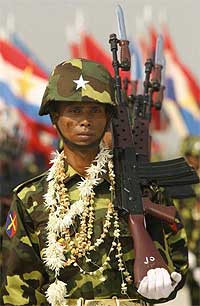 Rumour has it that Burma’s Vice-President Tin Aung Myint Oo will be on a visit to Beijing next week, representing Senior General Than Shwe who is widely believed to be still wielding the balance of power in the military-dominated country. Than Shwe has always enjoyed close rapport with the Chinese leadership, and Tin Aung Myint Oo’s visit is therefore invariably seen as an attempt to make amends. It may be premature for the
Kachin people
to feel elated yet.
Rumour has it that Burma’s Vice-President Tin Aung Myint Oo will be on a visit to Beijing next week, representing Senior General Than Shwe who is widely believed to be still wielding the balance of power in the military-dominated country. Than Shwe has always enjoyed close rapport with the Chinese leadership, and Tin Aung Myint Oo’s visit is therefore invariably seen as an attempt to make amends. It may be premature for the
Kachin people
to feel elated yet.
As far as China is concerned, the unexpected move by Thein Sein cannot be more unsettling at a time when Beijing is confronted with a host of geo-strategic challenges. The abrupt suspension is indeed rare, prompting the Chinese leadership to suspect if Burma is contemplating a new power alignment towards the West now that a supposedly civilian government is in charge.
In response to a more jingoistic North Korea, the United States has assured its two major allies - Japan and South Korea - of Washington’s military support. Vietnamese leaders have also been edging closer to the US on the issue of the South China Sea. The sabre-rattling rhetoric from Hanoi and the increased interaction between Vietnam and India continues to irk Beijing, which is already engulfed by a siege mentality.
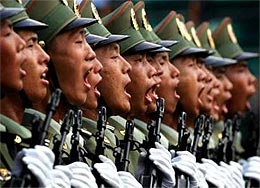 One article in the
Global Times
- popularly seen as a mouthpiece of the Chinese government - even
suggests
that China would have nothing to lose in a war over the Spratly Islands dispute since none of the oil and gas wells are Chinese built.
One article in the
Global Times
- popularly seen as a mouthpiece of the Chinese government - even
suggests
that China would have nothing to lose in a war over the Spratly Islands dispute since none of the oil and gas wells are Chinese built.
Adding to the disquiet is the Philippines’ position. The country, too, has a territorial dispute with China and President Benigno Aquino has proposed a so-called Coast Watch Initiative and requested that Japan help ensure his country’s free and safe passage along vital sea lanes in the event that the region became embroiled in military conflict, which is most puzzling to the Chinese leaders.
In early September, Aquino had visited China and met with his counterpart Hu Jintao. During the meeting, the Philippine president indicated Manila might not resort to the United Nations International Tribunal for Law of the Sea in resolving the Spratly Islands issue. He also took some time off to visit his ancestors’ village in Zhangzhou, Fujian Province, in reaffirmation of his Chinese roots.
The Chinese diaspora card
Playing the Chinese diaspora card is what China excels at. Every year, the Chinese government fetes prominent overseas Chinese in Beijing, giving them a false sense of glory and importance. It is also pleased to see foreign heads of state or government acknowledging their Chinese blood, hoping it would help forge closer ties.
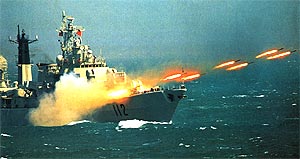 But international politics is always more about real interests than intangible sentiments. Time and again, China’s romantic imagination of a unified Chinese nation is shattered by raw politics. Aquino is acutely mindful of where his country’s interests lie, while Vietnam - which has no doubt been historically influenced by Chinese culture - finds the US a handy ally to guard against China.
Even Gary Locke - the US ambassador to Beijing who is of Chinese origin - has proven to be more assertive than his predecessors in defending Washington’s position.
It is out of utter dismay that many Chinese analysts now accuse the US of exploiting regional tensions to ‘hedge against China’s rise’. Seen in this light, the latest move by Burma to put on hold a project with vital Chinese interests will inevitably be interpreted as yet another sign of ‘containment’.
But no-one denies the fact that Sino-US relations have become more interdependent over the past decade, especially in the areas of trade and conflict resolution. To some extent, China’s suspicions are not entirely unfounded given that the US has been known - rightly or wrongly - for its perceived naked greed for oil and power.
How ironic that the passing of Steve Jobs reminds the world that the real strength of the superpower lies in its soft power made possible by innovation, creativity and an open mind. One can only hope rationality prevails as the two powers vie for influence in the region of South-East Asia.
JOSH HONG studied politics at London Metropolitan University and the School of Oriental and African Studies, University of London. A keen watcher of domestic and international politics, he longs for a day when Malaysians will learn and master the art of self-mockery, and enjoy life to the full in spite of politicians.


