




Mahathir: father of patronage
As Najib Abdul Razak is fishing for votes with his ballooning budget, his patron Mahathir Mohamad cautions against any move to call for the 13th general election anytime soon.
In doing so, Mahathir again proves himself to be a hypocrite par excellence. When he ‘retired’ eight years ago, he promised the country he would not interfere in government affairs. He also poked fun at Lee Kuan Yew - without naming names - by saying he would not be running the country from behind the scenes.
As Najib Abdul Razak is fishing for votes with his ballooning budget, his patron Mahathir Mohamad cautions against any move to call for the 13th general election anytime soon.
In doing so, Mahathir again proves himself to be a hypocrite par excellence. When he ‘retired’ eight years ago, he promised the country he would not interfere in government affairs. He also poked fun at Lee Kuan Yew - without naming names - by saying he would not be running the country from behind the scenes.
Since then, Mahathir has gone back on his word time and again, even having been instrumental in Abdullah Ahmad Badawi’s downfall.
A few months back, he had the nerve to suggest staying in power for longer than necessary could be detrimental to the people’s interests. Sometimes I wonder if Mahathir recognises himself whenever he looks into the mirror.
Dissolution of parliament in a constitutional monarchy is a prime ministerial prerogative. Any former occupant of No 10 Downing Street who publicly advises the incumbent on the timing of general election would be treated with contempt for having gone over the line.
Not Mahathir. Quite obviously, the man still misses the enormous powers that he once enjoyed, and each and every remark that he makes now is carefully chosen with a view to changing political dynamics - mostly for the worse.
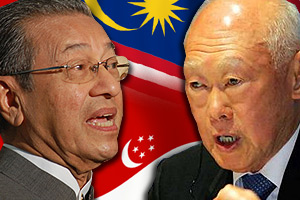 I never dispute Lee has been a merciless autocrat, but at least he has no qualms showing the world his naked ambitions, even having appointed himself first as ‘senior minister’ and then as ‘minister mentor’ after ‘retirement’.
Lee is a consistent and unashamed dictator. Although Mahathir, too, yearns for power and influence, he is always so shy of admitting it. He is like a child covetous of his neighbour’s new toy, but would only get others to grab it for him for fear that his insatiable greed would be laid bare. There may be years before Malaysians see a greater humbug than Mahathir.
Mahathir’s hypocrisy has its roots in his tumultuous upbringing. His failure to come to terms with his mixed ethnicity and his jealousy at aristocratic Umno leaders have all contributed to his twisted - almost perverted - personality.
Lee’s arrogance and snobbishness may have been partially responsible for Singapore’s expulsion in 1963, but by pointing his finger at Lee for sowing seeds of racism in Malaysia, Mahathir is basically saying Umno has been incompetent at solving the issue over the last few decades. Just like his incessant diatribe on colonialism is meant to cover up his own dirty linens.
And he has loads of them.
A state of patronage
Malaysia has become a state of patronage under Mahathir, who established numerous ‘quasi-governmental organisations’, or Quangos , in order to circumvent parliamentary scrutiny and to expedite executive decisions, especially on those related to mega-projects.
The Prime Minister’s Office, for instance, was expanded to incorporate functions of other ministries, with the Economic Planning Unit playing a predominantly role in steering Malaysia’s socio-economic development.
This modus operandi no doubted boosted ‘efficiency’ in decision-making, but also hindered deep and substantive structural reform of the bureaucracy. The increased opaqueness and rampant cronyism that followed have not only made Malaysia a less attractive investment destination, but also brought about negative impact on the people’s daily life.
In short, Malaysia became a patronage state under Mahathir. In both the private and the public sectors, availability of services and contracts is now overwhelmingly dependent on connection.
The frenzy of privatisation has also seen government services transferred to private sector providers, who have in turn been conferred the contracts thanks to their affiliation with the ruling coalition and, more specifically, with the powers-that-be. On this, examples abound: Indah Water Konsortium, Telekom Malaysia, Syabas of Selangor, and Tenaga Nasional, you name it.
 Even the
independent power producers
made up of politically well-connected groups, such as YTL. Whether or not these companies had had experience in the power sector was irrelevant, for ‘the strength of connections to the government was of central importance’, according to an academic report.
Even the
independent power producers
made up of politically well-connected groups, such as YTL. Whether or not these companies had had experience in the power sector was irrelevant, for ‘the strength of connections to the government was of central importance’, according to an academic report.
As a result, Malaysians nowadays are by and large forced to rely on services provided by politicians or political parties, while the state is (in)famous for being a hotbed for patronage. From lucrative contracts to government scholarships, an impenetrable system is now firmly in place to tilt politics in favour of the Barisan Nasional in general and of the bigwigs in particular.
Mahathir remains proud of this unique system of patronage, and has demonstrated no remorse over those whom he had punished. Under the Petroleum Development Act 1974, Petronas is accountable to the Prime Minister’s Office. Mahathir did not hesitate to use his power to punish the people in Terengganu when they defied him by voting Pas in 1999.
Even in ‘retirement’, Mahathir has not stopped working, literally. Or how else does one explain the fact that the Kencana Group , of which Mokhzani Mahathir is the CEO, continues to receive multi-million contacts from Petronas?
An instrument for the ruling elites
Mahathir has successfully created a state that serves nothing but as an instrument for the ruling elites to advance their agendas, political and non-political alike. With entrenched interests at every layer of Malaysian society, institutional reform has become virtually impossible. Abdullah did make feeble attempt at cleaning things up, only to be shoved out of power by none other than Najib and Muhyiddin Yassin.
Therefore, anyone who believes in Najib’s reform agenda and expresses sympathy with him is misguided by either pure naivety or sheer ignorance, for he is very much a part of the patronage system on which his political survival relies.
And there is only one reason why Mahathir has been nudging for Najib to postpone the next polls. The longer Najib stays, the more blunders he may make. The more blunders he makes, the more likely Umno will move against him. That would only be good for Mahathir and Muhyddin, for they can kill two birds with one stone. With Najib gone, Hishammuddin Hussein’s dream would be shattered.
Mahathir is ageing fast and running against time. Who, then, would be best-placed to stand next to Muhyiddin? One gets no prize for the right answer.
JOSH HONG studied politics at London Metropolitan University and the School of Oriental and African Studies, University of London. A keen watcher of domestic and international politics, he longs for a day when Malaysians will learn and master the art of self-mockery, and enjoy life to the full in spite of politicians.


