




Young minds enslaved
Someone asked me recently if the staggering rise of China as a quasi-superpower, coupled with the economic malaise of the United States and the European Union, would spell the end of the West.
Someone asked me recently if the staggering rise of China as a quasi-superpower, coupled with the economic malaise of the United States and the European Union, would spell the end of the West.
Not totally unlikely, I said. But to put things in perspectives, one must also look at the equally sharp rise in the numbers of Chinese nationals studying, working and even living permanently in the US, Australia, the United Kingdom and other parts of Europe.
In fact, it would seem that the greater the wealth the Chinese accumulate, the higher the possibility for them to send their children overseas in pursuit of higher education.
While prestigious institutes such as Peking, Tsinghua and Fudan Universities have consistently outdone their counterparts in the Asia-Pacific and even in the West in terms of worldwide ranking, the first choice for many Chinese parents - so long as they can afford it - would be to have their young ones educated at Yale, Harvard, Stanford, Cambridge or Oxford.
Not to mention the long queues outside foreign missions in Beijing, Shanghai or Guangzhou for a visa to travel to the US or other European countries. Of greater importance is the fact that many who will opt at the first opportunity for some sort of residential arrangements outside China tend to be wealthier and highly educated.
Basic human instincts inform them that their wealth could perhaps be better protected and their talent more appreciated in a country that upholds transparency, political freedom and individual rights. After all, the communist ideology by any other name still evokes fears of an ubiquitous state where one’s right to property is never fully secured.
But my focus here is actually tertiary education. Both China and Malaysia aspire to be a regional hub for education. Although the Beijing authorities have seen some success over the years, none of the Malaysian universities have made it to the top.
However, China has only succeeded in terms of hardware: grandiose buildings, state-of-the-art technology and first-world funding for each and every of its elite universities. When it comes to the software elements, such as academic freedom and intellectual creativity, the gap with its western peers remains insurmountable.
In the 1930s, Mei Yiqi, then the Tsinghua president, boldly advised the Chinese authorities that a truly great university must go beyond the veneer of magnificent architecture and focus more on quality teaching and a diverse pool of talent, not to mention academic freedom. His words have no doubt fallen on deaf ears.
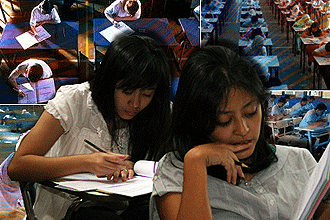 It is even worse for Malaysia. The frenzied drive of privatisation in the 1990s has seen business-centred institutes of higher learning mushroom across the country, churning out more mediocre graduates than the market can absorb.
Public universities, meanwhile, have become so suffocated that they are nothing more than a gargantuan secondary school. Nowadays, university administrators are not much different from civil servants, and the bloated bureaucracy can only be demoralising for the teaching staff who still prize academic achievement far higher than promotion and political affiliation.
Those who are brave enough to differ from the powers-that-be must be prepared to face the consequences, the outspoken constitutional law expert Professor Abdul Aziz Bari being the latest case in point.
Fostering a vibrant culture of debate
Although I do not fully share his political views, especially those in relation to the hudud law, a true university must do its utmost to foster a vibrant culture of debate and promote diverse opinions so
 as to maximise the potential benefits for the students and society as a whole. In suspending Abdul Aziz, the Universiti Islam Antarabangsa has proven itself to be just another state apparatus.
Almost every public university in the country now has a PhD quota to fulfill in order to demonstrate its ‘seriousness’ in moving to a higher ground. But numbers alone are horribly insufficient if there is no free flow of information and liberal exchange of views.
A tour around Oxford and Cambridge will clearly illustrate it is not the buildings, facilities and sheer numbers of students that have taken them to the top, but the people - both teachers and students. John Henry Newman, a 19th century cardinal and educationist at Oxford, even saw small-group seminars rather than a huge lecture room as the best place to nurture intellectual capacity.
 PhD holders do not necessarily make good leaders - just look at Koh Tsu Koon and Wee Ka Siong. On the contrary, Bill Gates, Steve Jobs (
left
) and Mark Zuckerberg did not complete their tertiary education but that did not stop them from contributing tremendously to the modern world.
PhD holders do not necessarily make good leaders - just look at Koh Tsu Koon and Wee Ka Siong. On the contrary, Bill Gates, Steve Jobs (
left
) and Mark Zuckerberg did not complete their tertiary education but that did not stop them from contributing tremendously to the modern world.
It is the environment that encouraged fresh ideas and innovative thinking that has made these men stand tall, not the aloof, monolithic - almost feudalistic - campus culture that we see in Malaysia.
We cannot hope to become a first-world economy (an elusive dream anyway) without first liberalising our young minds, but when even an Oxford graduate by the name of Khairy Jamaluddin did not hesitate to villify his political opponents, disgracing only himself, it does not leave us with too much hope.
While I am heartened to see close to 10,000 young Malaysians protesting against Professor Abdul Aziz's suspension, gutter politics may one day still devour the nation before it manages to achieve anything significant.
JOSH HONG studied politics at London Metropolitan University and the School of Oriental and African Studies, University of London. A keen watcher of domestic and international politics, he longs for a day when Malaysians will learn and master the art of self-mockery, and enjoy life to the full in spite of politicians.


