




Anwar, US , our foreign policy
What a pity, that a near-forgotten intellectual behemoth (by Malaysian standards, what else?) seems to have been plucked from oblivion by you-know-who to hit at Anwar Ibrahim again. There really is so much bad blood between the two although Chandra Muzaffar was supposed to quit his short tryst with politics more than a decade ago.
What a pity, that a near-forgotten intellectual behemoth (by Malaysian standards, what else?) seems to have been plucked from oblivion by you-know-who to hit at Anwar Ibrahim again. There really is so much bad blood between the two although Chandra Muzaffar was supposed to quit his short tryst with politics more than a decade ago.
In the aftermath of the so-called Arab Spring, is Malaysia a US target of regime change? This appears to be a grave concern for Chandra, whose anti-American streak often borders on paranoia and is matched only by that of Mahathir Mohamad, in whom he now finds a staunch ally in his crusade against Washington and Anwar.
The late Samuel P. Huntington sparked one of the most heated debates in the academic circle with his Clash of Civilizations theory nearly two decades ago.
The problem with the Huntingtonian argument is that it is statist and reductionist in nature, conveniently overlooking the impact that non-state actors can have in influencing government policy.
For instance, when Huntington expected the so-called Protestant and Catholic states to join hands in guarding against an imminent Chinese threat and Islamic menace, what happened was two major west European powers - France and Germany - opted to stay out of the 2003 invasion of Iraq, not because of principle, but pragmatism, national interests and pressure from a strongly sceptical electorate.
 Chandra is, unfortunately, showing similar symptoms as an overly and unreasonably suspicious scholar, so much so that his illogical anxieties have got the better of his otherwise (or erstwhile?) rational mind.
But before I rebut several of his contentions, I must say some of his concerns are valid, especially as regards the heightened tension in the South China Sea.
Unable to confront China alone, the Philippines and Japan have formed an alliance to halt Beijing's attempt at asserting further Chinese sovereignty over the disputed Spratly Islands.
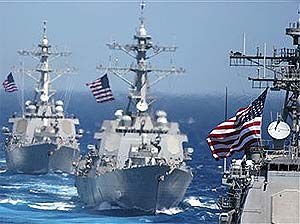
Naval exercises between the two countries - blessed by Washington - are set to begin soon. The Chinese leaders are well aware of the things and, watching from a distance, have promptly announced a sharp increase in defence expenditure .
At the same time, Vietnam has been adroitly positioning itself vis-à-vis China with the assistance of the US and, to a lesser extent, Russia.
If everything goes according to plan, Hanoi will see six Russian-made Kilo-class submarines by 2014. No longer dogmatic, the Vietnamese understand perfectly well that maximum of political benefits could be gained with minimum of endeavour if more stakeholders are on board, hence Russia's active participation in upgrading Vietnam's Cam Ranh Bay naval facilities and also other oil exploration projects.
Contradictions in international relations
What makes the whole scenario interesting is that both Vietnam and the Philippines - and also Indonesia and Thailand for that matter - enjoy increasingly closer trade relations with China. Still, economic interdependence has failed to translate into mutual trust and confidence.
Historically, small kingdoms in Southeast Asia were quick to seek acknowledgment and protection from the neighbouring powers - be it India, China, Majapahit or even Siam - for the sake of survival. Unlike other regions in the world, flourishing trade ties often grew along frictions, conflicts and even wars in Southeast Asia.
China has been at pains to project itself as a benign maritime power harking back to the era of Admiral Zheng He.
But Beijing now appears to have overplayed its cards by hugging some of the Southeast Asian countries to tightly that they are now in a haste to find a way out of the overbearing relationship, Burma being a case in point.
Having relied on the Chinese Big Brother to ward off western-imposed sanctions for years, it finally dawned on Rangoon that the more tango partners the better.
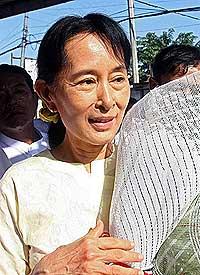 Aung San Suu Kyi (
left
) is fully cognizant of the political realities, but does the Lady have a choice other than to play her part well as a poster girl?
Aung San Suu Kyi (
left
) is fully cognizant of the political realities, but does the Lady have a choice other than to play her part well as a poster girl?
Little wonder Geoff Wade at the National University of Singapore has been arguing profusely that Admiral Zheng He was not a benevolent emissary as Beijing makes him out to be. After all, debunking the myth of the Muslim eunuch as a messenger of peace is essential to countering China's claim to be a friendly giant.
I have mentioned several countries in the region: Indonesia, Thailand, the Philippines and Vietnam, which are strategically vital to US interests by virtue of their sizes of population, military importance and economic potentials.
This aside, Singapore's support for Washington is a given and this has been proven true time and again. It also indicates convincingly the limit of cultural affinities: largely Chinese it may be, Singapore knows how to hedge its bets between China and the US.
With the US bent on restoring its influence in Southeast Asia, which China perceives to be its backyard traditionally, it is of utmost importance that all parties are committed to solving contentious issues by peaceful means.
But where does it leave Malaysia? This is where Chandra exposes his ignorance to the fullest.
Malaysia is of course not completely insignificant, yet it is not as strategically pivotal as Chandra allows himself to be deluded into thinking (or imagining) as such. Living in Bangkok, I know how this great metropolis came to be what it is today.
It is the geographical advantage - at the heart of Indo-China - and the Vietnam War that propelled the Thai capital to be the darling of the western world. According to Joshua Kurlantzick's latest book The Ideal Man, the CIA used to have the largest operation in the region not far from Bangkok.
But where is Malaysia? Why would the world's sole superpower want to take the trouble to engineer a regime change in a tiny, sometimes self-aggrandizing state like ours? It would be much more worthwhile, cost-effective and rewarding for the White House to work on more influential countries such as Thailand, Indonesia and Singapore.
Bowing to blowing world winds
Once a common policy is in place, Malaysia would be the odd one out. Looking back at history, I can safely say our leaders hate to be left out in the cold and will fall into line in no time. Whether Barisan Nasional or Pakatan Rakyat, it ain't gonna make much difference.
The fact is, the US and other countries that are cautious of China's charm offensive in Southeast Asia are fairly certain the Najib-led government is inclined towards the west, as evidenced in Rosmah's relentless but shameless pursuit of academic accolades from Australia and the US!
Finally, even if Anwar makes it to prime minister, I seriously doubt he would make drastic changes in Malaysia's foreign policy and orient it against China.
During the 1950s through to the 70s, when Mao Zedong's Little Red Book trumped MBA study material, Beijing had its communist brethren disrupt Thailand, Malaysia and Indonesia. Today, China's economic
 interests overlap with Southeast Asia and vice versa in more ways than one.
Moreover, Southeast Asian nations cannot afford to put all eggs in one basket, and will invariably seek a diplomatic alignment among all the major powers.
They know full well why Washington is keen to make a comeback this time, and there is no guarantee the geostrategic mooring will last into posterity.
Last but not least, a Pakatan Rakyat government will be made up of PAS, PKR and DAP. Any attempt to revise Malaysia's foreign policy root and branch will need the consent of all the component parties.
Why has Chandra failed to mention the highly probably backlash from PAS if Anwar chose to gear foreign policy towards the US' grand scheme of things at the expense of the Palestinian issue, or to pedal away from the ever-closer trade ties with China, even to the chagrin of the DAP?
Quite clearly, Chandra's obsessive hatred of Anwar has so severely crippled his once admired intellectual prowess that he can no longer think out of the box.
Let me end this article by reminding him that one fundamental difference between the Pakatan Rakyat and the BN is that the former is formed on an equal footing, while the latter exists at the mercy of Umno.
The once brilliant mind of the Malaysian academy deserves to be told of the raw truth in spite of himself.
JOSH HONG studied politics at London Metropolitan University and the School of Oriental and African Studies, University of London. A keen watcher of domestic and international politics, he longs for a day when Malaysians will learn and master the art of self-mockery, and enjoy life to the full in spite of politicians.


