




Death penalty in need of overhaul
I have been quite critical of Singapore on a number of issues, not least the authoritarian streak of the government and at times the racial profiling that it employs that is not too dissimilar from Umno’s modus operandi from across the causeway.
I have been quite critical of Singapore on a number of issues, not least the authoritarian streak of the government and at times the racial profiling that it employs that is not too dissimilar from Umno’s modus operandi from across the causeway.
But the passage of amendments to the island republic’s drug law which will exempt some cases from the mandatory death sentence represents an important step towards achieving restorative justice.
While those convicted of manufacturing and trafficking drugs will still be hanged, the ultimate punishment may not be applied to those caught carrying drugs exceeding certain amounts.
More significantly, that the Singapore authorities will from now on place more emphasis on tackling the fundamental issue of drug production and trafficking indicates that years of campaign against the mandatory death sentence that often victimises the most vulnerable and marginalised segments of society - the poor and the lowly-educated - is now bearing fruit.
As I argued two years ago, there were serious flaws in Singapore’s justice system when it came to drug offences, and international criticism had mostly fallen on deaf ears. But the persistence by some to highlight the injustice - sparing the powerful drug syndicates while sending the drug mules to death row - has proven effective.
I would like to commend K Shanmugam, Singapore’s Law Minister, for his vow to seek “justice to the victim, justice to society and justice to the accused, and mercy in appropriate situations to the accused”.
 However, I also hope the verdict on Alan Shadrake’s
defamation case
would be reversed because the amendments that the Singapore Parliament has just passed are precisely among the issues addressed in the book, and the British author is now vindicated.
However, I also hope the verdict on Alan Shadrake’s
defamation case
would be reversed because the amendments that the Singapore Parliament has just passed are precisely among the issues addressed in the book, and the British author is now vindicated.
Capital punishment has not always been effective in fighting crime. Various types of death penalty were implemented throughout Chinese history, yet they have failed to root out corruption. While the ruling Communist Party today regularly sentences high-ranking officials or prominent persons to death over corruption even on the flimsiest of evidence, corruption has only become more widespread and cancerous.
In the same vein, having death sentence may not necessarily contribute to crime rate reduction. In fact, crime rate in the United States continues to be substantially higher than that in Canada in spite of the presence of death penalty as deterrent in certain American states.
Root causes of crime
Similarly, Malaysia’s utter failure in arresting the rising use of drugs clearly suggests the government’s policy that is tough on criminals but soft on the root causes of crime is in dire need of a thorough, structural and radical overhaul .
In Malaysia, as in many other parts of the world, the root causes of crime are mainly poverty, unemployment, poor healthcare, racism (just look at the jobless Indian youths who are abruptly displaced from rubber estates but neglected by the race-centric state) and weak schooling. The widening wealth gap also means that the downtrodden may no longer hesitate in resorting to the most extreme form of crime.
Instead of eradicating crimes, the state tends to solve them by terminating lives whenever possible. This is nothing but political lethargy.
One may say since Singapore is a developed nation with one of the world’s lowest crime rates, it can afford to consider an alternative to the capital punishment. Malaysia, on the other hand, has seen all types of crime shoot up over the past two decades that making it more lenient for drug offenders may just aggravate the already serious problem.
Those who think likewise believe desperate times call for desperate measures. Interestingly, the same group of people may also be opposed to certain drastic laws proposed by the Islamic party!
Have we no mercy for many of the past victims who were hanged despite their innocence?
Singapore and Malaysia are two separate countries with different sets of societal challenges, and what is good for the goose may not always be good for the gander. However, as far as drug law is concerned, the city state has definitely made a just decision that will pave the way for a more holistic approach to its war on drugs, and it is certainly a move that is worthy of emulation by others in the region.
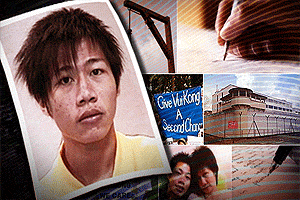 As a result of the amendments, former drug mules on Singapore, such as Yong Vui Kong from Sabah, may eventually be given a second chance. I earnestly hope it would not be too premature for me to register also my gratitude to those who have been fighting for a better justice system both in Singapore and Malaysia, especially the
fearless
M Ravi.
As a result of the amendments, former drug mules on Singapore, such as Yong Vui Kong from Sabah, may eventually be given a second chance. I earnestly hope it would not be too premature for me to register also my gratitude to those who have been fighting for a better justice system both in Singapore and Malaysia, especially the
fearless
M Ravi.
JOSH HONG studied politics at London Metropolitan University and the School of Oriental and African Studies, University of London. A keen watcher of domestic and international politics, he longs for a day when Malaysians will learn and master the art of self-mockery, and enjoy life to the full in spite of politicians.


Are you sure you want to delete this comment?
This action cannot be undone.