




A backlash against neo-liberalism
That it took Singapore’s Elections Department nearly three hours to declare the outcome of the Punggol East by-election last Saturday speaks volumes of the island republic’s facade of democracy.
That it took Singapore’s Elections Department nearly three hours to declare the outcome of the Punggol East by-election last Saturday speaks volumes of the island republic’s facade of democracy.
The sluggish news reporting by the mainstream media, including Channel News Asia , was also incompatible with Singapore’s pride in efficiency.
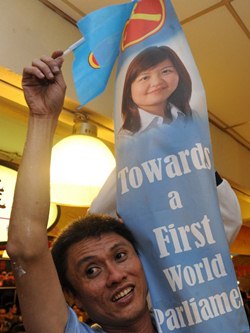 When the result finally came as it could not be delayed further, it was nothing less than a shocker by any standards, as the ruling People’s Action Party (PAP) was dealt a heavy blow in what had been perceived as its stronghold when Lee Li Lian, the Workers’ Party candidate, wrested the constituency. Even more shocking to the PAP was the margin of victory of nearly 11 percent, prompting calls within the government for earnest soul-searching.
If Facebook sources are to be believed, crowds started to gather in many coffeeshops in and around areas in Potong Pasir, Hougang and, of course, Punggol East, indicating that the numbers of disgruntled voters in Singapore are on the rise.
What went wrong?
To many Malaysians who seize every opportunity to deride the Barisan Nasional’s corrupt rule with the splendid economic achievements of our southern neighbour, a severe defeat as such on the part of the PAP is incredulous as well as unfathomable. But what Singapore's ruling party has endured is precisely a fate that has befallen many other governments that adhered to neoliberalism .
For the PAP, which once aspired to be a South-East Asian answer to western social democracy - although democratic it has never truly been - the veneer of socialist rhetoric was completely removed when the government began to wholeheartedly embrace neoliberalism in the aftermath of the Asian financial crisis in 1997/98.
Witnessing the domino effect of croynism which toppled one regime after another in the region, the PAP decided that only a full access to foreign capital and investment would it be able to establish Singapore as a strategic hub for globalisation and financial markets.
Since then, both Temasek Holdings and the Government of Singaopre Investment Corporation have been playing a pivotal role in offshore investment drive. Meanwhile, as new immigrants rushed in, the high-end segment of the property market pushed prices up significantly, with an adverse effect on the ordinary folk.
Today, MRT trains and buses - efficient they may still be - are generally overcrowded. As more affluent foreigners are given incentives to settle in Singapore, living in posh condos and driving fast cars, the average Singaporean continues to eke out a living.
Income disparity
According to the World Bank, Singapore has over the past few years ranked among the countries with alarmingly high levels of income disparity, along with China, Hong Kong and Malaysia. While 15.5 percent of Singapore’s households have liquid assets of US$1 million or more, a world record, the wages of the lowest income group have remained stagnant throughout the first decade of the 2000s.
 It is a picture not too disimilar from that of Malaysia, where a handful of the Umno elite, such as Mukhriz Mahathir and Syed Mokhtar al-Bukhary, have become filthy rich thanks to monopoly in many forms, while the majority of the Malays are caught in the so-called middle income dilemma, or even poverty.
The PAP was confronted with a groundswell of discontent when it first came to power, and sought to suppress any dissent through either trade unions or student movements.
In the early days, high-profile opposition members were detained en masse under the notorious Internal Security Act, a dirty tactic replaced later by what is popularly known as a cunning use of administrative law, i.e. intimidation through the courts, as Singapore’s political situation ‘stabilised’.
Acutely aware of his democratic deficit, Lee Kuan Yew made affordable public housing and transport the twin pillars of his legitimacy. For decades, the strategy succeded beyond imagination. However, as more immigrants came in and the country became more populous, the costs of living have gone up and the space is shrinking fast, leading to a notable decline in public services.
Compared to Malaysia, Singapore still enjoys a world-class transport system that makes me green with envy, while the streets are safe even in the middle of the night, not to mention the ultra-clean enviornment.
However, as citizens of a developed economy, Singaporeans naturally demand more from their government. But the PAP has not been listening because it trusts only its own elite, which explains why more voters in Punggol East identified more with Lee, the Workers’ Party candidate, rather than the elitist Dr Koh Poh Koon backed by the government.
They are also fed up with the fact that the PAP has been treating the people as purely a vessel for unlimited economic growths.
“Li Lian is one of us,” as many would have said of the Workers Party candidate.
Now that the people have paid a high price for the country to become a poster boy of neoliberal economics, teaching the government a lesson through a small but important by-election was the least that voters in Punggol East could do.
Therefore, for Malaysians to ridicule the Singaporeans for voting against a government that is comparatively more capable and effective than that of Malaysia is akin to a Zimbabwean telling us not to opt for the opposition just because Najib Abdul Razak is a better leader than Robert Mugabe!
Pent-up frustrations
To its credit, the PAP has handled the loss with dignity. But the bigger picture is lost on the Workers Party and the Singaporean electorate nonetheless. What the Singaporeans have been telling the PAP is their pent-up frustrations over government policies that favour foreign investors and capital, which is part and parcel of globalisation and neoliberalism.
However, the response of the Workers’ Party in the wake of the surprise victory shows that it has yet to look at the issue holistically. In reiterating its role of checks and balances and urging the public not to read too much into Punggol East, the Workers’ Party has demonstrated once again it harbours no aspiration for national government.
Most critically, without a comprehensive agenda as their counterparts in Malaysia have shown, the Workers’ Party and its opposition allies may not be able to present themselves as a real alternative to the PAP, although the outcome is now more than a wake-up call.
Hence, while Punggol East is a blessing for Singapore’s democratic development, a lack of commitment and vision on the part of the opposition to transform the country means that the PAP, which has proven itself responsive and resilient when pushed agaisnt the wall, may be able to rise above temporary setbacks after all.
JOSH HONG studied politics at London Metropolitan University and the School of Oriental and African Studies, University of London. A keen watcher of domestic and international politics, he longs for a day when Malaysians will learn and master the art of self-mockery, and enjoy life to the full in spite of politicians.


