




Trials of higher education
By and large, I am satisfied with the Pakatan Rakyat manifesto launched early this week. Granted, there are issues yet to be addressed therein, including the restoration of local elections and concrete steps to reach out to the weak minorities such as the disabled and Indian communities, it still represents the most comprehensive campaign document - on the part of the opposition - in more than two decades.
By and large, I am satisfied with the Pakatan Rakyat manifesto launched early this week. Granted, there are issues yet to be addressed therein, including the restoration of local elections and concrete steps to reach out to the weak minorities such as the disabled and Indian communities, it still represents the most comprehensive campaign document - on the part of the opposition - in more than two decades.
However, if there is one area that I think is in need of more clarification, it has to be the pledge of free education for all, and I take it to mean higher education, given that our primary and secondary education is already state-funded (except for the private and independent Chinese schools).
Here, a core challenge is manifested in the racial quotas in public universities, and the manifesto - laudable as it is - remains silent on whether the existing system would be reformed for the sake of natural justice.
Pakatan Rakyat's ambivalence in this regard is understandable, for any mention of removal of the New Economic Policy (NEP) could play into the hands of Umno.
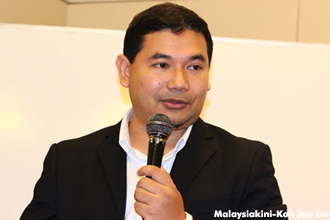 To his credit, PKR director of strategy Rafizi Ramli (
left
) did emphasise that the NEP which had amounted to nothing but cronyism would be phased out gradually, and that the party's focus would be on increasing Malaysia's per capita income across the board regardless of race, which could eventually benefit more Malays and other bumiputera communities.
To his credit, PKR director of strategy Rafizi Ramli (
left
) did emphasise that the NEP which had amounted to nothing but cronyism would be phased out gradually, and that the party's focus would be on increasing Malaysia's per capita income across the board regardless of race, which could eventually benefit more Malays and other bumiputera communities.
It is a risky move, and Rafizi should be well advised to brave himself for relentless smearing by the Umno-controlled media. But if I were a Pandan voter, I would not hesitate to vote for him rather than former MCA president Ong Tee Keat, who is now reduced to being a court jester awaiting crumbs from Najib Abdul Razak's table.
Anyway, my point is that without touching on the discriminatory racial quotas, any talk of improving the quality and competitiveness of our public universities would be premature.
To placate the disaffection of the non-Malay communities over the 'limited' places in public institutes of higher learning, Dr Mahathir Mohamad gave the green light for the private sector to take part in higher education. As a result, more private colleges were established and they became an instant tool for some such as Lim Kok Wing, and Tan Yew Sin of INTI College to get rich.
In 1997, the National Higher Education Loan Fund (PTPTN) Act was passed to allow more students to have access to study loans. The most significant and immediate outcome of this act of Parliament was the mushrooming of private universities and branch campuses of foreign universities in offering full degree courses, for a steep price.
Needless to say, those who are granted the license to enter the fray happened to be those who were closely-linked to the ruling coalition, including the YTL Corporation Berhad in the case of the Nottingham University and Jeffrey Cheah of Monash University’s Sunway Campus.
Some were directly-run by BN component parties, with the MCA-founded Universiti Tunku Abdul Rahman (Utar) being the most prominent one.
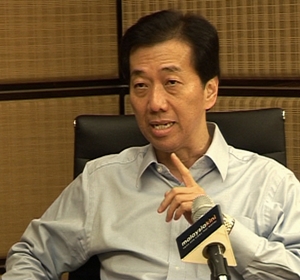 Three years down the line, Xiamen University, a prestigious institution in southern China, would start enrolling students for its Malaysian campus in Salak Tinggi. Special envoy to China Ong Ka Ting (
right
) is widely believed to have played a crucial role in bringing Chinese universities to Malaysia. No doubt, it is another cash cow in the making which would no doubt boost the property market in the local area, as had been the case with Utar in Kampar.
Three years down the line, Xiamen University, a prestigious institution in southern China, would start enrolling students for its Malaysian campus in Salak Tinggi. Special envoy to China Ong Ka Ting (
right
) is widely believed to have played a crucial role in bringing Chinese universities to Malaysia. No doubt, it is another cash cow in the making which would no doubt boost the property market in the local area, as had been the case with Utar in Kampar.
Precisely because higher education has become a highly lucrative business, many with the 'right connections' would want to have a share of it. But the proliferation of private education over the past 15 years has left more questions unanswered as to the quality of the educational products.
For instance, has anyone heard of Lincoln University College based in Petaling Jaya? I only came to know of its existence when the college was allegedly involved in dishing out Ukranian medical degrees not recognised by either the Malaysian Medical Council or the Health Ministry.
Several years ago, an Indian friend of mine sent her daughter to a medical institute in Ukraine through a private college, only to find out halfway that Malaysia had discontinued their recognition of its accreditation. After intervention by the MIC, the government relented by assuring that the Ukranian degrees of those who had enrolled before 2005 would not be affected.
These are only a handful of the cases that have come to my knowledge. How many more out there have been cheated by unscrupulous institutes of higher education?
 With easy access to PTPTN, many who fail to send their young ones to a public university have no option but to resort to the private ones. It has since become a vicious cycle in which the government is increasingly shifting its obligation of higher education onto the private sector, resulting in questionable quality of educational products and burdening the average families, with many cronies being the clear beneficiaries.
Hence, it would be meaningless to talk about free education without first tackling the politically-sensitive quota issue in public universities. It would also defeat the purpose of abolishing PTPTN if more parents are forced to send their children to private universities by taking another form of study loan. A loan in whatever name remains a burden still, and it would not solve the problem of the stagnant income faced by many Malaysian families.
It is clearly a moral dilemma that Pakatan Rakyat must confront sooner or later. I am all for free education because I am convinced that with Malaysia’s abundant resources, we can afford it if a responsible, just-minded and prudent government is in place.
However, the first priority should be to prop up the existing public universities, and if need be, to open more. Only with quality and affordable public universities can the private ones be challenged to improve their standards, eventually fulfilling the goal of quality higher education in Malaysia as a whole.
JOSH HONG studied politics at London Metropolitan University and the School of Oriental and African Studies, University of London. A keen watcher of domestic and international politics, he longs for a day when Malaysians will learn and master the art of self-mockery, and enjoy life to the full in spite of politicians.


