




M'sia-China ties to ponder
Recently, MCA president Chua Soi Lek warned that a Pakatan Rakyat government could pose a threat to the cordial ties between Malaysia and China because “Anwar Ibrahim is only interested in the United States and the Middle East”.
Recently, MCA president Chua Soi Lek warned that a Pakatan Rakyat government could pose a threat to the cordial ties between Malaysia and China because “Anwar Ibrahim is only interested in the United States and the Middle East”.
Unfortunately, not only is Chua’s concern in this regard misplaced, his rationale is also rather unsound. The fact that Teresa Kok, the second-most senior member of the Selangor state government, has been vigorously promoting investment opportunities to the Chinese speaks volumes of the importance that Pakatan Rakyat attaches to China.
While Anwar is indeed close to the US and the Middle East, there has been no indication that he is lukewarm to China. In fact, the contrary is true. When he was deputy prime minister, Anwar visited China on several occasions, including his landmark tour in 1994, during which he openly encouraged Chinese Malaysians to grasp the vast potential of the largely untapped mainland Chinese market.
It was at a time when the Beijing leadership was slowly emerging out of the shadows of the Tiananmen Massacre and still struggling to regain legitimacy in the face of an international boycott. Anwar’s overtures were well-appreciated by the then-Chinese leaders who were popularly seen as ‘Beijing butchers’, especially by the western media.
Nearly two decades on and after tremendous changes in Malaysia’s political landscape, to suggest that the opposition coalition that has been presenting itself aggressively as ‘the government-in-waiting’ would be so reckless and foolhardy to spoil the relationship with one of Malaysia’s top trading partners is ludicrous and bizarre. It is a nothing but an undue concern of mediocrity.
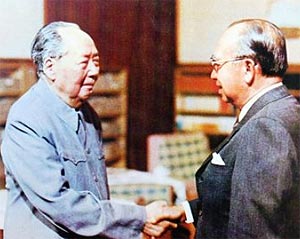 Still, it is clear that Chua’s mindset remains stuck in 1974 when the Chinese community in Malaysia responded enthusiastically to Malaysia’s establishment of diplomatic relations with China under Abdul Razak Hussein’s administration by voting overwhelmingly for Barisan Nasional. Today, the China card has lost its magic spell as Malaysians of Chinese origin are more concerned about the state of the country that they live in.
When Najib Abdul Razak, the apprentice prime minister, announced last month the opening of Xiamen University’s overseas campus in Salak Tinggi in three years time, only the businessmen with lucrative contracts in mind were clapping their hands. Ordinary Chinese Malaysian parents would not be able to afford the exorbitant tuition fees, and would still prefer a fairer and more transparent admission system for public universities anytime.
Meanwhile, for those Chinese Malaysians who are disgruntled with national politics and would like to vote with their feet, their choice destination of migration are almost always Singapore, Australia, the US and even the gloomy Britain, but hardly China.
Ignoring China’s influence at one’s own peril
Having said that, one ignores China’s growing influence at one’s own peril. It is fast becoming the biggest economy, and has been playing a more prominent role in the international arena. Now that the US has realised the failure of containment, there is no reason for Malaysia not to further cultivate ties with China.
The invasion of Iraq in 2003 and the catastrophic consequences thereafter have also exposed in full the dangers of a world dominated by Washington and London, Malaysia would have everything to gain if there are other powers such as China and Russia that can strike a balance whenever necessary.
Given the territorial and historical disputes involving many countries in the Asia-Pacific region, institutions such as the Asean Regional Forum and Apec must be strengthened in order to minimise the risk of war.
As Robert Keohane, a US scholar, argues in his seminal book After Hegemony , international cooperation can occur even among purely self-interested states when there are mutual interests. It would therefore be self-destructive for any Malaysian government not to engage China, or India for that matter.
But one must also be cautious as to not put all the eggs in one basket. Since the 1980s, Malaysian industries have become over-dependent on Japan thanks to Mahathir Mohamad’s obsession with “Asian values” and almost xenophobic anti-west sentiment, with the result of rising costs and lack of alternatives.
 I need not repeat here the national car industry that is modelled predominantly on Japan’s, only costlier and an extravagant fantasy in the first place. There has not been much technological transfer either and the relationship invariably tilts towards Japan, to the detriment of Malaysian industries that rely heavily on expensive Japanese imports. The Japanese are indeed laughing all the way to the bank.
Similarly, current and future Malaysian leaderships must bear in mind Beijing’s mercurial behaviour at times. Since Malaysia and China do have overlapping claims in regard to parts of the Spratly Islands, how the two countries can ensure a smooth partnership without descending into the kind of jingoism and belligerence among China, Japan, Vietnam and the Philippines will be a major challenge.
Although Malaysia has expressed keen interest in adopting some key Chinese technologies such as weaponry, it is not entirely certain at this stage whether it would bear fruit due to the territorial issues being, understandably, uppermost in the minds of the Chinese leaders.
The worsening tensions in the region have alarmed China so much that Beijing has delayed further talks on the long-proposed Code of Conduct on the South China Sea. In view of this, Malaysia cannot afford to be as ill-prepared in dealing with China as has been the case with the on-going Sulu conflict and there must be a blueprint for a realistic, comprehensive yet pragmatic engagement in the event of a new government.
Malaysia under a new leadership must do its utmost to encourage China and other states to adhere to the principles of non-alignment, supremacy of international law, equity and goodwill, as Russia and India have shown. But all this is beyond the comprehension of a third-rate leader by the name of Chua Soi Lek, and all the more so when MCA has, as I wrote years ago, never been privy to foreign policy-making in the real sense.
JOSH HONG studied politics at London Metropolitan University and the School of Oriental and African Studies, University of London. A keen watcher of domestic and international politics, he longs for a day when Malaysians will learn and master the art of self-mockery, and enjoy life to the full in spite of politicians.


Are you sure you want to delete this comment?
This action cannot be undone.