




Turkey, M'sia and the US
The waves of protests in Turkey have put Anwar Ibrahim and PAS leaders in a dilemma. On one hand, the brutal crackdown there resembles the very heavy-handedness of Umno, with Recep Tayyip Erdogan declaring that “the social media is the worst menace to society”; on the other hand, Erdogan and his Justice and Development Party (AKP) are perceived as a model of Islamic democracy.
PAS vice-president Husam Musa visited Istanbul just after he lost in GE13; Anwar often quotes Erdogan to enhance his own image as a moderate Muslim leader in South-Eeast Asia. Now their silence on the violent protests across Turkey is regrettable.
To be fair, Umno is similarly quiet, for Erdogan’s merciless clampdown on dissent is something that Dr Mahathir Mohamad and Najib Abdul Razak has long agreed with.
The waves of protests in Turkey have put Anwar Ibrahim and PAS leaders in a dilemma. On one hand, the brutal crackdown there resembles the very heavy-handedness of Umno, with Recep Tayyip Erdogan declaring that “the social media is the worst menace to society”; on the other hand, Erdogan and his Justice and Development Party (AKP) are perceived as a model of Islamic democracy.
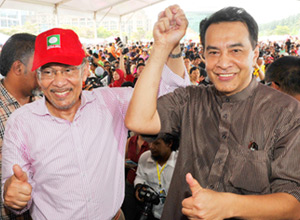 PAS vice-president Husam Musa (
right in photo
) visited Istanbul just after he lost in GE13; Anwar often quotes Erdogan to enhance his own image as a moderate Muslim leader in South-Eeast Asia. Now their silence on the violent protests across Turkey is regrettable.
PAS vice-president Husam Musa (
right in photo
) visited Istanbul just after he lost in GE13; Anwar often quotes Erdogan to enhance his own image as a moderate Muslim leader in South-Eeast Asia. Now their silence on the violent protests across Turkey is regrettable.
To be fair, Umno is similarly quiet, for Erdogan’s merciless clampdown on dissent is something that Dr Mahathir Mohamad and Najib Abdul Razak has long agreed with.
In any case, Erdogan perhaps underestimated the groundswell of discontent against his increasingly authoritarian rule.
He was once a heavyweight in the now defunct Refah Party (Welfare Party) - which had a hidden Islamist agenda and formed a coalition government along with others in the 1990s - only to be forced out of power in 1997 by the Turkish military which saw itself as the guardian of Ataturkism and secularism.
It is worth mentioning here that PAS, having realised that an outright Islamic platform could cost it votes, took a leaf from Refah’s book and started to talk about the welfare state after 2004.
Refah quickly recouped and rose to become the AKP. By far, it is the most successful Islamist-based political party in Turkey’s history since the 1920s. But Erdogan, after three electoral victories in a row, began to lose his sensibility by mistaking the strong endorsement of him as a mandate to Islamise further a country that is rooted deeply in a secularist tradition.
'Erdogen overplayed his influence'
Over the last few years, AKP started to regulate more tightly the sale of alcohol and increase religious classes in schools, while encouraging public servants - including bus drivers - to take a longer break for Friday prayers. Recently, Turkish Airlines, the national carrier, banned its female aircrew from wearing red or dark pink lipstick and nail polish, and AKP was widely perceived as having a hand in the controversy.
The order was only overturned last month after widespread public outcry .
To his credit, Erdogan moved shrewdly to curtail the once immense powers enjoyed by the Turkish military, landing many generals in jail. Given Turkey’s history of military intervention in politics, the bloodless counter-coup initially went down very well with the people, but Erdogan has now appeared to have overplayed his influence by behaving like just another pasha (general), albeit one who is without a uniform, and strong on religion.
After all, strong mandate does not necessarily mean unreserved endorsement for a full marriage between religion and politics.
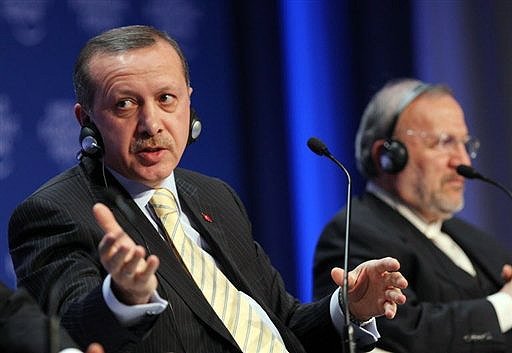 Externally, Erdogan (
left in photo
) has been a boon to the United States. He keeps a close watch on religious extremists at home, portrays himself as a Muslim leader with whom Washington can do business, and has gone out of his way to support the Syrian rebels.
Externally, Erdogan (
left in photo
) has been a boon to the United States. He keeps a close watch on religious extremists at home, portrays himself as a Muslim leader with whom Washington can do business, and has gone out of his way to support the Syrian rebels.
He even openly suggested of a regime change in Syria. Little wonder that Bashar al-Assad, the Syrian president, has remarked caustically and sarcastically that Turkey - now engulfed in domestic turmoil - is a dangerous country to visit.
As I have written before, the Syrian conflict is not one that is ‘good vs evil’ in nature, but an epitome of strategic conflict at a global level. It is a proxy war that involves the US, Britain (always the loyal poodle) and Arab countries that are ill at ease with a hostile rival to their north on one hand, and with Russia and Iran on the other.
It was in this very conflict that Erdogan saw an opportunity to win over the Americans. He declared in no time which side he was on, and started to provide logistical support in an attempt to destabilise Syria further. Since 2003, Erdogan has put hundreds of journalists in jail and come down hard on political dissidents - both Islamist and secular alike - and Washington could barely lift a finger to protest.
An awkward alliance?
Hence, the world has seen an awkward alliance made up of the US, Britain, Turkey, Saudi Arabia and Qatar ganging up against Syria (with Iran in sight, of course).
It is awkward because these countries - on the political spectrum - range from left (liberal) to the middle (somewhat democratic) to the right (downright autocratic), yet together they have stated unashamedly to the world that they want to get rid of the undemocratic regime of al-Assad.
However, it seems now that Washington may pay a price for having helped to radicalise the situation in Syria over negotiations since 2011.
Which is the very reason why I was among the first to oppose proposals by some Malaysians who were disgruntled by the outcome of GE13 to take the case to the White House.
The idea was half-baked and wrong, because if done, we would be sending a very wrong signal that we were inviting a foreign power that has condoned human rights violations in other parts of the world - Saudi Arabia, Qatar, the United Arab Emirates, Singapore, Thailand, Vietnam and Turkey - to help us topple BN.
Strategically, it would simply backfire and play into the hands of Umno which has been labeling Anwar and Pakatan Rakyat supporters as traitors!
And the effort will no doubt come to naught. Why? Because Malaysia has always been a model pupil when it comes to the US global strategy in South-East Asia. As long as US interests are assured, there is no incentive for Washington to take sides.
We do have oil reserves, but not rich enough for the Americans to do what they have been doing in Iraq and Iran; our foreign policy is indeed anchored in neutrality in accordance with the ‘Non-Aligned Movement’ spirit, but it is not so antagonistic that the US should devote its precious resources and money to destabilise a Washington-friendly Umno.
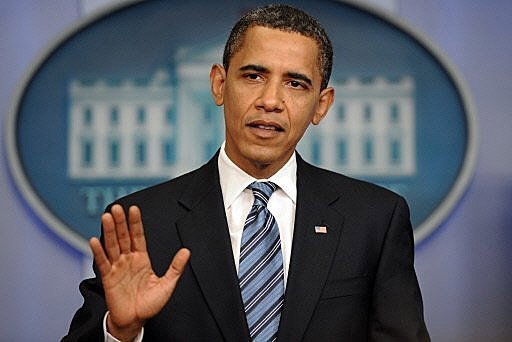 The US is even happy to sideline Taiwan if pleasing China would suit its agenda better.
If George W Bush and Barrack Obama ( right ) can have turned a blind eye to what Erdogan has been doing in Turkey, what hopes do we have in calling for foreign intervention? Just ask the people in the Ryukyu Islands , who have lived through bleak US occupation and are now made to endure Japanese colonialism.
My advice is for Anwar and PAS leaders to stop looking to Erdogan and AKP as a role model. If anything, the popular uprisings in Turkey have more in common with the pent-up frustrations felt by a large chunk of the Malaysian population.
The protests are a total reaction to arrogance and corruption on the part of the ruling elites, and Pakatan Rakyat should seize the opportunity to declare its support for the Turkish people who, like millions of Malaysians, are brave enough to say no.
More importantly, the PAS leadership should reflect earnestly if the mandate given by the people symbolizes the green light for an Islamic state.
After all, what is there to lose when you no longer have the superpower on your side?
JOSH HONG studied politics at London Metropolitan University and the School of Oriental and African Studies, University of London. A keen watcher of domestic and international politics, he longs for a day when Malaysians will learn and master the art of self-mockery, and enjoy life to the full in spite of politicians.


Are you sure you want to delete this comment?
This action cannot be undone.