




Saudi Arabia's religious extremism
As the crisis in Egypt continues to unfold, what is no longer in dispute is the fact that the old forces have made a strong comeback now that the Muslim Brotherhood's leaders are either in jail or under house arrest.
As the crisis in Egypt continues to unfold, what is no longer in dispute is the fact that the old forces have made a strong comeback now that the Muslim Brotherhood's leaders are either in jail or under house arrest.
The Barisan Nasional government is quietly gleeful over the disarray in the largest Arab country, having feared that the wind of change across the Muslim world could also spread to Malaysia.
Meanwhile, Mahathir Mohamad is likely delighted at the news that Hosni Mubarak, the former dictator ousted by the Egyptian people more than two years ago, has been cleared of one corruption case and may be granted conditional release.
Needless to say, the losses of precious lives on the streets of Cairo and in other parts of the country are most tragic. It ought to, however, be stressed that the merciless and senseless killing of civilians is being committed with Washington-provided weapons, while King Abdullah of Saudi Arabia has thrown his full weight behind the military-backed government in Cairo.
As the bloodbath in Egypt shows no sign of relenting, it is indeed ironic to witness the heartland of Islam turning a blind eye to the rising death toll.
The Muslim Brotherhood’s short-lived leadership had no doubt courted much criticism, but it surely did not deserve the massacre of peaceful, bare-handed protesters.
If anything, a Muslim Brotherhood with an universal appeal to the Ummah (Muslim communities) worldwide would not serve the interests of the House of Saud in Riyadh, which has been considering itself the sole defender of Islam. Much has been written about the rise of Wahhabism and its proselytising mission across the globe in recent decades, especially to Pakistan, Egypt and Central Asia.
The Saudi authorities have been adhering to this strict form of Islam which insists on a literal interpretation of the Quran. Beginning in the 1970s, Riyadh has been funding Wahhabi-inspired Islmaic charities and missions in many Muslim countries, giving rise to a monothilic version of Islam that is the ‘norm’ today. The wealth generated through massive oil profits only ensures that such programmes can go on unabetted as long as they benefit the Saudis.
But there is clearly a geopolitical agenda for Saudi Arabia to adopt Wahhabism and to regard those who do not practise it as ‘heathens’ and even ‘enemies’, since the Saudis’ Islamic programmes are conducted with a purpose of gaining political legitimacy within the Muslim world.
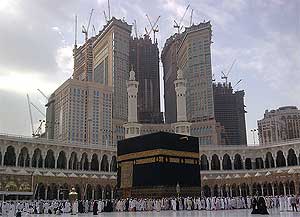 Given the paramount importance the Holy City of Mecca, it is no surprise that the Saudis are quick to raise their own religious profile by prescribing a set of rigid tenets that would work to their advantage in the long run. Whatever the origins of Wahhabism, there is no denying that it has since evolved into an ultra-conservative movement and highly politicised school of thought.
The explosive growth of Wahhabism has also led to the destruction of other Islamic relics and heritage in Saudi Arabia, as their continued presence would make it difficult for the authorities to justify the dominant doctrine as the only way for seeking out 'truths'.
Greatest irony
Still, the greatest irony lies in the fact that the United States and its western allies have been waging war against terror around the globe, but are yet to pay serious attention to the Saudi-promulgated doctrine that has subjected many - women in particular - to tutelage in the name of religion.
Thanks to its vast oil reserves and geo-strategic values, Riyadh has been spared the usual bashing by Washington over human rights violations that commonly befalls other autocracies such as Syria and North Korea. Even Iran, with at least some form of democratic process, is contantly portrayed by the western media as a far more menacing villain than Saudi Arabia.
More ironic is that the House of Saud, provided its rule and interests are secure, is ever willing to maintain the status quo, ie. not openly questioning and challenging the existence of Israel. Seen in this light, Muhamad Morsi’s ‘sin’ in expanding his Islamic vision to include also Gaza must have been so perfidious for which it could not be fully atoned short of a removal from power.
Hence, why would one still believe in the good faith of the Egyptian military when its strongest backer Washington is condoning the tyranny of the House of Saud while having condemned the Muslim Brotherhood for the latter’s ‘authoritarian’ tendencies?
More than two decades ago, the late Samuel P Huntington rose to fame with his Clash of Civilisations argument. What the great political thinker failed to appreciate was that the web of power is invariably complex and elastic, and power alignment is not necessarily reached along the lines of culture, faith and creed, as testified to by the amazingly harmonious relations between Washington and Riyadh, their opposing religious ideologies notwithstanding.
Although Malaysia is traditionally perceived to be a country in which moderate Islam prevails, the recent spate of religious incidents have demonstrated a clear pattern of Islamic hegemony, the controversy over a surau used by a group of Buddhists in Kota Tinggi being the latest case in point.
Much I once applauded the generosity of Malaysian Islam, my fear is that we have perhaps arrived at the point of no return on the path to full-blown religious conservatism even without Wahhabism taking root.
JOSH HONG studied politics at London Metropolitan University and the School of Oriental and African Studies, University of London. A keen watcher of domestic and international politics, he longs for a day when Malaysians will learn and master the art of self-mockery, and enjoy life to the full in spite of politicians.


Are you sure you want to delete this comment?
This action cannot be undone.