




Campaign against paraquat use gains momentum
Muniamah, a worker on an oil palm plantation in Malaysia, wakes up at 4am every day to cook for her husband, in-laws and children before she reports for work.
A mother of seven schoolgoing children, she is also the sole breadwinner in the family as her husband is sick.
 She earns between RM200-300 per month, but cannot earn more as she is chronically unwell herself, with headaches, backache and a rash on her hands and legs.
"I have no choice (but to push on). The children need to eat. I have no other skills and I am no longer young," said Muniamah, 46.
Ratini, 44, said she was seven months pregnant when she informed her Indonesian employer of her condition - and was scolded for having 'cheated' by having taken a day's leave allocated each month to menstruating women.
The management deducted her salary for those days and forced her to spray pesticide even during her pregnancy, she said.
"I could not ask for another job. I continued spraying till the month I gave birth and my baby was small compared to my previous children," said the mother of six.
 "He only weighed 2 kg compared to my eldest child who weighed 5 kg. After three months, my son developed rashes on his legs and body and I had to buy medicine for him."
In The Philippines, Joy, 42, has had a persistent itch on her hips and legs for more than a month. She has tried all kinds of creams from the local sundry shop to treat the condition, but to no avail.
She cannot take time off from work on a farm to seek treatment at the nearest clinic, a two-hour bus ride from where she lives.
They maybe countries apart but these women have several things in common - poverty, work- related problems, poor health and the fact that they are sprayers of the herbicide, paraquat.
Muniamah, a worker on an oil palm plantation in Malaysia, wakes up at 4am every day to cook for her husband, in-laws and children before she reports for work.
A mother of seven schoolgoing children, she is also the sole breadwinner in the family as her husband is sick.
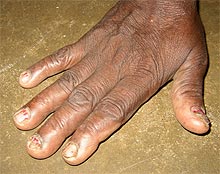 She earns between RM200-300 per month, but cannot earn more as she is chronically unwell herself, with headaches, backache and a rash on her hands and legs.
"I have no choice (but to push on). The children need to eat. I have no other skills and I am no longer young," said Muniamah, 46.
Ratini, 44, said she was seven months pregnant when she informed her Indonesian employer of her condition - and was scolded for having 'cheated' by having taken a day's leave allocated each month to menstruating women.
The management deducted her salary for those days and forced her to spray pesticide even during her pregnancy, she said.
"I could not ask for another job. I continued spraying till the month I gave birth and my baby was small compared to my previous children," said the mother of six.
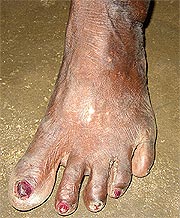 "He only weighed 2 kg compared to my eldest child who weighed 5 kg. After three months, my son developed rashes on his legs and body and I had to buy medicine for him."
In The Philippines, Joy, 42, has had a persistent itch on her hips and legs for more than a month. She has tried all kinds of creams from the local sundry shop to treat the condition, but to no avail.
She cannot take time off from work on a farm to seek treatment at the nearest clinic, a two-hour bus ride from where she lives.
They maybe countries apart but these women have several things in common - poverty, work- related problems, poor health and the fact that they are sprayers of the herbicide, paraquat.
Tenaganita, a migrant workers' lobby group in Malaysia, said most women sprayers are above 30 years of age and that they have no skills for other kind of work within a rural economy or plantation environment.
"In the factory, they would stop work at 45 but in the estate they can work up to the age of 55. The estates provides housing, which is a major concern to them," explained its director Irene Fernandez.
"With a roof over their head, the children can be with them and they manage with a little extra money by working overtime. It is a familiar environment to them."
Ban on paraquat
Paraquat has been banned by 13 governments to date, following a long history of connection to poisonings and deaths. It is acutely toxic, has no antidote and has been labelled one of the 'dirty dozen' chemicals by the Penang-based Pesticide Action Network, Asia-Pacific (PAN-AP).
But it is still widely used in 120 countries for the production of maize, fruit and vegetables, rice, sugarcane, bananas, cereals and other crops.
Last year, the European Commission's Standing Committee on the Food Chain and Animal Health approved paraquat for use in member-states under its Pesticide Authorisations Directive.
"But the decision was not unanimous," noted PAN-AP executive director Sarojeni V Rengam.
"The Swedish government is now suing the commission for misjudging the risks associated with the use of paraquat, and disregarding its duty of protection," she said.
Sweden alleged that the commission has "overstepped the limit of its discretionary powers by infringing the precautionary principle in connection with the risk assessment and risk management of paraquat".
The case is pending before the Court of Justice of the European Communities. Six public interest organisations have also initiated legal action against the EU in the European Court of First Instance, calling for annulment of the decision.
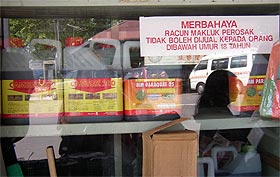 In Malaysia, the herbicide is mainly used on oil palm plantations, but is commonly available from grocery shops as well, as a random check in the northern region showed recently.
A long struggle to have it banned paid off in 2002 when the government announced that all new applications to register or re-register the herbicide would be rejected. The ban will take effect next year.
Malaysia thus became the first Asian country to say 'No' its use, on grounds that this poses unacceptable risks to the main users - and that less risky alternatives are readily available in the market.
Early last month, legislators considered amendments to the Pesticide Act 1974 when these were debated in the Dewan Rakyat.
Agriculture and Agro-based Industries Deputy Minister Mohd Shariff Omar, who tabled the amendments, said greater control was sought over research into, and experimentation with, unregistered pesticides, as well as an increased penalties and stricter control over labelling.
However, concerns have since arisen as to whether the ban will indeed be implemented because Syngenta, the biggest producer of paraquat, and the local oil palm industry have continued to lobby very strongly for the decision to be overturned.
Sarojeni said she was confident that the ban would not be lifted.
"If the government revokes the ban, it would be in bad faith as it would clearly indicate that they are not concerned about the effects of such pesticides on workers and farmers," she said.
Concerted campaign
PAN-AP has been campaigning for a global ban on paraquat through signature campaigns, awareness raising and training programmes for farmers.
Next month, it will work with more than 100 grassroots organisations in Asia, to organise the People's Caravan 2004 for Food Sovereignty, aimed at asserting rights to land and productive resources.
The caravan will travel to 13 Asian countries and hold several programmes such as seminars, public meetings, dialogues with local officials, rallies, film festivals, exchange of seeds, cultural presentations and food festivals as it moves from one country to another.
Culminating in Nepal, the Caravan will advocate agricultural reform that will give poor peasants access and control over land, seeds and water; yields which are free of pesticides and genetically modified organisms; guarantees of ecological production methods; support for the rights of women farmers; and ways to strengthen the communities in rural areas.
The impact of pesticides like paraquat on the lives of peasants, farmers and agriculture workers will feature strongly during the event, which is expected to involve about 50,000 participants from various sectors.
SUSAN LOONE is a researcher at Pesticide Action Network Asia-Pacific, a regional non-governmental organisation based in Penang, Malaysia.


Are you sure you want to delete this comment?
This action cannot be undone.