




How do we fare after 47 years of independence?
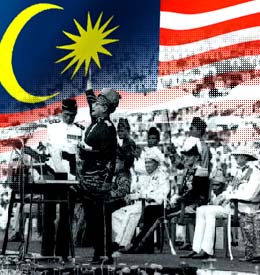
This August 31st, the nation will formally celebrate its 47th Merdeka Day, even though many in Sabah and Sarawak consider that their independence was only achieved after they joined Malaysia 41 years ago (in 1963).
This August 31st, the nation will formally celebrate its 47th Merdeka Day, even though many in Sabah and Sarawak consider that their independence was only achieved after they joined Malaysia 41 years ago (in 1963).
Once again, grand celebrations will be held, this time in Kuantan. But has Merdeka ended all the fundamental problems faced by the nation and her rakyat? Let us focus on two such problems in the field of politics and the economy.
 During the colonial days, Britain had formed the multi-racial society in Malaysia (Malaya at that time) by encouraging immigration of labourers and others especially from China, India and Indonesia. These immigrants can be said to have carried out separate economic, cultural and religious activities, spoken their own languages, and lived in areas and communities of their own. In that manner, the British could easily govern using the "divide and rule" principle.
Now, after independence, the same principle is still being practised. Even after the passage of so many years, it is still clearly evident during every general elections. At such times, racial and religious issues will be fanned using the government machinery and the government-controlled media to evoke fear of things like curfews, tension and even racial strife which will supposedly take place should the Barisan Nasional government fall.
The important institutions are still divided up and allocated according to race and religion. There is no well-planned policy direction and nurturing of programmes to ensure more rational fairness and balance for the Malays in economic activities and small- and medium-scale industries, and for the non-Malays in the public administration sector.
Even though through the education system, the granting of scholarships and the quota system, the number of Malays in various professions (such as doctors, engineers, accountants, etc.) have increased, it is still seen as inadequate. Unfortunately, the issues of scholarships and quota have become tainted by racial overtones and do not contribute towards racial harmony.
Signs of the split
There is no political will, especially on the part of the ruling coalition, to form political parties which are multi-racial in make-up and basis. Practically all the component parties of Barisan Nasional each champion a single race, and mainly speaks up for that one race.
By right, so many years after independence, political parties and politics based on race should not be encouraged any longer. As it is, there is insufficient incentive and motivation to open the doors in the armed forces and the police, and to attract non-Malays to join them. It is true that the Chinese are averse to joining the armed forces and the police, but has there been enough effort and encouragement to draw them?
Unfortunately, the dividing up of important institutions is more conspicuous and getting worse day by day. In the education system, from primary school to university levels, the signs of the split are ever more serious and evident. The system has engendered a gulf which stemmed not only from the medium of instruction, but also from the background, race and economic stratum of the students.
In the health services sector, more and more private hospitals being built to supplement the government-run hospitals actually serve to attract patients according to their economic stratum and race. And with an increasing number of hospitals built by a certain race, they are sure to focus on patients from that race.
It is not my intention here to restrict the freedom to build private schools, universities and hospitals. What I am trying to highlight is the sad lack of vision, policies and programmes on the part of the goverment to control the various forms of division and differences which have cropped up. Division and differences which can drive our society towards the hell of irreconcilable racial strife and discord.
The danger currently lies in schools, universities and hospitals which have been built outside the system due to feelings of dissatisfaction, being marginalised and disunity in the hearts of certain races. That was a form of opposition by the races.
Similarly, the reluctance of certain youths to participate in the National Service represents their opposition to various matters which they considered as unfair. They feel so marginalised and so deprived of their rights as citizens that they were willing to oppose whatever the risk of doing so may be.
Non-productive activity
The root causes of the problem must be studied, identified and overcome.
If not, efforts to build racial harmony are doomed to fail however many times we celebrate Merdeka, however many thousands of Jalur Gemilang are flown and however many times the nation's leaders appeal for harmony, patriotism and such.
When the rakyat, in particular the Malays, fought for independence, they hoped to bring about big changes in the fortunes and standard of living of the rakyat.
This nation is blessed with many resources. Unfortunately, under colonial rule, a large percentage of Malays had been trapped in traditional economic activities which were not very productive.
Many of them lived in poverty, and had poor access to education, health services and proper housing.
Admittedly, after 47 years of independence, many changes have taken place and the Malay standard of living has improved. The poverty rate has dropped from nearly 60 percent to approximately 10 percent. But even though the number of hardcore poor has decreased, actual relative poverty has worsened.
The relative gulf between the rich and the poor, or between the haves and the have-nots, has widened because wealth has been concentrated in the hands of a few who had easy access to lucrative opportunities due to their close links to those who monopolised power.
There have been frequent statements about the ever-widening chasm between the Malays and the non-Malays (in particular the Chinese), and between the kampung (village) folks and urbanites. And not any less seriously, about the chasm between the small group of elite Malays who are fabulously wealthy and the much larger number of Malays who are poor or have just an average
standard of living.
Even though in general the incomes of the lower and medium strata, or the low and medium income groups, have risen, inflationary effects on the prices of necessities and social services like health, education and housing have meant that their standard of living has deteriorated.
Malay Agenda
In the past few weeks, numerous Umno leaders and the Malay media have raised the Malay Agenda issue. They lament that the success of the Malays is more appearances than reality. They mutter that the Malays are still left behind compared to the non-Malays.
The New Economic Policy (NEP) stressed heavily on creating a group of crony corporate figures in business and industry. That has not been very successful. Even though the cronies amassed vast personal wealth, the big firms entrusted to them are almost failures.
As both Merdeka Day and the Umno general assembly draw near, the whispers and muttering about the fate of Malays grows louder and louder. If there is truth in what they allege, what has been done by the top echelon of government since independence? Or are those who complain merely playing to the galleries?
Dr SYED HUSIN ALI is a vice-president of the Parti Keadilan Rakyat. This article was first published in Suara PRM .


Report this comment
Are you sure you want to delete this comment?
This action cannot be undone.