




The fairer side of Malayan communism
Given her academic credentials, command of three languages and various Chinese dialects, as well as 15 years of exposure to Europe and Asia, Singapore-born Agnes Khoo could have reaped riches and influence by penning the biographies or speeches of some powerful ruling politicians or businessmen.
However, the 40-year-old PhD candidate at Britain's University of Manchester, has decided to do something she feels is more meaningful intellectually and fulfilling morally. She recently published a book compiling the oral accounts of the life experiences of 16 female rank-and-file members of the Communist Party of Malaya (CPM) now residing in southern Thailand.
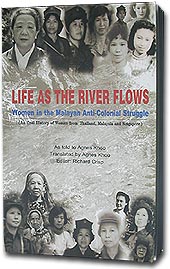
The book is titled ' Life As The River Flows - Women In The Malayan Anti-Colonial Struggle' (Kuala Lumpur, SIRD, 2004)
Given her academic credentials, command of three languages and various Chinese dialects, as well as 15 years of exposure to Europe and Asia, Singapore-born Agnes Khoo could have reaped riches and influence by penning the biographies or speeches of some powerful ruling politicians or businessmen.
However, the 40-year-old PhD candidate at Britain's University of Manchester, has decided to do something she feels is more meaningful intellectually and fulfilling morally. She recently published a book compiling the oral accounts of the life experiences of 16 female rank-and-file members of the Communist Party of Malaya (CPM) now residing in southern Thailand.
The book is titled ' Life As The River Flows - Women In The Malayan Anti-Colonial Struggle' (Kuala Lumpur, SIRD, 2004)
Childhood curiosity
 According to Agnes, her curiosity about the Malayan communists began as a child in Singapore, where her father, after involving himself in organising the International Labour Day celebrations in 1965, was detained under the preventative security law for allegedly being a communist.
The disappearance of her father in what she now calls 'white terror' took place just several weeks after Agnes was born. For a while, she was communist-phobic but it later became a kind of curiosity.
Agnes said her school textbooks failed to satisfy her curiosity, not only about who the Malayan Communists were but also the history of independence in Singapore and Malaysia.
So, the search for more convincing answers continued even though she had already read Karl Marx as part of her university's sociology course.
Agnes's personal experience and search is not unique: thousands of working class children born in Peninsular Malaysia and Singapore in the 1960s or early 1970s quietly share with her all or some elements of the circumstances, as well as the curiosity.
However, Agnes is still exceptional because, having succeeded in her quest for answers to her childhood questions, she has never forgotten her roots.
In fact, she is proud to be identified with them, in her academic project, even as the highly educated intellectual, she now is. The great Italian Marxist and anti-fascist Antonio Gramsci (1891-1937) called this kind of intellectual 'organic'.
In the collection, the 16 female rank-and-file members of the Communist Party of Malaya who told their stories to Agnes are Lim Guan Ying, Chen Xiu Zhu, Zhu Ning, Cui Hong, Luo Lan Luo Yue Er, Zhao Ya Yin Qiang Lin, Meng Yue Ying, Huang Xue Ying, Ropiah binti Mat Yatin Mk Chu, Siti Meriyam binti Idris Atom, Xioa Hua, Feng Su Qiong, Xiu Ning, Guo Ren Luan Lin Mei and Guan Shui Lian.
Confronting circumstance
They told Agnes their personal stories or histories as warriors, daughters, lovers, mothers and grandmothers. These personal stories are also often intertwined with the political environments, within which they found themselves having to make choices and decisions.
These circumstances included the Japanese invasion and occupation, the war of resistance, liberation, the return of British colonialism, the period between 1945 and 1948, the 'emergency' in between 1948 and 1960, the second 'emergency' in the 1970s and the period leading to the signing of the 1989 Peace Accord between the Communist Party of Malaya and the governments of Malaysia as well as Thailand.
Indeed, as Karl Marx himself insightfully observed: "Men (and women) make their own history, but not of their own free will; not under circumstances they themselves have chosen but under the given and inherited circumstances with which they are directly confronted." ( Karl Marx, The Eighteenth Brumaire of Louis Bonaparte in Survey From Exile , London, Penguin, 1977)
In other words, at the time of the Japanese invasion and occupation, there was no PAP, Umno, MCA, MIC, DAP, PAS or Keadilan. The some 80,000 British troops were either forced to retreat to India or Australia or interned as prisoners of war after only 70 days of defence.
There was only the Communist Party of Malaya which rose to the occasion and took up the challenge, armed the people and led and empowered them to resist tyranny and barbarity.
To assist readers, especially younger ones, to maintain a linear time-line to follow the stories a brief outline of historical background marked by years and important happenings is provided at the beginning of the book.
This is certainly very helpful as an intellectual tool to read memoirs, biographies or autobiographies.
Like Alias Chin Peng: My Side of History (Singapore, Media Masters, 2003), this collection of stories told by the Malayan Communists is important for us to gain insight into the human ideas and passions prevalent in different circumstances or eras. Such ideas can never be quantified in bar charts, statistical surveys or operational research or graphs in ISO 9200 offices, or legalistically simplified into the courtroom question of 'answer-me-yes-or-no'.
Equally interesting is that in all their narratives or story-telling, none of the female Communists told us that before they made up their minds to join the Communist Party of Malaya and before the party decided to accept them, did they have to complete textual, semantic or epistemological or ontological analyses of Karl Marx's three-volume Das Kapital and the Grundrisse .
Under the given or inherited circumstances, they, like millions around them all over the world including Europe, just made decisions to respond, in manners they then saw as the most effective, to what they then felt to be an exploitative and oppressive society.
Of course, memories being memories, the oral accounts may contain factual errors and mistakes on the parts of the sixteen female members of the Communist Party of Malaya, either due to the process of aging or incomplete knowledge or understanding of situations which existed years ago. It is all understandable for normal human beings.
Life As The River Flows - Women In The Malayan Anti-Colonial Struggle has another edition in Chinese. It is a soft book that is nevertheless filled with hard lessons for all.


Are you sure you want to delete this comment?
This action cannot be undone.