




The Anwar dilemma
 When Anwar Ibrahim was sacked by Dr Mahathir Mohamad in 1998, some Malaysians had more than a few things to say about the two leaders. After all, they were from the same party and had shared the same faith in the corrupt system.
Clearly, the economic crisis of 1998 had exacerbated their already strained relationship. It is no secret that Mahathir needed funds to bail out his cronies and Anwar, as the finance minister, was standing in his way. Anwar too had his own cronies and the battle lines were drawn between the two men.
Similarly in 1987, when Razaleigh Hamzah took on Mahathir, it was also against the backdrop of an economic crisis. Economic crises ultimately lead to political crises, and this has been repeated many times in history.
So what is the difference between Mahathir and Anwar?
When Mahathir was the deputy prime minister, non-Malays were very worried. He was seen as a racist, as he kept harping on the issue of Malay unity and Malay rights over everything else. This same accusation was leveled at Anwar when he was Umno Youth leader, and later deputy prime minister.
 When Anwar Ibrahim was sacked by Dr Mahathir Mohamad in 1998, some Malaysians had more than a few things to say about the two leaders. After all, they were from the same party and had shared the same faith in the corrupt system.
Clearly, the economic crisis of 1998 had exacerbated their already strained relationship. It is no secret that Mahathir needed funds to bail out his cronies and Anwar, as the finance minister, was standing in his way. Anwar too had his own cronies and the battle lines were drawn between the two men.
Similarly in 1987, when Razaleigh Hamzah took on Mahathir, it was also against the backdrop of an economic crisis. Economic crises ultimately lead to political crises, and this has been repeated many times in history.
So what is the difference between Mahathir and Anwar?
When Mahathir was the deputy prime minister, non-Malays were very worried. He was seen as a racist, as he kept harping on the issue of Malay unity and Malay rights over everything else. This same accusation was leveled at Anwar when he was Umno Youth leader, and later deputy prime minister.
It is perhaps mandatory for one to talk along racial lines if one wants to win the support of their own community and in this case, Umno. Thus, Mahathir and Anwar do not differ much in their styles on issues that made them the champions of the Malay community.
Anwar went along with Mahathir when Umno Baru was set up, when the judiciary was ripped apart with the sacking of Salleh Abas and five top judges, when the monarch's powers were curbed and when the draconian Internal Security Act was used against political opponents.
The pressure group that Anwar built, Abim (Malaysian Islamic Youth Movement) did not raise a finger in protest because they had been co-opted by the government.
Since then things have changed. Abdullah Ahmad Badawi is now prime minister, Mahathir has retired, and Anwar is back in the good books.
The release of Anwar last Thursday could not have come in a better time. It is perhaps the best tonic for the opposition after the landslide defeat in the recent elections.
Reigniting the opposition
The opposition, who had been so used to battling against Mahathir's iron fist in the past 20 years, found it baffling to fight against Abdullah's soft approach.
If one thought PAS would win the recent by-election because of sympathy votes, then the shock continued - BN won the election with an even higher majority. All indications were that we were heading towards the same path as Singapore, where there is almost no credible opposition.
The unexpected release of Anwar has rekindled the opposition spirit. Suddenly, Malaysian politics have become interesting again. Malaysian newspapers, which have only been highlighting rape, murder and crime, have again found some political news to write about.
Reading the editorials of major newspapers, it is clear that they want Anwar and his supporters to reconcile and forget the past. They kept repeating Anwar's own words - that he would not take vengeance on Mahathir.
 The worry is clearly written all over the face of Deputy Prime Minister Najib Abdul Razak - known to be closely linked to Mahathir. He kept insisting that Anwar is a Keadilan member and that the issue of him joining Umno will not arise.
Mahathir too was forced to call a press conference, backed by his wife and three children - an indication of how the news of Anwar's release had shaken him.
This, and the stock market reacting positively to Anwar's release, is a clear indication of the power and influence Anwar has on Malaysian politics as well as internationally.
Many who stayed away during the difficult period in the last six years have re-emerged. Keadilan, which was almost wiped out in the last election, has found new momentum. It is indeed time to rejoice for those who have been committed to the struggle of reform.
Having said that - and taking a line from Lenin that the role of the party is to be the memory of the people - it is important to list some past mistakes, so that history does not repeat itself. This can serve as a caution to the people, as well as to Anwar.
Worrying past
1) In 1969, at the height of the student movement, there was a call for Tunku Abdul Rahman to resign because of his failure the handle the May 13 incident. The student organisation led by Syed Hamid Ali (Socialist Club) called on Tunku to resign because the capitalist economy promoted by Tunku was allowing foreign capital to control the wealth of the nation.
This was different from the line taken by Anwar, who was leading the PBMUM (University Malaya Malay Language Society). Anwar blamed Tunku for giving in too much to the Chinese and his failure to uphold the Malay language by implementing the national education policy.
2) In 1982, Anwar joined Umno after being wooed by Mahathir. Most people thought that Anwar would join PAS after leading Abim for 11 years because of his Islamic background, but he was roped in by Mahathir to oppose PAS.
3) In 1987, during the Operasi Lallang, Anwar was the education minister. In spite of being arrested under the ISA in 1974, Anwar supported Mahathir's move in using the draconian law against the opposition. He officially stated that Mahathir had no choice but to use the ISA because the opposition did not want to back down.
Another worrying aspect of Anwar is his relationship with the US. Though this might not be true, it appeared that while Mahathir took a stand against the International Monetary Fund and put currency control in place, Anwar is said to have supported moves to further liberalise and globalise Malaysia's economy.
Dr M Mahadevan, a famous psychiatric, once said that Anwar is like an egg. If you put fire on him, he won't melt, he will became hard. He said some people are like ice, they melt when you put fire on them, but not in the case of Anwar.
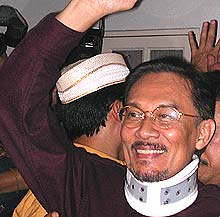 True to form, six years after his incarceration, being tortured and beaten during detention and publicly humiliated, Anwar has come out even stronger. So far, Anwar has made a principle stand on a number of issues including his call to continue the fight for reforms.
DAP and PAS have both welcomed the return of Anwar, and these two key opposition parties seem prepared to allow Anwar to take the lead.
It is without doubt that Anwar is the only person today who looks capable of uniting the opposition and to wrest power from the ruling BN coalition, and pave the way for a more democratic Malaysia, which respects human rights and democracy.
Beware of pitfalls
In order to do this task, Anwar has to be aware of three major pitfalls:
1) Anwar should be principled in building a multi-racial party and not fall into the trap of Semangat 46, who amended their constitution to include the word 'Malay', because they felt that they needed this to beat Umno. Their game was to be more Malay than Umno.
2) Anwar needs to work towards building a movement that would empower the people rather than building everything around himself. I can still remember immediately after Anwar and number of his key supporters were detained under the ISA in 1998, Abim members did not know what to do.
Over the past few years, the only thing they had learnt was how to cooperate with the government. That is why it didn't take that long for Mahathir to cripple the reformasi movement.
3) Anwar needs to safeguard the nation against global forces, whose agenda is to colonise the country using economic control.
The danger is still the same. Anwar told his supporters to wait for him to come back from his surgery in Munich, and he will tell them what plans he has. A movement cannot be built around one person.
In recent years, a lot of dedicated activists have emerged. This group of dedicated activists, with the exception of a handful, have been true to the reformasi struggle and have stuck to their principles. It is important for Anwar to consolidate this group.
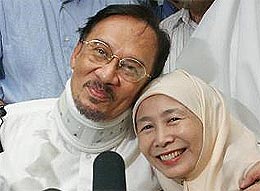 His wife, Wan Azizah Wan Ismail has also proven to be a dedicated, principled and a non-manipulative leader. She should continue to play an important role, as I believe she is the conscience Anwar needs in order to faithfully lead the opposition and not stray away.
While much hope has been rightly placed on Anwar's shoulders, the people must remain vigilant. If we have a bad leader, it is only because we allow it to happen. Let's build a multiracial Malaysia together, one that respects human rights, democracy and freedom.
S ARUTCHELVAN is Parti Sosialis Malaysia's pro-tem secretary-general and a member of the human rights group Suaram.


