




Was there a secret deal?
 Of course, if there had been a secret deal, it will only be known to the parties involved. Otherwise, it is no longer a secret. As such, if the freeing of Anwar Ibrahim resulted from a secret deal, it will be difficult to root out information about it, as none of those involved will openly admit it.
In any case, Prime Minister Abdullah Ahmad Badawi had to guarantee that there was no interference with Anwar's case, when the Federal Court was about to make its decision, and after Anwar had been freed, the PM had to deny rumours that there had been a secret deal made.
This means that the standing of the judicial system in our nation is still not quite right, and is not independent yet.
 Of course, if there had been a secret deal, it will only be known to the parties involved. Otherwise, it is no longer a secret. As such, if the freeing of Anwar Ibrahim resulted from a secret deal, it will be difficult to root out information about it, as none of those involved will openly admit it.
In any case, Prime Minister Abdullah Ahmad Badawi had to guarantee that there was no interference with Anwar's case, when the Federal Court was about to make its decision, and after Anwar had been freed, the PM had to deny rumours that there had been a secret deal made.
This means that the standing of the judicial system in our nation is still not quite right, and is not independent yet.
The guarantee of non-interference may give rise to these implications when linked to Anwar's case:
- Confirmation of the possibility of interference by former prime minister Dr Mahathir Mohamad in Anwar's case to ensure the success of the political conspiracy to sideline and oppress Anwar as has been alleged by Anwar and his supporters.
Zainur's case
 Those who have read 'Cerita Zainur Zakaria - Satu drama dalam 4 babak' (The Zainur Zakaria Story - A drama in four acts), which was distributed by the Free Anwar Campaign (FAC), may find it difficult to be believe that members of the judiciary were not deeply involved in a political conspiracy to oppress Anwar.
This includes how they were manipulated by the Attorney General's office, who used the death penalty under Section 57 of the ISA, as a negotiating instrument 'to gather false evidence involving five females (three married and two single), in the form which could be used against Anwar', as revealed in a letter dated Oct 12, 1998, from Manjeet Singh Dhillon, Nallakaruppan's lawyer, sent to the Attorney General, Mokhtar Abdullah.
From Anwar's final appeal hearing recently, it was also clear that after ten days of intensive questioning (read: torture) and 12 days in detention, Sukma Darmawan Sasmitaat Madja, who was supposed to be held as a witness, but was questioned as a criminal, ended up being charged in court, following his admission that he had allowed Anwar to sodomise him. That admission by Sukma was also used later as evidence to charge Anwar.
That, together with Anwar's black-eye episode, the oppression of Anwar's lawyer and the way the trial was conducted, all showed that justice was not being dispensed transparently. Instead, it was as though a political conspiracy closely orchestrated by the highest authorities was being played
out.
It cannot be denied that the political scenerio in our nation has changed greatly following Anwar's six year incarceration. Among others, Mahathir, Anwar's biggest enemy, has retired and lost a great deal of his influence.
Meanwhile, Abdullah has been appointed as the new prime minister, his grip on power in Umno and the Barisan Nasional growing stronger with each passing day.
General elections
Under his leadership, BN achieved a stunning victory in the last general elections in March. On the other hand, Barisan Alternatif (BA) disintegrated before the general elections, and in the confusion, BA suffered a terrible defeat.
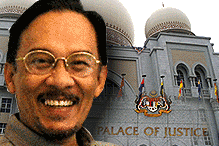 Consequently, if there was the possibility that Anwar's case, which was brutal proof of the government stomping on the freedom of the judiciary, being ended - and what's more via legal processes, leaving the burden of Anwar's case behind and in one stroke reviving the image of a free Malaysian judiciary - would such a decision from the Federal Court not be welcomed by Prime Minister Abdullah Badawi? Would it be so strange for Abdullah to use his influence to see that Anwar is freed?
That means that the present climate and political scenario favoured the settlement of Anwar's case.
Whether the secret deal, which was the subject of much coffee shop talk existed or not, Anwar's freedom appears to be welcomed by the parties involved, and an understanding, which looks harmonious at this stage, seems to exist between Anwar and Abdullah. Even the animosity between Anwar and Mahathir seems to be history.
It feels like a win-win situation, as the Malay saying 'buang yang keruh, ambil yang jernih' (discard the muddy, keep the clear) goes, is being embraced by some parties.
On being freed by the court, Anwar said, 'Praise be to Allah, everything has ended. I thank Pak Lah and hope that he will continue the political changes and correction in Malaysia.'
Short and meaningful. Suddenly Abdullah had become an Umno leader, who is acceptable to Anwar, even though he (Anwar) also stated his commitment to the Opposiiton.
When he was asked about his feelings towards former prime minister, Mahathir, Anwar said, 'I feel no malice towards Dr Mahathir.'
Forgiving attitude
Mahathir was also reported to have reciprocated Anwar's forgiving attitude by saying, 'I think that he is someone who is most kind hearted.' Even though 'somewhat shocked' at the freeing of Anwar, Mahathir had to accept the truth that the court had decided that Anwar was not guilty.
Abdullah's reaction to the freeing of Anwar was also positive. He considered the decision of the court as not threatening to the political stability and security of the nation.
 When asked if he will meet with Anwar to heal political differences, Abdullah replied that he had never quarreled with the former deputy prime minister. As such, he was ready to meet Anwar if that was what Anwar wanted.
On the possibility of Anwar returning into Umno's fold, he also did not close Umno's doors to Anwar, and only replied that the question should be posed to Anwar.
On top of that, Deputy Prime Minister Najib Razak also stressed that the government welcomed Anwar's intentions to cooperate with the government for the sake of the development of the rakyat and the nation.
At this stage, it appears that the freeing of Anwar is welcomed by all parties. In the first round, Abdullah has taken a strategic step and effortlessly placed himself in a dominant position. Dr Mahathir has been allowed to retire and be forgotten like a toothless tiger, and Anwar has his foothold in the opposition with his reformasi stance while maintaining good relations with Umno and the government, especially with Abdullah, who is also seen as a reformist.
In this situation, who is brave enough to say that Anwar is no longer relevant in the political turmoil of our nation?
He will most certainly be playing his part unless there is some major misstep - what is not certain yet is only what the part that will be, and which arena will be involved. I will touch on these aspects in future articles in the weeks to come.


