




Umnos Malay agenda
The 55th Umno general assembly, reportedly the largest ever with the attendance of approximately 2,500 delegates and more than 30,000 observers, is being held at the Putra World Trade Centre (PWTC) from Sept 21 to 25.
The general assembly this time is most important as it marks the beginning of a new era - the Abdullah era - in the politics of this country.
This new era, aside from providing continuity from the old era - the Mahathir era - it will also see the emergence of several new directions and policies in the political landscape as well as new challenges from both within and outside the nation, in line with the character and leadership style of the new Umno president, Prime Minister Abdullah Ahmad Badawi.
Aside from Abdullah and his partner, Najib Abdul Razak, who had won the posts of president and deputy president of Umno respectively without contesting, six top posts in Umno's wings, that is the heads and deputy heads of Youth, Wanita and Puteri, were also won without contesting.
Apparently, all this took place in the name of party tradition and in order to ensure party harmony. In reality, it represents a manifestation of the practice of patronage politics which reeks of feudalism and sets back the spirit and practices of a system of democracy through fair elections which secures victory for candidates who have the support of the majority.
The 55th Umno general assembly, reportedly the largest ever with the attendance of approximately 2,500 delegates and more than 30,000 observers, is being held at the Putra World Trade Centre (PWTC) from Sept 21 to 25.
The general assembly this time is most important as it marks the beginning of a new era - the Abdullah era - in the politics of this country.
This new era, aside from providing continuity from the old era - the Mahathir era - it will also see the emergence of several new directions and policies in the political landscape as well as new challenges from both within and outside the nation, in line with the character and leadership style of the new Umno president, Prime Minister Abdullah Ahmad Badawi.
Aside from Abdullah and his partner, Najib Abdul Razak, who had won the posts of president and deputy president of Umno respectively without contesting, six top posts in Umno's wings, that is the heads and deputy heads of Youth, Wanita and Puteri, were also won without contesting.
Apparently, all this took place in the name of party tradition and in order to ensure party harmony. In reality, it represents a manifestation of the practice of patronage politics which reeks of feudalism and sets back the spirit and practices of a system of democracy through fair elections which secures victory for candidates who have the support of the majority.
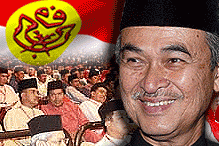 The close contests among seven candidates vying for the three vice-presidential posts, and the 51 candidates for the 25 supreme council (SC) seats proves that elections are most needed. At the very least, it gives the opportunity to those who wish to try to contest, and those who are elected in the end, to get a mandate from the delegates.
This time, the clampdown on money politics in the polls is the main strategy of Abdullah and his supporters to ensure victory for those who are considered as "the best" (read: Pak Lah's candidates), so much so that undercover agents have been used to look out for incidences of money politics, with those involved being hauled in front of the Umno disciplinary board.
Still, there are reports of agents, even a syndicate of them, who were busy running about seeing to the buying and selling of votes in a professional and systematic manner.
MBs exerting influence
The implications of the setting up of the 'Menteris Besar Club' which campaigns openly for delegates to vote for club members (seven vying for SC seats and two for vice-presidency) also drew the attention of the media, in view of their influence in state governments.
In short, the results may reflect how far money politics has influenced the outcome of the polls this time.
During the previous weeks leading up to the Umno party polls, a hot topic which was frequently discussed was the Malay agenda advanced by Umno. Many programmes about political positions, socio-economy, education and religion were aired in the Malay mainstream media.
For example, the Utusan Malaysia editorial for Sept 20 entitled 'Memikirkan semula agenda Melayu' (Rethinking the Malay agenda) stressed that "it is appropriate for Umno to stop for a moment and think again about the struggles of the party, in particular, in relation to the Malay agenda."
The editorial went on to state: "When we look around us, the physical changes which have taken place are awe-inspiring. The country has undergone rapid changes and the position of the Malays is now far better than it was decades ago.
"But what we are concerned about is that the Malays will be carried away by their fantasies due to the rosy picture, when in truth they are only spectators admiring the progress around them, and other people are tasting the pleasures and rewards."
Quoting Abdullah: "Even though the Malays have succeeded, we have actually been left far behind. This means that it is like they have not succeeded because in comparison with the other races, the gap is too wide. That is why the gap must be narrowed. If not, it will result in a variety of other problems."
Pak Lah's dilemma
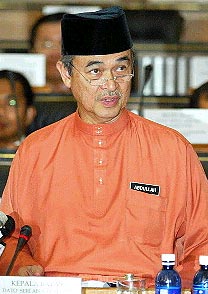 The challenge, or dilemma, for Abdullah and the whole of Umno is from the racial perspective (not class perspective which does not differentiate between races), even though the Malays have succeeded, but when compared to non-Malays (in particular the Chinese) they are still lagging far behind.
But according to Mahathir, and also Abdullah, the non-Malays are more successful not because they have been assisted by the government, but due to their own efforts. The Malays, who are not as successful compared to the non-Malays, have benefitted from the NEP (New Economic Policy) and other forms of government aid.
Now, Umno has been urged to see that a fresh NEP is implemented, with more tongkats (walking sticks) provided, and the special rights and ketuanan (lordship) of the Malays emphasised again. And due to these factors, a Malay agenda which is complete must be prepared and implemented without delay.
According to Abdullah, he once met with non-Malay businessmen, and they told him that whenever the restructuring of a company occurs, a portion of its share are set aside for Malays, but these shares are quickly sold off by them. They asked if it will be necessary to restructure the company a second time so that another portion of shares will be allocated to Malays to be
once again sold off quickly?
He feels that (other) non-Malay businessmen may also have such a view but were afraid to tell the Malays, especially the prime minister, about it. They are pragmatic about it, and understand that it is a sensitive issue. Mahathir once cried when he admitted is failure to change the attitude of the Malays, who were too dependant on government aid.
If Malay ketuanan, special rights and tongkats provided by the government were the causes of the political patronage mentality which depends on government aid did not benefit the development of a spirit of self-dependence, and instead stunted the competitiveness who vital to the Malays in this era of globalisation, was such a Malay agenda the appropriate solution to the dilemma the Malays face now?
Together we await how Abdullah and Umno will handle the Malay agenda issue during the on-going Umno general assembly.


