




Malay agenda versus Rakyat agenda
 The 55th Umno general assembly held in the Putra World Trade Centre ended recently. The assembly, which sprang several surprises, also marked the dawn of a new era, that is the era of Abdullah Ahmad Badawi (fondly known as Pak Lah), one which has its own qualities and challenges.
Without doubt, the new Umno president, who is also the prime minister, does have very high ambitions. He is prepared to face challenges which Dr Mahathir Mohamad has failed to overcome. Mahathir has admitted that he has failed to change the attitude of Malays even though he had urged, scolded, pleaded, prayed and wept.
"While Hang Tuah had declared, ' Tak Kan Melayu Hilang Di Dunia! ' (The Malays will never vanish from the face of the earth!), Pak Lah said, ' Melayu hidup biar bermartabat! " (Malays should live with dignity!'). Living with dignity, according to Pak Lah's definition, meant "becoming a race which did not hope for any aid, and instead strives hard with its own strength."
Abdullah also stated some points firmly and critically about aid which was like crutches: "Bumiputeras are aware that they are being propped up by crutches and would like to walk without them, but are still afraid to discard the crutches."
 The 55th Umno general assembly held in the Putra World Trade Centre ended recently. The assembly, which sprang several surprises, also marked the dawn of a new era, that is the era of Abdullah Ahmad Badawi (fondly known as Pak Lah), one which has its own qualities and challenges.
Without doubt, the new Umno president, who is also the prime minister, does have very high ambitions. He is prepared to face challenges which Dr Mahathir Mohamad has failed to overcome. Mahathir has admitted that he has failed to change the attitude of Malays even though he had urged, scolded, pleaded, prayed and wept.
"While Hang Tuah had declared, ' Tak Kan Melayu Hilang Di Dunia! ' (The Malays will never vanish from the face of the earth!), Pak Lah said, ' Melayu hidup biar bermartabat! " (Malays should live with dignity!'). Living with dignity, according to Pak Lah's definition, meant "becoming a race which did not hope for any aid, and instead strives hard with its own strength."
Abdullah also stated some points firmly and critically about aid which was like crutches: "Bumiputeras are aware that they are being propped up by crutches and would like to walk without them, but are still afraid to discard the crutches."
"Due to this concern, they are inclined to revert to old approaches, looking for quick excuses like blaming others. If this inclination is allowed to flourish, bumiputeras will grow weaker, declining from the already worrying state of walking with crutches, losing more and more of their competitiveness till one day they are completely disabled and need to rely on wheelchairs."
It looks like the 'Malay agenda' which was widely promoted before and during the recent Umno general assembly, may represent an 'inclination to revert to old approaches', which Abdullah had spoken about, if it is not handled rationally.
Concrete proposals
A phenomenon which needs to be viewed seriously is the three Umno wings - Youth, Wanita and Puteri - simultaneously and similarly calling for the 'Malay agenda' to be made the top priority of both the party and the government.
The Umno Youth head, Hishammuddin Hussein, even proclaimed that the time had come for the Malays to see the approach and implementation of the New Economic Policy [NEP] in a new dimension.
The Youth, he added, wanted to stress that the basic aim of the NEP cannot be compromised as long as it has not been achieved. He also revealed eight concrete proposals to revitalise the Malay economic agenda.
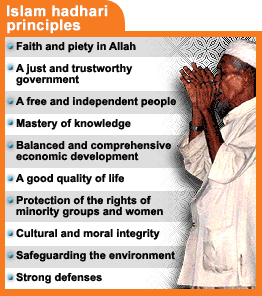 To build a dignified race, which strategy should be utilised - giving them new crutches as per Hishammuddin's call or starting a mental revolution by means of the 10 virtuous principles of Islam Hadhari [civilised Islam] as Abdullah advocated?
If the strategy of providing more crutches is implemented, can we avoid the negative consequences as Abdullah himself had described, that is, becoming 'completely disabled and needing to rely on wheelchairs' ?
Racial phenomenon
If we apply the virtuous principles, in particular the second - just and trustworthy government - and the fifth - balanced and comprehensive economic development, as advocated by Abdullah, then why has priority not been placed on a 'Rakyat agenda', which is more inclusive and encompasses the various races (as compared to the 'Malay agenda' which concentrates on just
one race), and which is suitable for the plural society of Malaysia?
Is Umno not the backbone of the Barisan Nasional government which claims to share power with the various races in our nation? Why then is it that within the psyche of Umno there only exists the Malay race, and no trace at all of the other races?
If the Malay race needs the 'Malay agenda', what about the other bumiputera races and the poor of the other races which are considered to be successful races? It must be stressed that poverty and backwardness is more of a social-economic phenomenon than a racial one.
It cannot be denied that in our nation, the country's wealth actually is in the hands of a small number of large investors/cronies of the ruling party which are of various races, and the percentage of equity ownership by race can only reflect the wealthiness of the upper crust of each race, who are very small in number, while the majority of the ordinary members of each race do not enjoy the wealth which the equity ownership percentage of the race infers.
The percentage of equity owned by the upper crust of a race is not meaningful to the ordinary members of the race. Be it the Chinese, the Malays or the Indians, the ordinary people cannot hope for assistance from the upper crust who have already accumulated fabulous wealth, and want to acquire even more of the same.
Gapping chasm
Even if the equity ownership percentage for Malays reaches 30 percent or more, it does not mean that the poverty and backwardness of Malays in general will vanish just like that. This is because if the wealth owned by a certain race is not more fairly and evenly shared out, but is instead accumulated by the small numbers of large investors/cronies of the ruling party, then the chasm between the haves and the have-nots of the race may grow ever wider instead of narrower.
It is a misconception that the Chinese are rich and the Malays, poor. A large portion of the wealth held by the Chinese and the Malays are in the hands of small numbers of large investors/cronies of the ruling party, with the majority of the rakyat (of the various races), in particular the labourers, farmers, fishermen, hawkers, small businessmen and government servants, need goverment aid the most.
Of course, any form of assistance should not be the form of 'handing out fishes', but in the form of 'providing fish hooks and boats, nets and vessels, compasses and maps, so that the recipients themsleves learn to withstand the waves and are prepared to look for sihes for themselves in the deep oceans', as advocated by the prime minister!
 Is an economic agenda for the rakyat, which includes all the races without bias towards any, more meaningful than the Malay economic agenda in the style of the NEP, which only focusses on increasing the equity ownership percentage of the Malays, a large portion of which may end up accumulated in the hands of large Malay investors/Malay cronies of the ruling party, in the same manner as a large portion of the equity owned by Chinese is in the hands of large Chinese investors/Chinese cronies of the ruling party?
Whether it is the rakyat agenda or Malay agenda which is given priority will be the touchstone test to determine whether the prime minister is a national leader or just a narrow-minded Malay nationalist.
Would it not be wonderful if the shouts of 'Hidup Melayu ' (long live the Malays) which Abdullah used at the end of his policy speech can be replaced by, or at least accompanied by, shouts of ' Hidup rakyat ' or ' Hidup Malaysia '.


Are you sure you want to delete this comment?
This action cannot be undone.