




Zhao Ziyang: A man beyond his times
When the rumours first spread on the weekend of Jan14-15, China's totalitarian leaders scoffed at them. Then, when Japan's media started reporting it, Chinese leaders denied the whole thing. Soon, with no place to hide, they finally admitted that former Chinese Communist Party president and famous reformist Zhao Ziyang had died, aged 85.
 But China's oppressors are a recalcitrant and abominable lot. Never mind the world's eulogies for the old reformist: Beijing wouldn't even utter a single syllable about the man the party and its henchmen had kept under house-arrest, politically scorned and exorcised for his support of the Tiananmen Square pro-democracy students.
In life Zhao was rebuked for his liberal leanings; in death his jailers seem bent on continuing their meanness. So paranoid about their stranglehold on power they were that they heightened security as news spread of Zhao's death, afraid a fresh round of pro-democracy protests would break out spontaneously.
As if.
When the rumours first spread on the weekend of Jan14-15, China's totalitarian leaders scoffed at them. Then, when Japan's media started reporting it, Chinese leaders denied the whole thing. Soon, with no place to hide, they finally admitted that former Chinese Communist Party president and famous reformist Zhao Ziyang had died, aged 85.
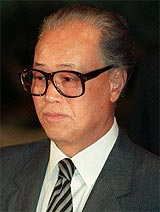 But China's oppressors are a recalcitrant and abominable lot. Never mind the world's eulogies for the old reformist: Beijing wouldn't even utter a single syllable about the man the party and its henchmen had kept under house-arrest, politically scorned and exorcised for his support of the Tiananmen Square pro-democracy students.
In life Zhao was rebuked for his liberal leanings; in death his jailers seem bent on continuing their meanness. So paranoid about their stranglehold on power they were that they heightened security as news spread of Zhao's death, afraid a fresh round of pro-democracy protests would break out spontaneously.
As if.
The last words Zhao is known to have voiced were in the dead of the night of May 19 1989. As the placard wielding students were starting to sting the totalitarian state of strongman Deng Xiaoping (deceased), Zhao suddenly appeared at Tiananmen Square. Through a megaphone he tearfully said to the million-plus protesters that he had come "too late". That was Zhao's coded language warning the students to run for their lives. But they stayed their ground.
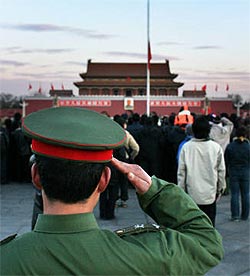 Fifteen days later, Deng's People's Army stormed the square and cold-bloodedly murdered hundreds of its young and brave citizens to this day without any remorse and in justification of national stability and capitalist economic growth.
In fact, at the time of writing this (Jan 20), President Hu Jintao, apparently a reformer himself, still couldn't decide if comrade Zhao should be given a state funeral or just an ordinary, little-fussed send off. Not that Zhao's family is worried: his surviving family said he's free, at last.
Branded a heretic
It's not the first time Zhao has been ostracised by China's vicious tyrants. One of Zhao's favourite quotes is attributed Karl Marx: "If I don't go to hell, who else will?" In the 1980s Zhao was branded a heretic for his Marxist revisionism. He always said that political reform would be the greatest test to socialism in China.
In post-socialist China, political reform isn't only anathema to Beijing's autocrats; it's plainly also dangerous for their position. And that's mainly because economic reforms have brought them untold personal wealth mostly by crook.
Zhao wanted transparency in policymaking, including public participation in the process. And he wanted transparent government at all levels. But his progressive ideas were also quickly making him enemies at the top of the party and among the highly corrupt provincial governments. Little wonder why in January more and more Western power companies said they'll be pulling out of China's bourgeoning domestic energy market because local governments won't honour power purchase agreements, a problem worsened by contradictory policies and corrupt administrative and legal systems.
Yet Zhao was a protg of strongman Deng. For nearly a decade he was one of China's most powerful people. More than Deng and far too much as been attributed to Deng, despite Mao Zedong labelling Deng a "capitalist roader" it was Zhao who had spearheaded market-oriented reforms.
He had promoted private enterprise, the dismantling of the inefficient farm communes and opening up China's coastal provinces to foreign investment, thus laying the foundation for the boom China has been experiencing since 1982. And he had championed political reforms that would separate power between party and the state, the expansion of press freedoms and the role of representative assemblies, and strengthening the rule of law. But all are taboo to a bunch of patriarchal octogenarians who have no inclination to take China down the road towards political reforms. That's not unusual in Asia, since no other country in the region save India has moved down that path. And nevermind Indonesia's recent 'democratic' elections.
Revered by the poor
 Ordinary Chinese liked Zhao more than they did Deng (
left
). He was revered in many circles, especially in China's poor countryside, which is still being ignored by Beijing for its widespread and grinding poverty. Anti-government sentiments are promptly repressed by the People's Army and brainwashed party cadres. Zhao was born among the poor. His father was a rich landowner in Henan province, who was killed by the party during the rural uprisings in the 1940s. Yet Zhao had joined the Communist Youth League in 1932. He had worked underground as a party official during the Liberation War of 1937-49. He rose to prominence in the party in Guangdong from 1951. For supporting Liu Shaoqi's reforms, he was dismissed as Guangdong party leader during the 1966-69 Cultural Revolution and was paraded through Canton in a dunce's cap. In 1971 he was assigned to work in Inner Mongolia.
Ordinary Chinese liked Zhao more than they did Deng (
left
). He was revered in many circles, especially in China's poor countryside, which is still being ignored by Beijing for its widespread and grinding poverty. Anti-government sentiments are promptly repressed by the People's Army and brainwashed party cadres. Zhao was born among the poor. His father was a rich landowner in Henan province, who was killed by the party during the rural uprisings in the 1940s. Yet Zhao had joined the Communist Youth League in 1932. He had worked underground as a party official during the Liberation War of 1937-49. He rose to prominence in the party in Guangdong from 1951. For supporting Liu Shaoqi's reforms, he was dismissed as Guangdong party leader during the 1966-69 Cultural Revolution and was paraded through Canton in a dunce's cap. In 1971 he was assigned to work in Inner Mongolia.
He was rehabilitated by Zhou Enlai in 1973 and sent to China's largest province, Sichuan, as first party secretary in 1975. There he introduced radical and successful market-oriented rural reforms, which led to a rapid increase in output. Deng Xiaoping had him inducted into the Politburo as an alternate member in 1977 and as a full member in 1979. After six months as vice premier, Zhao was appointed prime minister in 1980 and also assumed the post of CCP general secretary in January 1987. His economic reforms were criticized for causing inflation. Still, the little people who remember Zhao Ziyang understand that he, more than Mao Zedong or Deng, Jiang Zemin or Hu Jintao, had made their lives a little more bearable, even if for a while. During his time in Sichuan, Zhao became known by the little Chinese ditty: "Yao chi liang, Zhao Ziyang." Loosely translated: "If you want to eat, seek Ziyang."
After his ignominious detention following Tiananmen Square, few if any could seek Zhao. His house was cordoned off from everyone, except the People Army's guards who watched his place around the clock. Even then, it's said that the guards were rotated frequently; if they stayed too long they'd befriend the man. And that would be dangerous in a China that is paranoid about giving any political freedoms to its people. So much for the economic freedoms of the Chinese: they've bought their political subservience to the neo-authoritarian state.
Meanwhile, Zhao Ziyang, the man who came in from the cold, returned to it but with his principles held high and greatly respected, especially by the multi-million Chinese peasantry. And modern China owes Zhao Ziyang big time.
MANJIT BHATIA studied, among other things, Chinese political economy at university. This article is in part written in memory of the late Professor William Brugger of Flinders University, Australia, who unceasingly encouraged the writer's academic interests.


Are you sure you want to delete this comment?
This action cannot be undone.