




Suriani, the resistance heroine
"Progress in human affairs, whether in science or in history or in society, has come mainly through the bold readiness of human beings not to confine themselves to seeking piecemeal improvements in the way things are done, but to present fundamental challenges in the name of reason to the current way of doing things and to the avowed or hidden assumptions on which it rests." (British historian E H Carr on ' What is History? ')
Suriani Abdullah is one of many less well-known leaders of the Communist Party of Malaya. However, once upon a time, her beauty, charm, oratory skills and sprit of dedication to her cause attracted even her ideological and political opponents.
 According to Victor Purcell, the Chinese affairs adviser in the British Military Administration (BMA) which ruled Peninsular Malaya and Singapore immediately after the end of the Pacific War, Suriani had "sex appeal" and "a streak of humour and phases of near charm".
In his 1945 confidential reports, Purcell goes on with his observations of Suriani.
"She has a quite good figure beneath her dowdy blue cotton dress, but the fountain pen stuck in her bosom is a sharp reminder that she puts business before allurement. Her most remarkable features are her eyes. At one moment they are flat, brown and dull, at the next revealing in baleful flashes the smouldering fires of fanaticism...
"I had heard much of her oratory and of her decidedly unfair behaviour at the meeting in October 1945 during the rice troubles when she had stood at a platform on the Padang and had worked up the crowd of 3,000 with inflammatory speeches and by beating time for revolutionary songs by her trained choir for an hour or more before Brigadier Willan's arrival, so that when she came the crowd was in no mood to listen to reason.
 "There she sat in front me, and whilst I detected in the occasional flashes of her eyes the eternal Tricoteuse and firebrand of the Revolution, she was surprisingly subdued during the interview." (quoted in Cheah Boon Kheng's
The Masked Comrades - A Study of the Communist United Front in Malaya
, 1945-1948, Singapore, Times Book, 1979, pp 49-50)
"There she sat in front me, and whilst I detected in the occasional flashes of her eyes the eternal Tricoteuse and firebrand of the Revolution, she was surprisingly subdued during the interview." (quoted in Cheah Boon Kheng's
The Masked Comrades - A Study of the Communist United Front in Malaya
, 1945-1948, Singapore, Times Book, 1979, pp 49-50)
Suriani was then only 21 years old. She had also just been released from the torture chamber of the Japanese secret military police in Ipoh where she was detained and brutalised for some six months since Jan 28, 1945 when she was betrayed and captured as an underground partisan affiliated to the Kinta Valley-based 5th Independent Regiment of the Malayan People's Anti-Japanese Army (MPAJA).
"Progress in human affairs, whether in science or in history or in society, has come mainly through the bold readiness of human beings not to confine themselves to seeking piecemeal improvements in the way things are done, but to present fundamental challenges in the name of reason to the current way of doing things and to the avowed or hidden assumptions on which it rests." (British historian E H Carr on ' What is History? ')
Suriani Abdullah is one of many less well-known leaders of the Communist Party of Malaya. However, once upon a time, her beauty, charm, oratory skills and sprit of dedication to her cause attracted even her ideological and political opponents.
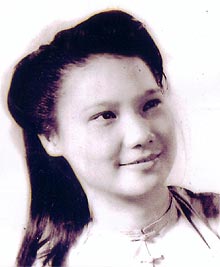 According to Victor Purcell, the Chinese affairs adviser in the British Military Administration (BMA) which ruled Peninsular Malaya and Singapore immediately after the end of the Pacific War, Suriani had "sex appeal" and "a streak of humour and phases of near charm".
In his 1945 confidential reports, Purcell goes on with his observations of Suriani.
"She has a quite good figure beneath her dowdy blue cotton dress, but the fountain pen stuck in her bosom is a sharp reminder that she puts business before allurement. Her most remarkable features are her eyes. At one moment they are flat, brown and dull, at the next revealing in baleful flashes the smouldering fires of fanaticism...
"I had heard much of her oratory and of her decidedly unfair behaviour at the meeting in October 1945 during the rice troubles when she had stood at a platform on the Padang and had worked up the crowd of 3,000 with inflammatory speeches and by beating time for revolutionary songs by her trained choir for an hour or more before Brigadier Willan's arrival, so that when she came the crowd was in no mood to listen to reason.
 "There she sat in front me, and whilst I detected in the occasional flashes of her eyes the eternal Tricoteuse and firebrand of the Revolution, she was surprisingly subdued during the interview." (quoted in Cheah Boon Kheng's
The Masked Comrades - A Study of the Communist United Front in Malaya
, 1945-1948, Singapore, Times Book, 1979, pp 49-50)
"There she sat in front me, and whilst I detected in the occasional flashes of her eyes the eternal Tricoteuse and firebrand of the Revolution, she was surprisingly subdued during the interview." (quoted in Cheah Boon Kheng's
The Masked Comrades - A Study of the Communist United Front in Malaya
, 1945-1948, Singapore, Times Book, 1979, pp 49-50)
Suriani was then only 21 years old. She had also just been released from the torture chamber of the Japanese secret military police in Ipoh where she was detained and brutalised for some six months since Jan 28, 1945 when she was betrayed and captured as an underground partisan affiliated to the Kinta Valley-based 5th Independent Regiment of the Malayan People's Anti-Japanese Army (MPAJA).
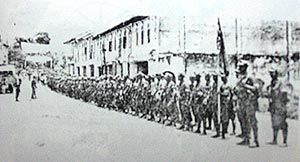
Ipoh was occupied by the invading 25th Army of Imperial Japan on the Boxing Day of 1941 after being bombed several times a few days earlier. After the announcement of Imperial Japan's unconditional surrender on Aug 15, 1945, Ipoh was liberated by the MPAJA 5th Independent Regiment, its civilian support groups as well as some Allies' special operations personnel.
From Purcell's account of her in October 1945, Suriani's spirit was obviously not broken by the incarceration and torture.
An octogenarian in Ipoh, Lai Ying, whom I met earlier this year, recalled that Suriani and Sybil Kartigasu were "two most admired and respected women in our generation in the Kinta Valley because they showed that women could be charming and brave at the same time" and "they were also our protectors and saviours".
 Sybil Kartigasu was a Eurasian Christian housewife who secretly supplied medicines and medical services to MPAJA in Papan, and she, like Suriani, was also captured and brutalised by the Kempeitai, the Japanese secret police.
However, while Sybil Kartigasu had to be sent to Britain for intensive medical treatment for the severe injuries she suffered inside the Kempeitai's torture chambers, Suriani immediately continued with her struggle - with renewed vigour and dedication - in the new phase of the history of Malaya.
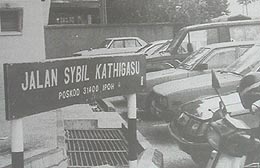 Kartigasu eventually did not survive the torture inflicted on her. On June 4, 1949, while still under medical care in a London hospital, Kartigasu passed away and her body was flown back to be buried at the St Michael Church's Cemetery in Ipoh according to her final wish as a Malayan.
When asked about Kartigasu, Suriani admitted that she did not know her at that time but only read about her after the war had ended.
Personal pain
Meanwhile, Suriani was not only appointed as the Perak representative of the Communist Party of Malaya, which enjoyed a brief period of semi-legality as a victorious force of the Pacific War and British ally, but also seconded by the party to work as a government official with the British Military Administration (BMA) in Perak.
A few years after the war had ended, Suriani was awarded, in absentia, the honour of 'Resistance Heroine' at a international conference held in Beijing.
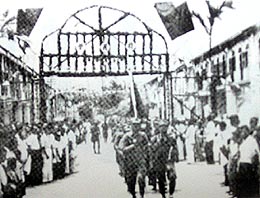
"One day, I was even officially invited to board a British military helicopter, circling the sky of Ipoh and sprinkled flowers to crowds down there cheering for the liberation.
"From the helicopter, we saw hundreds of people gathering in crowds here and there in the streets, singing, cheering, waving flags - that was the moment I felt the personal pain I suffered were not in vain," she said when met at her residence in southern Thailand.
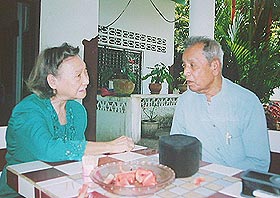 "It was during those days in Ipoh that I first met other comrades like Abdullah CD, Rashid Maidin (
photo
) and R G Balan who were also underground communists working with MPAJA to resist the Occupation in different places in Perak," she said.
"It was during those days in Ipoh that I first met other comrades like Abdullah CD, Rashid Maidin (
photo
) and R G Balan who were also underground communists working with MPAJA to resist the Occupation in different places in Perak," she said.
Abdullah CD, who was later appointed CPM's chairman, was to become Suriani's husband in 1955.
Suriani also met and befriended Dr Burhanuddin al-Helmy, Ahmad Boestaman and other young Malay progressive nationalists in Ipoh in the period between late 1945 and mid-1948. Dr Burhanuddin al-Helmy (1911-1969) was to become a president of PAS while Ahmad Boestaman (1920-1983) founded PRM.
Those were the happier days in Ipoh but it did not last long. Soon, Suriani, like so many of her comrades, became a 'bandits' and 'CTs' (communist terrorists) in the mainstream media - in both colonial and the newly independent Malaya (later Malaysia).
Suriani @ Eng Ming Ching was born the only daughter in a Chinese family of five in January, 1924 in Sitiawan, which is also the hometown of Chin Peng. She graduated from Sitiawan's Chinese-language Nan Hwa High School and continued her studies up to Standard 7 in an English school in Ipoh.
In 1940, she was officially admitted in Ipoh as a card-carrying member of the underground CPM. Like Chin Peng, Suriani was progressively radicalised by racial discrimination in colonial Malaya and the rising anti-Japanese sentiment in the Chinese Malayan community as the result of Imperial Japan's incessant aggression against China, especially since the 1931 'Manchurian Incident' and the 1937-1938 Nanjing Massacre.
 As a student, Suriani joined the local protest and solidarity movement against Japan's invasion of China.
Her final conversion to communism was facilitated by, among other people, Tu Lung Shan - who had four aliases, Du Lung San @ Li Fuk @ Lai Fuk @ Lai Lai Fuk - a trilingual communist cadre who influenced her the most during her school days in Nan Hwa High School.
Tu, whom Chin Peng honours as "my mentor" in his memoirs, was later captured by Japanese and beheaded in Ipoh at the age of 21 in 1943.
Family opposition
What about her family? Didn't they know about her political activities and party affiliation?
"My parents did not approve my political involvement but I ran away from home. Later, my elder brother located me and brought me back. After some 'negotiations', I was allowed to continue my studies and move about freely. Of course, I continued my underground work. It was Lung San who helped me to live independently from my family. He left a deep impression on me," she said.
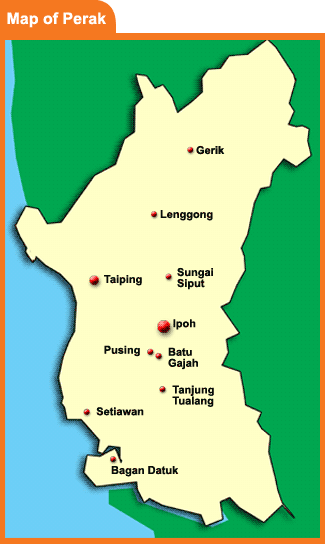 According to Suriani, after being admitted as a member, she was assigned by the party in Perak to organise, educate and unionise women workers in various places like Tanjong Tualang, Kampar and Pusing. In 1941, before the Japanese invasion of Malaya, Suriani succeeded in mobilising a women workers' strike in Kampar.
Suriani said, even before Japanese invasion, she was nearly detained by the British authorities for being a strike organiser and a communist. According to her, she managed to evade arrest because she was protected by the workers.
However, on Dec 18, 1941, the CPM reached an agreement with the British defence authorities in Singapore to cooperate militarily to oppose further Japanese southward advance. Hundreds of jailed communists were released and some joined the Dalforce which defended Singapore while 165 were sent for last-minute training in guerrilla warfare in Special Training School 101 (STS101) set up and managed by Special Operations Executive's Oriental Mission.
"After that, the party organisation in Perak decided to assign me to work in Singapore. Although I hesitated for a short while, I accepted the assignment. On the day I was supposed to leave by train for Singapore at 1pm, the Japanese had already begun bombing Ipoh at 11am. From the Ipoh Railway Station, I then decided to change plan and went back to the rural areas in Perak," Suriani recalled.
She added: "The first place I went after the bombing of Ipoh was Chemor. Many female comrades and other sympathisers had already gathered there. Chin Peng was also there and we lived in Chemor for about two months. Most of the young females had to cut their hairs short and dress like men to avoid becoming Japanese soldiers' targets of sexual violence."
"After that, I was transferred back to Ipoh to work as a member of the party's Ipoh Town Committee. Soon later, I was promoted to be the secretary of the committee. Unfortunately, a turncoat reported us to the Japanese. I was on the top of the blacklist. Many people were arrested.
"I escaped, joined the Model Company of the 5th Independent Regiment of MPAJA in Chemor's jungle and became the temporary party's representative in the armed unit."
White skin, red heart
During the Japanese occupation, MPAJA were organised in eight independent regiments (IRs) covering Selangor (1st IR), Negeri Sembilan (2nd IR), Northern Johore and Malacca (3rd IR), Central and Southern Johore (4th IR), Central and Northern Malaya (5th IR), Northern Pahang (6th IR), Eastern Pahang and Terengganu (7th IR) and Kedah (8th IR).
According to a veterans' history of the MPAJA published in Hong Kong in 1991, while the 5th IR protected and covered British officers Spencer Chapman, Frank Qualye, Bob Crystal, a Haywood and a Robinson during the British retreat and Japanese Occupation.
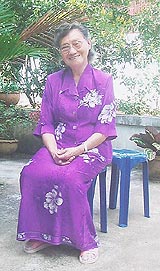 Later, Suriani was transferred to Sungai Siput, Pusing, Batu Gajah, Tanjong Tualang and other places to work among female members and supporters of the underground resistance movement. She said she had always been under Chin Peng's directive and her spirit was good because the party and its armed resistance enjoy broad support among the people, including in some Malay villages in Tanjong Tualang and Batu Gajah.
"Even people from the upper and business classes secretly supported us. In the open, they pretend to be very friendly to the Japanese but they actually supplied us with information, money and food like sugar, salt, fish, meat and rice. We were often sheltered by some rich tin-miners in their workers' quarters. We nicknamed them 'White-Skin-Red-Heart' people.
"A few seafood wholesalers were also particularly helpful because they supplied us with fish every week to keep us healthy. We actually had more food than we could consume," she said.
Although Suriani narrowly escaped several times, luck was not always on her side. On Jan 28, 1945, just about six months before Japanese surrendered, she was captured in Tanjong Tualang.
Tomorrow: Tortured by Kempetai
|
Malayan People's Anti-Japanese Army (MPAJA)
|
The Malayan People's Anti-Japanese Army (MPAJA) was the guerrilla forces founded and led by the Communist Party of Malaya (CPM) during the Japanese invasion and occupation of Peninsular Malaya and Singapore. By all historical accounts, it was the largest and most organised armed resistance to the 44-month Japanese occupation.
On Dec 18, 1941, British military authorities reached an agreement with CPM in Singapore to cooperate to fight further Japanese southward advance to Singapore. On Dec 31, 1943, Lord Vice Admiral Louise Mountbatten's Ceylon-based South East Asia Command (SEAC) also signed an agreement with CPM/MPAJA in Perak to further military co-operation in anticipation of an Allies' general offensive against Japanese-occupied Malaya.
By virtue of these two agreements, MPAJA itself was therefore effectively a component of the Allies' forces in the Pacific War.
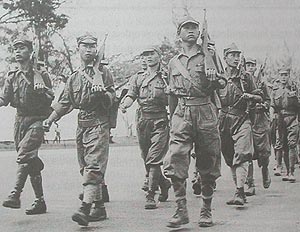 During the Occupation, MPAJA was organised into eight independent regiments covering Selangor, Negeri Sembilan, Northern Johore and Malacca, Central and Southern Johore, Central and Northern Malaya, Northern Pahang, Eastern Pahang and Terengganu, and Kedah and Perlis. According to the regimental history of MPAJA published in Hong Kong in 1991, it fought about 340 engagements with Japanese troops and killed about 5,500 of them.
At the end of the war, MPAJA numbered about 9,900 fully armed personnel with about 45,000 reservists and political, intelligence and logistics operatives.
Between the announcement of Japan's surrender on Aug 15, 1945 and the return of the British troops on Sept 3, 1945, MPAJA liberated and occupied many towns and villages. Ipoh, for example, was first liberated by the 5th Independent Regiment of MPAJA and one of the most celebrated partisan against Japanese occupation, Sybil Kartigasu, was first rescued by MPAJA.
Parts of MPAJA were demobilised after the British return, but some other parts prepared for anti-colonial armed struggle. On June 20, 1948, the colonial authorities declared 'Emergency', and many MPAJA veterans were either killed, detained, banished to China or compelled by circumstances to take up arms and retreated into the jungle to fight another war that lasted until 1960.


