




Rashid: Why I turned Red
Rashid Maidin may be 87 years of age, but he is still a jovial fellow who couldn't wait to share a joke or two.
 He does not live in Ban Chulabhorn 12 - the southern Thailand village where the majority of the Malay communists live - but after he was told that I would be there, he travelled to join Abdullah CD, Suriani Abdullah @ Eng Ming Ching and Abu Samah "to see how a Perak boy looks like nowadays".
Unlike Suriani and Abu Samah, Pak Rashid is well-known as a top communist since the days of the 1955 Baling Peace Talks in Kedah. He was one of the three CPM delegates in the failed talks.
Photographs of Rashid, together with those of Chin Peng, Chen Tien, Tunku Abdul Rahman, Tan Cheng Lock, David Marshall and John Davis were printed in the mass media all over the world.
Rashid Maidin may be 87 years of age, but he is still a jovial fellow who couldn't wait to share a joke or two.
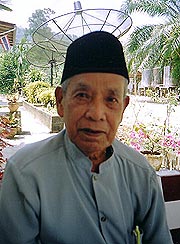 He does not live in Ban Chulabhorn 12 - the southern Thailand village where the majority of the Malay communists live - but after he was told that I would be there, he travelled to join Abdullah CD, Suriani Abdullah @ Eng Ming Ching and Abu Samah "to see how a Perak boy looks like nowadays".
Unlike Suriani and Abu Samah, Pak Rashid is well-known as a top communist since the days of the 1955 Baling Peace Talks in Kedah. He was one of the three CPM delegates in the failed talks.
Photographs of Rashid, together with those of Chin Peng, Chen Tien, Tunku Abdul Rahman, Tan Cheng Lock, David Marshall and John Davis were printed in the mass media all over the world.
He also attended the 1947 (British) Empire's Communist Conference held in London and he was one of three top leaders of the Communist Party of Malaya (CPM) who signed the1989 Peace Accords with the Malaysian government.
Rashid was born into a poor family in Kampung Gunung Mesah, Gopeng, Perak in November, 1917 - the year of the Bolshevik Revolution in Russia. He is the eldest of eight children. He completed five years of primary education in a Malay-language school but he later took up English-language courses at a night school and also through distance learning by post.
Finally, he acquired enough living skills and language proficiency to work as an electrical technician in British-owned tin-mines in the area of Perak's Batu Gajah and Tanjong Tualang.
According to him, since young, he was inspired by stories on how legendary Malay heroes like Maharajalela fought the British in Perak but when he started work, he was only concerned with earning a living for his family in Gopeng.
Top party recruiter
In 1939, when he was 22, he met Tu Lung Shan - the CPM recruiter who had four aliases - Du Lung San @ Li Fuk @ Lai Fook @ Lai Lai Fook. Tu's communist group was assigned by the party to educate and organise the working class in the vicinity of Tanjong Tualang.
At that time, Tu was only about 17 and World War II had already broken out in Europe with Germany's invasion of Poland.
 "(Tu) Lung Shan (
right
) was a very intelligent boy. He spoke Malay, Chinese and English. He was also very knowledgeable about politics and world affairs. We were all impressed by him. Slowly, many of the questions in our hearts were made clear by him. We were convinced by what he said," Rashid recalled.
"(Tu) Lung Shan (
right
) was a very intelligent boy. He spoke Malay, Chinese and English. He was also very knowledgeable about politics and world affairs. We were all impressed by him. Slowly, many of the questions in our hearts were made clear by him. We were convinced by what he said," Rashid recalled.
He added: "Lung Shan usually began with conversations on topics which touched on everyday happenings. He did not bring books or pamphlets. Probably, at that time, the party was not rich enough to produce books."
Rashid joined the party in 1941 just before the Japanese invasion.
Upon admission into the party - which was established on April 30,1930 in a rubber plantation near the Negeri Sembilan's Kuala Pilah - Rashid was assigned to conduct organisational work in southern Perak.
According to him, it was an open secret among the Chinese working class in that area that he was "a close friend of Tu Lung Shan" and that highly respected name was always associated with the CPM. So, when the Japanese arrived and occupied the area, Rashid was their natural leader.
He said, in the first few months after the Japanese occupied Perak, the tin mines were closed and he had to balik kampung (return to his village).
"Initially, everyone was frightened and kept quiet, but after a few months, when the tin mines were re-opened, we gathered and talked to each other again. I often told them not to worry too much because 'Tiongkok' (China) could never be defeated. It boasted their morale and gave their hope to live," Rashid said.
"Before the Japanese came, I had already read a lot about the war in Tiongkok. I knew for sure the 'Tionghua' (Chinese) people would win ultimately because Tiongkok was a big country and there were many communist guerrillas in the vast countryside. Many other Malays I knew at that time also believed that Tiongkok would prevail," he added.
After the outbreak of World War II, China at that time was in league with the United States, Soviet Union, Britain and France as Allies against the alliance of Nazi Germany, fascist Italy and militarist Japan which was called Axis.
United front
On Dec 18, 1941, the CPM reached an understanding with the British defence authorities in Singapore to forge a united front to resist further Japanese southward advance and to train CPM leaders and members for special operations to fight behind the enemy lines.
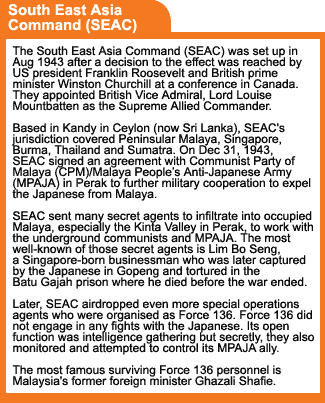 According to historical records on both the British and CPM sides,165 communists, including Tu Lung Shan, were sent to be trained in Special Training School 101 (STS101) in Singapore immediately after the agreement was reached until the fall of the city on Feb 15, 1942.
Rashid revealed that he did not join the MPAJA during the Occupation because he was assigned by the party to do only political, publicity and organisational work around Gopeng, Tanjong Tualang, Malim Nawar and the Tronoh Mine.
"When the Japanese came, many Malays and Indians were not frightened but after they had seen or heard more and more brutal incidents, their blood began to boil and many started cursing them in private.
"There were certainly a small number of rich Chinese who worked for the Japanese as collaborators but most of the Chinese, both the rich and poor, were anti-Japanese in their hearts."
He said he first heard about the execution by public decapitation of his mentor, 21-year-old Tu, in mid-1943 through a secret network linking Ipoh and Tanjong Tualang. He wept.
There was enough food during the Occupation and he was paid for his work as an electrician in the re-opened tin-mines which were taken over by the Japanese from the British.
Racial tensions
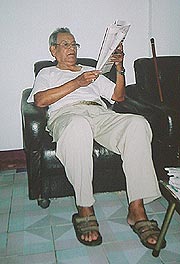 Rashid confirmed that there were indeed some inter-racial tensions and incidents in the immediate post-war period like the happenings along the Perak River, but according to him, the main cause was the "provocation" and "instigation" by pro-British elements in the society.
He argued that the British supporters felt "the loss of face" because British troops did not fight hard against the Japanese invasion and so they started to spread all kinds of rumours to stir up some troubles here and there so that their return would be justified on the ground of restoring law and order.
"Some rumours circulated among the Malays had it that the Chinese were going to take over the country from the Malays because they had won the war ... some pro-British elements also publicly praised the Chinese sky-high to cause uneasiness among the Malays...," Rashid added.
After the war, Rashid was assigned by the party to organise the Malays and also to promote inter-racial understanding on an anti-colonial platform.
JAMES WONG WING ON is chief analyst of Strategic Analysis Malaysia. He is a former DAP member of parliament for Kampar (1990-1995) and a former columnist for the Sin Chew Jit Poh Chinese daily (now Sin Chew Daily ). He read political science and economics at Monash University in Melbourne, Australia.


Report this comment
Are you sure you want to delete this comment?
This action cannot be undone.