




How to lose friends and make enemies
There's one thing that can be said about the individuals or group who caused this week's carnage in London.
It's quite obvious they have not studied the correct guidebooks, such as 'How to win friends and influence people', or stories about the Long March on why, in order to win a 'war', one needs to win hearts and minds first.
To begin with, blowing innocent people, who most likely participated in marches against the war in Iraq and kept 'Red' Kenneth Livingston in office all these years won't bring them new converts or change the minds of the Blair government.
There's one thing that can be said about the individuals or group who caused this week's carnage in London.
It's quite obvious they have not studied the correct guidebooks, such as 'How to win friends and influence people', or stories about the Long March on why, in order to win a 'war', one needs to win hearts and minds first.
To begin with, blowing innocent people, who most likely participated in marches against the war in Iraq and kept 'Red' Kenneth Livingston in office all these years won't bring them new converts or change the minds of the Blair government.
In fact, a friend of mine, Liz F, works for a distinguished advocacy institute just across from King's Cross station. Liz and her colleagues have been battling anti-terror laws in the UK, and fighting for the rights of migrant communities and refugees. I don't want to imagine what would have happened if she had gone to work on time that fateful day.
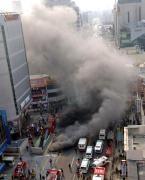 Secondly, these badly-read folks decided to do their job right in the middle of the G8 Summit where, really, there are urgent and important issues in other parts of the world aside from the Middle East.
So boom the immediate effect is that our attentions veered from Africa to the heart of London to the dismay of Sir Bob and friends; and resealed the solidarity between Blair and Bush so much so that 'God Save The Queen" was played in Washington DC.
Then, there's that very silly long name that no one can be bothered to remember.
What sort of civilisation?
Now we have to hear the broken record of saving 'civilisation' and 'protecting our way of life'; naturally there are some of us who wonder what sort of civilization are we living in these days?
Does our 'way of life' include deporting those who have been acquitted in a jury-trial back to their country of origin where, according to Amnesty International, may face the risk of further detention and torture, such as in the case of Algerians Mustapha Taleb, Sidali Feddag, David Khalef and Mouloud Sihali who were earlier charged for being part of the 'ricin plot'?
Does a civilized society require governments to force citizens and residents to carry ID cards in the name of combating terrorism? From this month onwards, new British passports will have biometric images of holders, with finger-prints added in a couple of years time.
This will proceed despite a surprisingly frank statement by the Chief Executive of the UK Passport Service, Bernard Herdan, in last month's Financial Times that these new biometric passports would help tackle organised crime and "illegal immigration" though there was less evidence to suggest they could prevent terrorism.
 This year, the Blair government came under the spotlight of the Council of Europe for its deteriorating record of human rights, including its anti-terror measures which, according to spokeman Alvaro Gil-Robles, have far-reaching implications to entire communities beyond that of individual persons, "(W)e exclude one person from their enjoyment at the risk of excluding all of us."
The irony of it all
The Council of Europe Report further noted that UK was not immune to "a tendency increasingly discernible across Europe to consider human rights as excessively restricting the effective administration of justice and the protection of the public interest". It condemned the use of evidence obtained under duress and torture, detention without trial which posed as control orders and selective application of human rights.
 What is particularly ironic are the similarities shared by governments bent on curbing civil liberties and extremists of all shades and colours who like fiddling with explosives. They share a mutual disdain for liberty and a genuinely liberated citizenry. This tacit, perhaps even ideological to a certain extent, alliance has held us hostage for far too long. These tragedies in New York, London, Bali and Jakarta show that increased security measures have not been able to prevent
acts of terror.
George Galloway claims Londoners paid the price for British complicity in the war in Iraq. There will many who may find adequate reasons to disagree with him. But when has living under an ever-expanding cocoon of cameras, racial profiling and draconian security laws constitute a free and civilized society?


