




Voices from below
Could the London bombings of July 7, followed not long after by one in the Egyptian resort town Sharm el Sheikh, mark a new watershed for Muslim self-reflection with regard to violence and terror by our extremist fringe?
Seven years earlier, it was embarrassing to watch Muslims openly rejoicing on camera when New York's twin towers came down, but we were rather slow in taking in the lessons from that defining event.
With subsequent bombings in Bali, Jakarta, Casablanca, Istanbul and Madrid we have to admit that we displayed insufficient, perhaps more accurately, very little of critical self-examination - why is it that in the current age we seem to have the monopoly in producing violent extremists?
Could the London bombings of July 7, followed not long after by one in the Egyptian resort town Sharm el Sheikh, mark a new watershed for Muslim self-reflection with regard to violence and terror by our extremist fringe?
Seven years earlier, it was embarrassing to watch Muslims openly rejoicing on camera when New York's twin towers came down, but we were rather slow in taking in the lessons from that defining event.
With subsequent bombings in Bali, Jakarta, Casablanca, Istanbul and Madrid we have to admit that we displayed insufficient, perhaps more accurately, very little of critical self-examination - why is it that in the current age we seem to have the monopoly in producing violent extremists?
Our sense of outrage was unusually muted even when many of the victims of terror-bombings had been in fact Muslims. Our initial response to Sept 11 ranged from open rejoicing to quiet satisfaction at Al-Qaeda's valiant efforts in redeeming the honour of Islam and the Muslim ummah (community), far from it being terrorism as the West says it was.
Jewish conspiracy theories abound, and not many of us cringed at the statements issued by radical groups that openly endorsed such acts as jihad . At that time it was difficult to express views that merely suggested that rhetoric of anger political violence is strategically counter productive for Islam and justice in Muslim lands, let alone to say that the killing of innocents by terror tactics is not sanctioned by Islam, and Islamic jurists have set down strict rules of engagement should war becomes inevitable.
The general sentiment then was, the least we could do was cheer Al-Qaeda from the sidelines, ourselves being too feeble and lacking in courage, too bogged down with the burdens of living to take part in the jihad.
Spirit of brotherhood
One of Islam's greatest achievement is instilling the spirit of brotherhood among its believers that transcends the boundaries of geography and race, the sense of belonging to one global community, the ummah . It is this that enables us to share the pain and misery of our co-religionists in other parts of the world.
 But in the course of the last few years when 'Islamic terrorism' has become a phenomenon as all other faces of terrorism have run their course, our sense of moral and ethics has unfortunately been subordinated to this spirit of brotherhood, clouding our judgment and paralysing our capacity for objectivity, even when fellow Muslims may be guilty of political violence.
The incendiary rhetoric of radical groups like Hizb-ut-Tahrir and Al Muhajiroun are tolerated as merely part of the spectrum of acceptable opinions, rather than ones that merit scrutiny and studied criticism.
From Bali to Madrid we were still unsure what to do apart from some muted condemnations and press statements. The overwhelming sentiment among us was perhaps, yes all that is bad, but how else do we make the West acknowledge our grievances from decades of humiliation, exploitation of our resources and imposition of ruthless dictators upon us?
We were weighed down by that sense of futility, that even if we issue condemnations, they're not going to believe that we are sincere anyway. The battle lines have been drawn between 'us and them'.
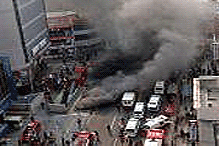 More than a month after London 7/7, as things are beginning to normalise and the anxieties of Muslims over the real possibilities a major backlash gradually subside, it is sobering to note that there has been much greater self-reflection among Muslims, something that we did not see in an obvious way after Bali or Madrid.
Of course they are always individual commentators and sections of media well-known for their entrenched prejudices against Islam who exploit such a tragedy to excoriate Muslims and their faith, like the recent vitriol by The Observer on the Muslim Council of Britain and the commonly practised teachings of Islam which has generated a storm of protests by Muslim groups.
And undoubtedly there will be tougher measures that will further restrict civil liberties especially on Muslims with religious inclinations, and already they were talks of deportation of radical imams, activists and scholars.
Despite the reassurances, there will almost certainly a few who will receive rough justice. Bracing for racist attacks on Muslim women, a prominent scholar based in London recently issued the edict that women may take off the hijab in the current climate should they feel that their safety is under threat. But on the whole, the collective blame on Muslims and Islam seems no where near as bad as compared to the reaction that followed earlier events of similar gravity.
It is encouraging to note that there has been numerous voices from a cross-section of mainstream Islam, ranging from politician-activists to intellectuals and ordinary Muslims, debating and discussing freely on the Internet and the media on the many facets of a deep crisis affecting Muslims today - crisis of leadership, social, moral, theological.
They are coming to the realisation that within a few years we have gained the dubious distinction of being the source of radical extremists who have no qualms about using terror as weapon, with chillingly greater efficacity and an unprecedented global dimension, when the Basques, the IRA and the Tamil Tigers have begun to realise its shoot-in-foot futility.
Collective responsibility
It seems Muslims are fast getting tired of being held collectively responsible for the action of the extremists few on our fringe. Rather than 'progressive' Muslims who have problems finding acceptance within their community for being too eager to please the West, today, it is mainstream Muslims, those who identify with the traditional outlook and practices of Islam, people who are not embarrassed to proclaim the Prophet as a model of behaviour and a guide, who are voicing displeasure at how the extremists are hijacking Islam in their pursuit of a jihad to realise that fantastic totalitarian vision to which we all are supposed to submit and glorify.
Even before 7/7, the website opendemocracy has been especially open to thoughtful, sympathetic analyses and quality debate on Islam especially in Europe, on the problems of marginalisation vs integration of Muslims in wider society, the different strands of political Islam and its relation to terrorism, conflicts in Muslim lands and how the West helps sustain them.
Since the London bombings however there has been a much bigger participation by Muslims themselves commenting of these issues, especially terrorism and the politics of extremism within the Muslim ummah , dissecting them from the ethical and moral perspective of mainstream Islam.
 The range of voices with varying nuances coming from mainstream Islam in the wake of 7/7 is enlightening. The debate inevitably extends into the question of Iraq and Palestine, something that Prime Minister Tony Blair wishfully tries to delink from this 'perversion of Islam'. That the bombing took place in the London Underground rather than the Paris Metro have probably made quite a lot of difference.
Britain's Muslims, despite having a fair share of inmates in Guantanamo and young men who took part in suicide bombings, fare much better than French Muslims in education, the professions and in social-political activism despite the odds that Muslims face in the West generally.
Rational response
This is complemented by the more nuanced understanding of the Muslim situation among the more respectable British commentators and journalists, something that British secularism perhaps can be credited for.
Also, his Iraq policy notwithstanding - which journalists like John Pilger have blamed as bringing terror to Britain - Blair deserves credit for his cool and rational response in the immediate aftermath of the event. He united the political forces and opinions behind him, even if briefly, while clearly isolating the purveyors of terror from the main body of Islam.
In some way this has helped assuaged Muslim anxiety about reprisals by racist extremists. Inviting Muslim leaders for a dialogue at Downing Street was a statesmanly gesture, carefully wording his pronouncements to avoid the 'either you're with us or against us' ultimatum of his Iraq war ally.
Unfortunately it took a tragedy of such a magnitude in terms of lives lost, in a major Western capital, for Muslims to finally confront our malaise and multi-faceted crisis as we grapple with modernity. But better late than never. Even before 7/7, they have been lecturing us loudly and repeatedly that 'Islam is badly in need of a reformation'.
This is seen as a signal of Western support by modernists who wish to drag mainstream Muslims to conform to the ideas and fashions of a post-modern secular liberalism, to free Islam of the stifling weight of tradition, the Sunnah (prophetic guidance) and teachings that are considered archaic and embarrassing to the modern spirit.
Before 7/7, the US administration and think tanks around it were seriously toying with the idea of dictating the agenda for the 'reformation' of Islam, mainly for its own security and economic interests.
It wants an Islam that is uncomplaining, or better still acquiescent to US hegemony, and for Muslims to be captive consumers of goods and entertainment products of American capitalism. This seemed a terribly ludicrous project, as the now infamous Rand study 'US strategy in the Muslim world after 9/11', which reflects this determination of effecting 'reformation' within Islam.
According to the study, this is to be achieved by exploiting the divides within Islam, supporting modernist Muslims against fundamentalists and traditionalists, empowering moderates, calling for madrassah (religious schools) and mosques reforms in the Muslim world and even paying professional imams to counter radical Islam.
Simplistic thinking
This simplistic thinking has failed to grasp the complexity, nuances and range of opinions and perspectives within the Muslim world. The disagreement on definitions of what constitute moderate, modernist, traditionalist, fundamentalist Muslims alone is a major obstacle, given that the great majority Muslims, like all other people, cannot be neatly compartmentalised as there will always be overlap of opinions and perspectives for any given issue.
 But the surge of mainstream Muslim voice participating in intelligent debates in the wake of 7/7 especially in the British media has greatly helped the Bush administration - if what it really wants is neutralisation of radical Islamism that has no qualms with violence and terror as instrument of politics - in one stroke rendering irrelevant the ridiculously fanciful, randy objectives of the Rand Corporation project.
Even the more well-intentioned if somewhat grand sounding initiative 'Alliance of Civilisations' co-sponsored by the Turkish and Spanish prime ministers and announced by no less a person than UN secretary-general Kofi Annan a week after 7/7 has been eclipsed by the Muslim voices from the ground.
What could be more effective that voices from within mainstream Islam itself to deconstruct radical Islamist ideologies in a common language that all Muslims - radicals or otherwise - understand?
Even before Blair announced that plans are afoot to proscribe radical Muslim groups like Hizb-ut-Tahrir and Al-Muhajiroun, the former had greatly toned down its incendiary rhetoric. It is well on the road of irrelevancy when mainstream Muslims distance themselves from the struggle it claims to fight on their behalf.
Once ordinary Muslims are able to articulate abhorrence for political violence and terrorism while not allowing the world to forget the continuing injustice in Palestine, Iraq and Afghanistan, and reminding them of the hypocrisy of US administration that talks of 'forward strategy for freedom' in the Middle East while continuing to prop up ruthless dictators, it is going to be a bit more difficult to find new recruits for suicide bombers.
The prospect for a better understanding between the Islamic world and the West is going to be brighter when this is articulated by the people themselves. Such is the power of communication.


Are you sure you want to delete this comment?
This action cannot be undone.