




Tossed on scrapheap of humanity
At a recent conference in the United States, someone who had presented his research paper on Japan was asked why it was that there was no obvious social stress despite Japan's successive years of economic stagnation and recession since its bubble economy burst in 1989.
A few shifted in their chairs in the hall, a few murmured and then there was silence as the paper presenter took the podium to answer the question.
This was his response.
At a recent conference in the United States, someone who had presented his research paper on Japan was asked why it was that there was no obvious social stress despite Japan's successive years of economic stagnation and recession since its bubble economy burst in 1989.
A few shifted in their chairs in the hall, a few murmured and then there was silence as the paper presenter took the podium to answer the question.
This was his response.
"Japan's economic stagnation has long perplexed analysts. Despite successive years of negative or flat economic performance and historic high unemployment, there are few obvious signs of the social stress analysts expect.
"Two glaring exceptions to that, however, are suicides, which have soared to more than three times the number of auto fatalities in the country, and the growing legions of homeless men and women sleeping on park benches and washing in public restrooms."
Yikes! Don't know about you, but I cringed at this hare-brained response. And 'yikes' is an understatement; I was swearing under my breath. I could not believe that an academic could make such a stupid claim when all the research points to the contrary. Worst of all, although, this academic rather painfully made a glaring contradiction, he didn't even realise it.
Bizarre? You bet. Funny thing is, I've heard more and more academics make silly assertions like this one. Too long ensconced in the ivory tower, I think, and it's time to weed out the dead wood before the whole structure rots as well.
Sick joke
During my countless trips to Japan, especially since 1997, nothing has been more the norm (as opposed to "exceptions") than social stress among a growing number of Japanese - thanks to the blowback from Japan's crazy years of economic growth that did not and could not cushion the effects of a serious, long-term collapse of the economy on its people.
And it was only in late 2000 that the Japanese government awoke from its malaise to recognise that homelessness and broader social stress was in fact a reality.
The world's second-largest economy and among the world's top eight richest nations, it had long boasted lifetime employment and living standards beyond anything Japanese would have envisioned in 1945 after the misadventures with fascist militarism had created an underclass problem right under the government's nose.
Go anywhere in Tokyo, for example, and you'll find that suicides have soared to more than four times the number of motor vehicle fatalities this year. And there are literally legions of homeless men and women sleeping on park benches and washing in public restrooms.
More than that, as in China, there's now a movement of homeless people in a migratory pattern in search of salvation from the economic devil that the Japan's clueless prime minister, Junichiro Koizumi, has unleashed upon these luckless people.
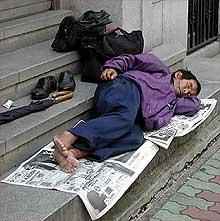 Still, faced with the growing sprawl of makeshift shanties erected by the homeless in parks and public areas of Tokyo, Osaka and even rural areas, the federal ministry of health and welfare has offered to erect shelters and help local governments run them.
But how does this short-term measure, made by political calculus, assist homeless Japanese get up on their feet again, become independent again, become valued and worthy members of a society that seems to have shunned them and heap them on Japan's mounting scrapheap of human tragedy?
As Koizumi becomes more and more desperate to keep his job, his economic reforms almost wholly a failure - if they've managed to get off the ground at all - the greater free-marketisation of the economy is marginalising more and more Japanese who have fallen out of the historical promise of lifetime employment and headed squarely in the direction of Western economies - the greater casualistion of labour.
And with this comes a pittance in wages and massive exploitation of workers by unscrupulous Japanese employers. Social justice in Japan is a sick joke, and few take it seriously these days.
Gaps in safety net
More problems are emerging with changes in Japan. In contrast to the homeless population in America, where alcoholism, drug abuse and psychological ills are quite high, experts say a large proportion of homeless in Japan had steady jobs and stable lives until their companies went bankrupt or they lost their jobs.
American ills are clearly and unmistakably present among homeless Japanese, just as among the homeless in the United States. And as for the latter claim - that a large proportion of homeless in Japan had steady jobs and stable lives until their companies went bankrupt or they lost their employment - that's a big lie, and these so-called experts should be driven out of their ivory-tower safe havens.
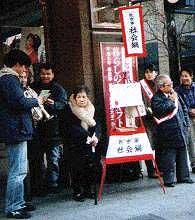 I spent some time with a Salvation Army outreach programme in the outskirts of Tokyo a few months ago. Its social welfare team acknowledged that the country's social safety nets, designed to help stereotypical families with homes for only short periods, have failed to catch the new homeless. Not only have the health and welfare ministry's policies been an abject failure but there's an additional rub for the down-and-out homeless Japanese citizens.
"There are systems to help, but only if the people have joined and paid dues. Many have not. "A lot of these people feel stranded," said Naoko Harita, who helps run Salvation Army assistance programs for the homeless in Tokyo.
Stranded, nothing. More like abandoned, like garbage, by the Koizumi government. The prime minister would rather pay his respects to his World War II fascists soldiers who had brutalised innocent foreigners than lift his finger to dig his post-war homeless Japanese citizens out of their downward spiral. This is through no fault of their own but that of the dominant Liberal Democratic Party government of which Koizumi is president.
Now is the time for change, but who'll make the first real move in Japan? Someone with a social and moral conscience? Sadly not one exists in Japanese politics.


Are you sure you want to delete this comment?
This action cannot be undone.