




Parliament: Nazris survival game turns ugly
Minister in the Prime Minister's Department responsible for parliamentary affairs Nazri Aziz dropped a bombshell last week. He took almost everyone by surprise when announcing the Cabinet decision on Sept 15 (while Prime Minister Abdullah Ahmad Badawi was away in the US) to establish a Parliament Department with a director-general at its helm.
The new department would manage "the affairs and administration of Dewan Rakyat and Dewan Negara members." It was meant to "enhance and improve the effectiveness of handling Parliament issues as well as its management." More importantly, Nazri said that the department would come under his purview.
 Until now, according to Parliament's website, "the Head of the Parliamentary Department is also known as the Secretary of the Parliament of Malaysia cum Secretary of the Dewan Rakyat." He is assisted by the deputy secretary of parliament cum secretary of the Senate.
Nazri presented a picture of the two secretaries serving their respective chambers with no overlapping responsibilities. That is not true. Actuality, the existing Parliamentary Department is a single bureaucracy with a "head of administration" in the person of the secretary of parliament. It is disingenuous on the part of Nazri to conveniently twist this fact.
Minister in the Prime Minister's Department responsible for parliamentary affairs Nazri Aziz dropped a bombshell last week. He took almost everyone by surprise when announcing the Cabinet decision on Sept 15 (while Prime Minister Abdullah Ahmad Badawi was away in the US) to establish a Parliament Department with a director-general at its helm.
The new department would manage "the affairs and administration of Dewan Rakyat and Dewan Negara members." It was meant to "enhance and improve the effectiveness of handling Parliament issues as well as its management." More importantly, Nazri said that the department would come under his purview.
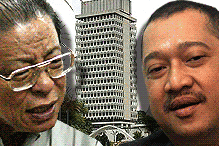 Until now, according to Parliament's website, "the Head of the Parliamentary Department is also known as the Secretary of the Parliament of Malaysia cum Secretary of the Dewan Rakyat." He is assisted by the deputy secretary of parliament cum secretary of the Senate.
Nazri presented a picture of the two secretaries serving their respective chambers with no overlapping responsibilities. That is not true. Actuality, the existing Parliamentary Department is a single bureaucracy with a "head of administration" in the person of the secretary of parliament. It is disingenuous on the part of Nazri to conveniently twist this fact.
After the Parliamentary Services Act 1963 was repealed in 1992, the secretary of parliament and his subordinates are technically part of the civil service but maintained a certain degree of independence from the executive enough to irk Nazri. The Parliamentary Department is responsible to the speaker of Dewan Rakyat and the president of the Senate.
The surprise move made headlines and generated a lot of confusion. Members of the opposition, senior staff in parliament, some backbenchers and the civil society were obviously shocked and upset by the move. Parliamentary Opposition Leader Lim Kit Siang called it the "gravest parliamentary crisis in nation's history" as it buried altogether the remaining facade of the notion of separation of powers in Malaysia.
As the criticisms intensified, Nazri seemingly backed down on nomenclature. He said it was not meant to be a "department" but merely the creation of a new position. Further, as "director- general usually denotes the head of a government department," the post is now called the "head of administration," filled by National Service Training Department director-general Kamaruddin Mohamed Baria.
Parliament cannibalised
But there is no change in Nazri's intent. Essentially, the parliament's administration will be cannibalised into three parts - the two existing secretaries serving their respective chambers and beyond that, all residual powers to be placed in the hands of the new head.
According to Nazri, the new position is "parallel to the secretaries of Dewan Rakyat and Dewan Negara" and "the trio are all answerable to the speakers of respective Houses." Notably, Kamaruddin is on the Superscale B wage scale while the Secretary of Parliament Abdullah Abdul Wahab is on the lower Superscale C.
Such are the likely scenarios: the existing Parliamentary Department will be dissected and the trio will constantly engage in bureaucratic dog fight over who controls what, when and how. As the line of command and responsibility is profoundly blurred, nothing will get done in parliament without a fight. Instead of enhancing efficiency, a move to the other extreme is more plausible. To understand this, the proverbial rocket scientist is not needed.
 As the new "head of administration" is directly responsible to Nazri, the minister is likely to invite himself into the game by favouring the new head over the two existing senior administrators of parliament. It is in direct opposite to the notion of separation of powers between legislature, executive and judiciary.
Why is Nazri doing this? Aren't there better alternatives if he is truly concerned with improving parliament's "toilets and canteens", as well as enhancing the general administrative efficiency of the Parliamentary Department?
It is unfair to solely blame the Parliamentary Department for poor services and performance. While the Executive expanded by astronomical scale in the last four decades or so, the parliament is starved of resources in the face of increased duties and demands.
The parliament employed 156 personnel in 1981 while 4,414 persons (ratio 1:28) worked at the Prime Minister's Department the kingpin of the executive. In 2001, the Parliament had 157 staff and the PMD 9,673 persons (1: 61).
The recent 2006 budget proposes to have 232 parliamentary workers but the PMD will expand further to 19,079 persons (1:82). Obviously, more staff and resources should be devoted to the Parliament.
Desperate move?
Some may think that Nazri Aziz introduced the change with naively good intention. One Fahri Azzat, who attended the "Save Parliament" roundtable organised by the office of the parliamentary opposition leader, beautifully put it when he said, "the road to hell is paved with good intentions, coupled with ignorance it is an expressway."
However, never underestimate the intellect of Nazri, who received his barrister-at-law from Lincoln's Inn. He is probably one of the very few Barisan Nasional MPs who really understood the reasons behind the call for an independent parliamentary service.
Nazri told the Dewan Negara on May 19 that he would propose to Prime Minister Abdullah Badawi to detach parliamentary staff from the Prime Minister's Department "to ensure parliament is truly independent". He also proposed to revive the Parliamentary Services Act 1963.
"If we want to be true to the spirit of Vision 2020, Parliament should not be put under any ministry. Once revived, the legislature will be able to administer its own affairs, including staff recruitment and wage payments," he said. The suggestion was met with cold reception at the highest level.
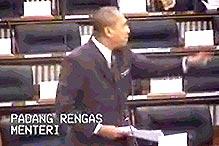 Nazri's change of position is all about political survival and nothing to do with principles. Nazri comes from a political family his father Tan Sri Abdul Aziz Yeop was also a member of parliament. Nazri was appointed a senator in 1991, elected a member of parliament in the 1995 elections and soon after, appointed a deputy minister.
Although close to Anwar Ibrahim at one stage, Nazri shifted his loyalty to Dr Mahathir Mohamad and became the latter's blue-eyed boy. Mahathir rewarded Nazri with the powerful entrepreneur development ministry.
As the Mahathir era drew closer to an end, Nazri was visibly moving closer to the Najib camp. He was later accused of corruption. At the cabinet reshuffle in the wake of the 2004 elections, Abdullah was rumoured to have dropped Nazri from the frontbench but brought him back to the list at the request of Najib minutes before the press conference to announce the post-election Cabinet.
Nazri's parliamentary affairs portfolio was announced a week later. The portfolio was inspired by the Indian Ministry of Parliamentary Affairs, which manages the government's legislative agenda in the parliament but remains external to the administration of parliament.
Still a cold storage
Thus far, Nazri has turned his demotion into an art form. He uses parliament as a perfect platform to remain relevant in the public eye, more visible than ever. Whenever parliament is in session, he calls a press conference almost on a daily basis. On any sitting day, he will be in the parliament all day to provide the executive's immediate response to any development in the House.
Further, he has pushed for some reforms in the Parliament - such as employing ten researchers in the library - and facilitated the formation of select committees. Even Lim Kit Siang recognised his many "baby-steps" achievements.
But a cold storage is still a cold storage. When Nazri helmed the Ministry of Entrepreneur Development, he had about 760 ministerial staff at his disposal and a billion ringgit to spend. Now he is the only minister that is "not able to hold post-Cabinet meeting" because he has no officers under his watch.
(Other ministers in the Prime Minister's Department oversee various agencies, for instance, Mustapa Mohamad watches NEAC and the EPU; Bernard Dompok the ACA; Maximus Ongkili the Unity Department.) Nazri cited this as one of the reasons to create the new post in Parliament.
Worse still, Nazri felt that he was at the whim of the secretary of parliament who, rightly so, turned his back on Nazri with regard to several issues including a request to approve MPs' claim of allowance without supporting proof. These administrative favours for backbenchers are crucial for Nazri's long-term political survival.
In the dog-eat-dog fight over bureaucratic resources, none of Nazri's cabinet colleagues will support a full-fledged department of parliamentary affairs a la the Indian model. Nazri's "innovative" way out is to superimpose one single new post on top of the current structure, in the hope that the new guy will magically move the entire parliamentary department to him. It is doomed to fail.
The creation of the new "head of administration" is the result of a petty bureaucratic fight between Nazri and Abdullah Abdul Wahad and obligated by the political imperative to pacify the backbenchers, and Nazri's ambition to re-establish a bureaucratic fiefdom.
Liew Chin Tong is a postgraduate student at a local university .


Are you sure you want to delete this comment?
This action cannot be undone.