


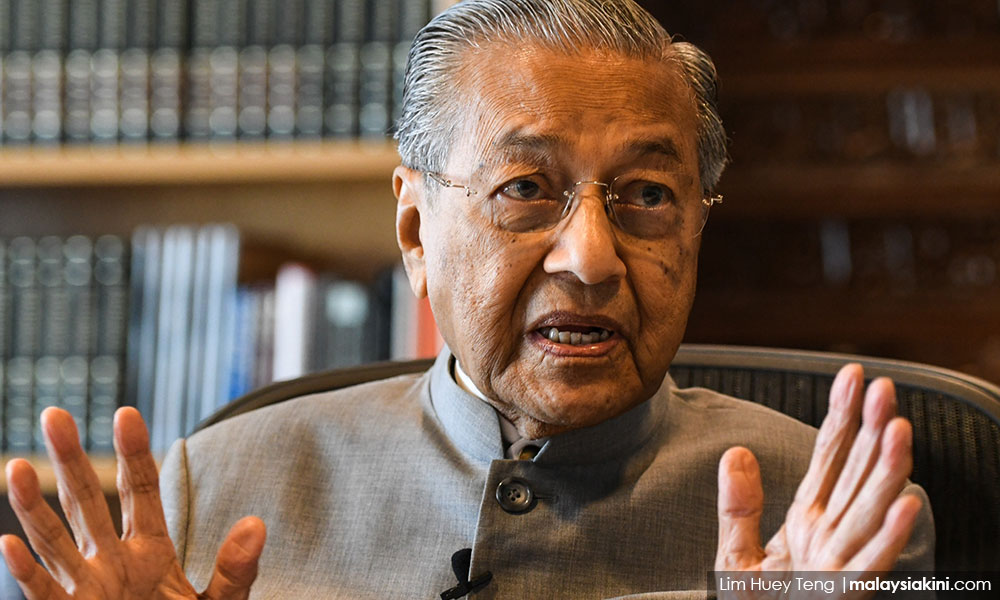

By jove! A first-ever apology from Dr M
COMMENT | For as faithful a practitioner of Machiavellian political craft as Dr Mahathir Mohamad has been, the whole idea of tendering an apology is anathema.
It is not hard to surmise that Pakatan Harapan components – you may conjecture that DAP, PKR and Amanah, not so much Bersatu – had been instrumental in getting the coalition's chairperson to apologise over his use of the term “keling”, widely regarded as denigratory towards Indian Malaysians, when denouncing the other day the alleged bias of the Election Commission and Registrar of Societies (ROS)...
COMMENT | For as faithful a practitioner of Machiavellian political craft as Dr Mahathir Mohamad has been, the whole idea of tendering an apology is anathema.
It is not hard to surmise that Pakatan Harapan components – you may conjecture that DAP, PKR and Amanah, not so much Bersatu – had been instrumental in getting the coalition's chairperson to apologise over his use of the term “keling”, widely regarded as denigratory towards Indian Malaysians, when denouncing the other day the alleged bias of the Election Commission and Registrar of Societies (ROS).
The 16th century political scientist Niccolo Machiavelli, who became famous for originating the craft said to have been helpful to rulers of chaotic Italian principalities in bringing their domains to heel, was averse to the whole idea of a ruler apologising over anything.
Machiavelli held that it is better for a ruler to be respected than loved. In that vein, apologising would be a sign of weakness, something that does not invite respect. Ditto, don't apologise, he counselled.
By persuading Mahathir to apologise and succeeding in getting him to do so, the Harapan leadership cohort has signalled they are not under his thrall.
Harapan component party leaders are justly awed by their chairperson's indomitability, but by succeeding at getting someone of Mahathir's fidelity to Machiavellian political craft to apologise – surely the first time he has ever done so – it is indeed reassuring.
Prior to this, among opposition circles not so enamoured of the Bersatu chair, there has been anxiety at Mahathir's apparent command over Harapan's leadership cohort.
Mohamad Sabu, the Amanah president, has been the object of the most apprehension on this score.
He himself has recently alluded to his supposed bewitchment, admitting that people were hard put to understand the way he gets along with Mahathir – like “kekasih berbisik-bisik” (smitten lovebirds).
When you consider that not even the "black eye" that Anwar Ibrahim suffered under ISA detention in September 1998 - an incident Mahathir suggested was self-inflicted - and subsequently found by a Royal Commission of Inquiry to have been not Anwar's doing but former police chief Rahim Noor's work, that Mahathir could not bring himself to apologise for his devious insinuation, you have the measure of Harapan's achievement in getting their chair to apologise.
Experiential wisdom holds that nuances matter.
Mahathir's apology may have been galling to his temperament and mindset, but it is a necessary catharsis for the Harapan leadership coterie.
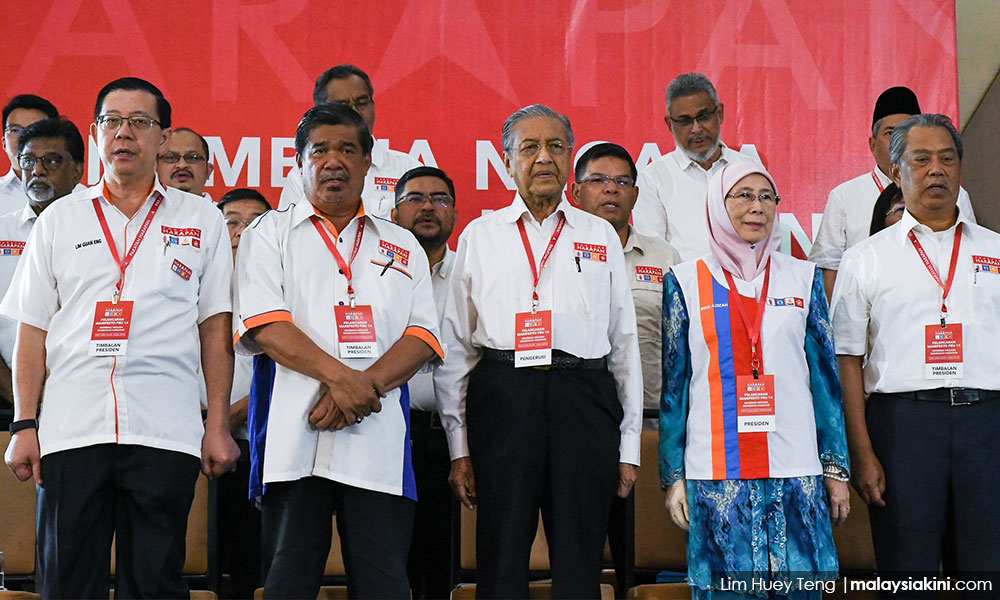
More than anything else it validates their claim that issues are discussed in the leadership council thoroughly and decisions arrived at by consensus.
Scepticism that this is so would now recede, in the wake of Mahathir tendering an apology, something he finds wholly repugnant.
Accumulation of nuances
Henry Kissinger, former secretary of state of the United States and originator of the shuttle diplomacy that made his tenure at the State Department famous, once aired his views on leadership to Hugh Sidey, a regular columnist in the 1980s in the renowned weekly, Time magazine.
Kissinger told Sidey that good leadership did not consist so much in the achievement of big breakthroughs as in an accumulation of nuances.
He said leaders were successful by dint of a hundred things done a little better; they suffered failure when a hundred things were done a little worse.
Kissinger deprecated the notion that leaders can learn their craft on the job. He held that if they came to office empty, they would leave empty.
Before becoming President Richard Nixon's national security adviser and then Gerald Ford's secretary of state, Kissinger was a scholar, one who in his academic works, was not so much interested in studying political institutions as in appraising historic leaders.
He found Germany's Iron Chancellor, Otto von Bismarck, the most riveting of the figures he studied. Bismarck was a brilliant deployer of Machiavellian court craft who used the skill to keep adversaries at bay and to weld antagonistic Prussian provinces into a united German nation - a grand achievement.
A view that Bismarck, a fascinating mix of egoism and ambition (no prizes for guessing his parallel in Malaysian politics), offered on his role as a leader does shed light on how he conceived his task.
He said he tried to “listen to the rustle of God's mantle in history and catch the hem of it for a few steps.”
In sum, a view of leadership that is both humbling and exalting. Which is the way Mahathir presently views his task.
He has said, apropos of his age, that he will not be around for long but he has an urgent task to accomplish – to save the country from the perdition that a manic kleptocracy has beckoned.
Towards that end, he has been prepared to do what he has never done – eat humble pie and say sorry for a mistake.
TERENCE NETTO has been a journalist for more than four decades. A sobering discovery has been that those who protest the loudest tend to replicate the faults they revile in others.
The views expressed here are those of the author/contributor and do not necessarily represent the views of Malaysiakini.


Are you sure you want to delete this comment?
This action cannot be undone.