




Is the French revolution over?
The famous French philosopher Jean-Paul Sartre had once remarked that violence is 'the beginning of humanity'. And as rioting black-blanc-beur youths and men stormed and torched Paris a desecration that had also threatened to engulf Europe Britain's Economist magazine was already trumpeting the end of the 'ambient violence'.
Ambient because the government of President Jacques Chirac welcomed it as a "near-normal situation". But that would goad Chirac, who had made himself as small as possible during the riots, into addressing the social, political and economic marginalisation of France's ethnic immigrants.
Just as Sartre hadn't articulated what the end of violence would look like for humanity, odds are that the crude, populist Chirac and Jean-Marie Le Pen, of the far-right racist National Front, hadn't a clue, either
The famous French philosopher Jean-Paul Sartre had once remarked that violence is 'the beginning of humanity'. And as rioting black-blanc-beur youths and men stormed and torched Paris a desecration that had also threatened to engulf Europe Britain's Economist magazine was already trumpeting the end of the 'ambient violence'.
Ambient because the government of President Jacques Chirac welcomed it as a "near-normal situation". But that would goad Chirac, who had made himself as small as possible during the riots, into addressing the social, political and economic marginalisation of France's ethnic immigrants.
Just as Sartre hadn't articulated what the end of violence would look like for humanity, odds are that the crude, populist Chirac and Jean-Marie Le Pen, of the far-right racist National Front, hadn't a clue, either.
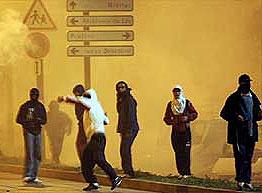 Yet what sparked the violent uprising, variously described by French intellectuals as a moment in French radicalism, can't be agreed on by various groups in French and indeed European political circles. If the
Economist
reckons all this will boil down to burning a torch under Chirac's uninspiring leadership by those opposed to him - including within Chirac's cabinet - it's right.
Yet what sparked the violent uprising, variously described by French intellectuals as a moment in French radicalism, can't be agreed on by various groups in French and indeed European political circles. If the
Economist
reckons all this will boil down to burning a torch under Chirac's uninspiring leadership by those opposed to him - including within Chirac's cabinet - it's right.
Besides the uncouth Le Pen, the interior minister and head of the ruling UMP party, Nicolas Sarkozy, is also upping the ante. Le Pen, who like Chirac hid as rioters rampaged through Paris and elsewhere in the republic, blames France's soft immigration policies. And Sarkozy, suddenly buoyed by opinion polls, has metamorphosed into a tough-talking bellicose cowboy.
Using terms like racaille (scum) to describe the rioters, Sarkozy wanted to expel these criminals. Sadly, that kind of talk will win Sarkozy votes from Le Pen's followers who, as in the 1968 riots, will overnight become rightwing nationalists.
Insipid platitudes
Addressing the problems of France's teeming Muslim Arabic and North African immigrants will be shoved aside again for immediate political gamesmanship: survival of the fittest in the run up to the 2007 presidential elections. Chirac will want to hang on to his job but no amount of insipid platitudes and rhetoric by him or opportunistic rightwing malarkey by his challengers will avert another and probably greater disaster upon an arrogant white-dominated France.
Conversely, the rioters, regardless of their anger at being marginalised, isolated and targeted by French authorities, including the police, would be too stupid to fly the flag of Islamism as their cause and way of integrating into the republic. And too stupid to be easily brainwashed by fundamentalist imams and mullahs on the payroll of certain Middle Eastern states who comfortably condone a jihad that kills innocent civilians.
An editorial in France's L'Humanite declared that the riots "did not reflect an isolated problem of suburban crime but a terrible failure of the policy or urban and social segregation that has been imposed for years on the people of these districts". Much of France's media bristled at the international criticism of state policy but generally admitted the problems facing its migr populations were deep-seated.
The Washington Post 's Jim Hoagland was less courteous, calling the forgotten people in France's ghettoes as "casualties of a particular brand of politically correct arrogance" that French politicians had been practising for 30-odd years.
And if anything, the riots should "illustrate to the French the dead-end nature of the physical and social architecture of building a tall fence around the country's five million to ten million Muslim immigrants and their offspring and then pretending they are essentially not there".
Germany's Der Spiegel added to what all of Europe had been thinking, out loud and quietly, of the unrest as "only the latest chapter in the difficulties Europe has been having in integrating immigrants," and warning that it could easily provide "a taste of what may well be in Europe's future".
Question remains
Whatever the real causes of the recent riots (two teenage boys from Clichy-sous-Bois, who thought they were being chased by police, hid in a power substation and were electrocuted), the image of France and Europe have been shattered. More than 15 years of state neglect has sunk these migr districts into ghettoes festering with deepening social, political, economic problems and, in more recent years, discontent within Islam.
But the more France and other European governments ignore the plight of their migr communities, the greater the possibility of their easy manipulation and recruitment by cowardly murderous terrorist organisations like Al-Qaeda.
France and for that matter Europe must start with tearing down its hypocritical idea citizenship, which is at best superficial. It only serves to further bastardise the French boast of being the world's first nation to enshrine human rights when, after the guillotine, the modern French state continues to treat its immigrants as second-class citizens who, almost everyday, are racially discriminated in education and the workplace. Catherine Audard of the London School of Economics calls it "a situation of the broken promise of integration".
It gives lie to the philosophies of galit and fraternit that both white and the migr children learn in French schools. Immigration and integration must become problems that will need to be resolved and not ignored.
But the big question remains: do French politicians, including Monsieur Chirac, have the political will to do the right thing for humanity's sake? Sartre may not have articulated humanity's end-point but it's not hard to guess what that will be. It's an ugly future if every country on earth ignores similar problems in their own backyard. The age of rebellions or indeed revolutions may not yet be over.
MANJIT BHATIA, an academician and writer, is also research director of AsiaRisk, a political, economic and risk analysis consultancy in Australia. He specialises in international economics and politics, with a focus on the Asia-Pacific.


Are you sure you want to delete this comment?
This action cannot be undone.