




A suggestion to the chief secretary
Chief Secretary to the Government Samsudin Osman protested that civil servants should not be singled out for anti-corruption drive on corruption. This appeared in the mass media, including malaysiakini too on Dec 9. He hinted that everyone has a role to play in this battle as well.
A day later, Suaram director Dr Kua Kia Soong lamented that Prime Minister Abdullah Ahmad Badawi has not shown the leadership and determination to eradicate this social cancer contrary to his earlier promises.
The message is fairly clear in that everyone wants to see the eradication of corruption, but nobody seems to know the best ways of doing so, not even the prime minister.
Chief Secretary to the Government Samsudin Osman protested that civil servants should not be singled out for anti-corruption drive on corruption. This appeared in the mass media, including malaysiakini too on Dec 9. He hinted that everyone has a role to play in this battle as well.
A day later, Suaram director Dr Kua Kia Soong lamented that Prime Minister Abdullah Ahmad Badawi has not shown the leadership and determination to eradicate this social cancer contrary to his earlier promises.
The message is fairly clear in that everyone wants to see the eradication of corruption, but nobody seems to know the best ways of doing so, not even the prime minister.
I wish to offer my 10 sen's worth of suggestion this apparent chicken and egg situation to the chief secretary. I resort to the Malay wisdom 'sesat di hujung jalan, balik ke pangkal jalan' (when you are lost at the end of the road, do a reversal, just backtrack to the beginning of the road).
I now try to recollect the features existing in the country 'at the beginning of the road'. I admittedly arbitrarily put this as at the time of the first two prime ministers Tunku Abdul Rahman, and Tun Abdul Razak
During their tenure, the country was a newly independent nation. But despite its infancy and tender years the government institutions we inherited from the British were pretty solid.
Specifically there was the clear demarcation of power and authority between the legislators or lawmakers, the executive or the civil servants, and the judiciary. Each party is independent of the other, so there is this check and balance system between the three branches.
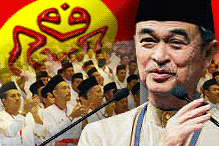
At the 'end of the road' i.e. at around the period after Tun Hussein Onn became prime minister and Tun Dr Mahathir Mohamad took over until today's Abdullah Ahmad Badawi, this fragile check and balance system of governance well and truly tested in many mature democracies, had sustained a tremendous fracture.
This fracture had developed at around the rise of the Ketuanan Melayu era soon after the May 13 1969 riots. As an aftermath the Malay-dominated legislature engineered some social engineering public policies. The Malay-dominated civil service was given the task of implementing the policies.
'Sensitive' policies
As these policies were controversial, the government did not wish for them to be actively debated in the public domain. Employment into the civil service was designed heavily in favour of the Malays, most probably to make it easier for the policies to be carried out. Thus the Malays dominated employment in the civil service and the armed forces.
These policies were then classified as 'sensitive' and not to be subjected for public debate. Laws like the infamous ISA, the Official Secrets Act, the Printing Presses and Publications Act were then enacted or perfected to prevent open debate and discussion. These laws have effectively put the people in a state of confusion and fear.
Confusion because the government has always told the people that all corruption cases will be dealt with if evidence and proof are produced. These words of encouragement sound good until it is realised that the government is not about to release government secrets; people who somehow manage to secure them may be charged under the Official Secrets Act. Fear because under the ISA, a person may be taken into detention without any charge.
Effectively the general population was gagged, thereby disabling them to forward their input, reactions and feedbacks to these policies.
Market forces of the capitalistic economic system were tampered with impunity. The independent civil service was hijacked to become subservient to the legislators. The independence of the judiciary was undermined. Muslim clerics got into the picture and claimed leadership role, relevance and legitimacy in the running of the otherwise secular government. The police department also took the cue and are known to be quite creative in discharging their duty and responsibility in maintaining public order.
In short, the delicate check and balance system of good democratic government was completely broken.
Without any check and balance, the warning of Lord Acton that "power corrupts and absolute power corrupts absolutely" came unmistakeably into fruition. Pandemonium ensued.
Malay racist tendencies came into full gear. When the Malays were trying to exert their hegemony and leadership they were trying to be very 'Malay', very Muslim and very nationalistic. They were championing the rallying call of untuk ugama bangsa dan negara too literally. They went headlong into propagating the interests of the ugama and bangsa while forgetting the negara part.
Civil servants become yes men to political interests at the expense of the interest of the general population. There were many instances of breakdown of institutions, like the falling of education standards, and the disfiguration of the judiciary.
Unfortunate features
I can go on listing the breaking down of institutions and degeneration of social life, but let me not harbour the point too much in detail. Suffice it is for me to say that the unintended consequences have yielded some more unfortunate features:
 One, the rise of the religious leaders whose main aim seems to maintain the conservatism of the Malay mind and the preservation of the status quo. These leaders would somehow find the 'Third World' mentality of the Malay ideal for this era. In effect they were trying to uphold and propagate the rise of the Malay civilization under the threat of oblivion from the incoming forces of modernity.
Two, the rise of corruption to an obscenely stratospheric level, the main issue of this writing; and, three, the creation of a massive cleavage in the social fabric of society.
The situation might not have been so bad had the targets of the massive and concerted social engineering programmes had achieved the targets they were meant to achieve.
But lately the prime minister again has stated that in the earning patterns within the country, for every one ringgit the Malay earns, the non-Malay earns RM1.80. He then used this set of statistics to rationalize his decision for the NEP to continue despite his earlier exhortations for the Malays to be out of their crutches and be towering figures. (The contradiction is alarming, but we shall not delve into this issue here).
I come back to the main issue: just what can the chief secretary do to eradicate corruption? I say he should just work to 'balik ke pangkal jalan' i.e. to restore the eroded check and balance system between the legislators, the executive and the judiciary.
How can he set about to do it? As a service chief presently under the yoke of political masters, he is not entirely without recourse to correct the situation. By his own admission 'civil servants and public officialshold the power and authority that affect ordinary people's lives'. He has to be more aware to the fact that as a civil servant the people have bestowed upon him considerable administrative power and authority.
He can then use this power to say no to the legislators whenever they step beyond their boundaries. On no account must the civil servants be made into a position of subservience to the politicians.
Create the environment
How can this be done? He should work with intellectuals and independent public representatives to create greater transparency in government operations, and greater public input and participation in formulating policies. To achieve this he has to exorcise and dispel the debilitating elements of confusion and fear. For this he can work towards repealing some of the more draconian laws that had been used or perfected by the legislators.
 Of course this can't be done overnight. But the civil service under his leadership must create the environment conducive for the repulsion and abrogation of these repressive laws.
Why should I be bothered by all this? Why not? I am a citizen of this country. I was born here and place my full love and loyalty here. But I also know that it is going downhill very fast. For one, the people are split into two broad categories Malay and non-Malay despite the government's curious plans to develop a 'Bangsa Malaysia'.
Also, religious orthodoxy could easily drive believers into religious extremism. My feeling is that there is a very thin line between orthodoxy and extremism in this context. Orthodoxy is exemplified by the need for the Malay to be 'Syariah compliant' to everything he does, and extremism is illustrated by a Malay bomber creating havoc in Indonesia.
Racial and religious divisiveness especially between the Malays and the non-Malays is becoming more overt each day, despite the government protestations and tourism board propaganda that we are all living in peace and harmony. Frustration and despair seems the order of the day for the marginalised non-Malay citizens.
The immediate impact is dire. This can be seen when young and not-so-young people, many of whom are skilled professionals are migrating to countries anxious and happy to receive them. There is hardly anybody who does not have a son or daughter, brother or sister, uncle or auntie, or cousin near or distant, who has migrated or is making active plans to do so.
In the meanwhile the economy is facing challenges from external competition especially from the newly emerging super economies like China and India. Foreign investment is trickling with many already within the country making plans to relocate to more competitive greener pastures.
Not too late
With the bright and talented young generation leaving or making plans to leave, just who will be manning the factories and protecting the investments? Who will be taking over the mantle of leadership in future? My bet is this: the presently unemployable graduates of today, and their successors, all basking in the comfort zone of government protection. God help us then for these otherwise well meaning individuals just do not have the technical, scientific and management acumens to shoulder their responsibilities competitively, effectively and professionally. The competitiveness of Malaysia as an economic powerhouse is at serious risk.
Is it too late for Samsudin Osman to initiate the climate of reversal of these laws and thus help eradicate corruption? He is after all at the end of his long and illustrious tenure as a very senior civil servant. For this, do allow me to narrate an old Chinese folklore, which is only fair for I began this writing by quoting a Malay wisdom:
A traveller was travelling deep in the countryside when he chanced upon an old man digging the soil at the slope of a hill.
Feeling curious, the traveller asked, "Old man, what are you doing?"
The old man replied "I am levelling this hill to grow some vegetables for my family."
"But are you not too old to do this?"
"Oh, I am not worried. My son is here to continue levelling this hill when I am gone."


Are you sure you want to delete this comment?
This action cannot be undone.