




When 'journalism' is public relations
The greater reason for the crisis in journalism in Malaysia today is with the government. That does not mean the media or its practitioners evade blame. Journalism is after all the megaphone to authority.
The media in Malaysia is not independent but owned by commercial or political groups, and all that matters is the balance sheet, not its reporting.
Yes, there is. The current furore over a cartoon drawings and of the Prophet Muhammad shows how angry people can be. The herd mentality takes over.
The greater reason for the crisis in journalism in Malaysia today is with the government. That does not mean the media or its practitioners evade blame. Journalism is after all the megaphone to authority.
The media in Malaysia is not independent but owned by commercial or political groups, and all that matters is the balance sheet, not its reporting.
Yes, there is. The current furore over a cartoon drawings and of the Prophet Muhammad shows how angry people can be. The herd mentality takes over.
The cartoons were drawn in the West to annoy the Muslims. It was deliberate, though this is dismissed there as freedom of expression. But every freedom has its rights and obligations.
Publishing the cartoon, when the West is at war with Islam, was meant to evoke the response it has.
But the comic strip in the New Straits Times (NST) was making fun of cartoonists, not of the Prophet. Good sense and reason go overboard when politicians, not necessarily from the government, think otherwise to gain public support.
In south-eastern Nigeria, where Christianity is the dominant religion, the Christians and Muslims fight and 150 people are killed.
In many ways Malaysia is in the same boat as Nigeria: Muslim is the official religion, most of the country are Muslim but parts are not. In Malaysia, Sarawak and Sabah have a Christian predominated population, Protestant in the former and Roman Catholism in the latter. As in Nigeria, many are animists.
It takes but a rumour or word-of-mouth to fan a clash between the religions. In Malaysia, the government has kept the lid on. It talks of unity but believes in keeping the races separate. The country is racially divided, and soon in terms of religion, too.
The people in authority know this. The newspapers are controlled by the ruling coalition Barisan Nasional (BN) through its component parties or its components, and spread the message but not what that has caused.
Slavish political orientation
Umno rules the roost in BN. The NST is owned by a party-linked conglomerate, its editor is appointed by the prime minister. Its editor knows which side his bread is buttered on, and acts accordingly.
The NST reports fearlessly on countries and individuals who cannot fight back. It acts as a public relations arm of the government.
It used to be the best-selling newspaper in the country but is now third, behind the free newspaper, The Sun . The NST used to sell more than 300,000 copies daily but can only manage about 120,00 now.
 The decline in leadership can be blamed on its slavish political orientation, with reporters not reporting what should be and its recent editors are mediocrities, selected so that Umno can be comfortable.
It does not report opposition activities, except occasionally to show its 'independence'. Like all newspapers, its journalists do not usually write their reports until they have seen the sanitised Bernama version of the event. It does not often, like most newspapers, quote Bernama as the source, and the report would appear in other newspapers.
The New Straits Times Press has spawned The Malay Mail, Berita Harian, Harian Metro , among others. Every editor of the group is selected for his Umno, not BN reliability. In recent years, the prime minister selects or okays the name. To make it easier to control, one of his close aides or man he trusts is made editor-in-chief.
 Dr Mahathir Mohamd (
photo
), when prime minister, appointed Abdullah Ahmad, the former MP for Kok Lanas, a former deputy minister and political secretary to second Prime Minister Abdul Razak Hussein
Dr Mahathir Mohamd (
photo
), when prime minister, appointed Abdullah Ahmad, the former MP for Kok Lanas, a former deputy minister and political secretary to second Prime Minister Abdul Razak Hussein
Current premier Abdullah Ahmad Badawi appointed Kalimullah Hassan and after he stepped down, Hishamuddin Aun.
Kalimullah promised the NST that no action would follow the publication of the cartoon, even if opposition parties, including PAS, NGOs and others had lodged a police report.
'Soft news'
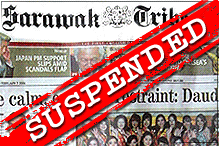
Given the harshness with which the government dealt with the Sarawak Tribune , in effect closing it down, and penalised Chinese newspapers for carrying stories it did not like, the NST must be penalised.
 Mahathir, when he called for the suspension of the
NST
editor, said what those up and down the peninsular are talking about.
Mahathir, when he called for the suspension of the
NST
editor, said what those up and down the peninsular are talking about.
What the NST did could be justified on the grounds of freedom of expression, but not if it upsets one or other races or religion in this multi-racial country.
The NST is as guilty as the Sarawak Tribune in printing cartoons that are deemed offensive. If the government flinches in the case of the NST , it would have ramifications in Sarawak and Sabah as well. It cannot fight a hostile crowd led by the government.
The other newspaper Umno owns is the Utusan Malaysia group. But it takes its orders not from the prime minister but from other leaders in Umno. Its former editor-in-chief is now Information Minister Zainuddin Mydin. Pak Lah is trying to bring the Utusan Malaysia group into his clutches, but so far has not succeeded.
But this is not in case of The Star . It is owned and run by the MCA, and it supports the Umno leadership, so that it can continue to be financially successful. Many MCA leaders complain of not getting any coverage, particularly if they are opposed to the current leadership of their party.
The government will not think twice to take action against the MCA's paper, as it did in 1987. So the paper will not report or write anything which offends the ruling men and women.
 In the absence of informing the people what happens in the country, the superficial fights of the leaders with the newspapers are regarded as more important that news on the ground.
MPs, who normally do not visit their constituencies, prefer to keep quiet when asked questions, but are quick to join any campaign which will give it support.
Reporters following them are more interested in what they can get than reporting. The emphasis these days in on 'soft news'. People do not read newspapers to be fed with propaganda or even news about accidents, telling them nothing of what happens, except accidents and crime.
It is no wonder the circulation of these newspapers is not what it should be. To reverse the trend, reporters should be told to report what those in authority would rather they do not. Even the worm turns.
The newspapers should also have opinion pieces on local matters. But this is asking too much of newspapers that decide that their prime role is not to annoy the government.


