




For whom the bell tolls
Ernest Hemingway would no doubt be extolling this aphorism from his grave, which was the title of his magnificent classic novel. Thailand's version of George W Bush as the boy emperor, Thaksin Shinawatra, would obviously be denigrating the idea as silly and completely out of touch with the realities of contemporary Thailand and nothing to do with the Spanish Civil War in the 1930s which Hemingway had covered as a foreign correspondent.
 Thaksin thinks about a lot of things, though mostly with his branded indignation and arrogant impudence, especially of his domestic and foreign critics. Still, the bell now tolls for Thaksin as prime minister. And it is clanging ever louder. Even Thailand's King, the maker or breaker of Thai governments, elected or otherwise, has whispered in Thaksin's ears, metaphorically, using images of the past that have made previous prime ministers redundant in an instant. Thaksin may feign deafness, even blindness. But does he know his time is up? Given his mulish stubbornness, what will it take to oust him?
Ernest Hemingway would no doubt be extolling this aphorism from his grave, which was the title of his magnificent classic novel. Thailand's version of George W Bush as the boy emperor, Thaksin Shinawatra, would obviously be denigrating the idea as silly and completely out of touch with the realities of contemporary Thailand and nothing to do with the Spanish Civil War in the 1930s which Hemingway had covered as a foreign correspondent.
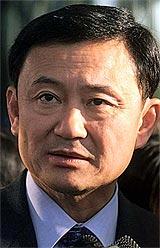 Thaksin thinks about a lot of things, though mostly with his branded indignation and arrogant impudence, especially of his domestic and foreign critics. Still, the bell now tolls for Thaksin as prime minister. And it is clanging ever louder. Even Thailand's King, the maker or breaker of Thai governments, elected or otherwise, has whispered in Thaksin's ears, metaphorically, using images of the past that have made previous prime ministers redundant in an instant. Thaksin may feign deafness, even blindness. But does he know his time is up? Given his mulish stubbornness, what will it take to oust him?
On March 12, Thai state television stopped programming midstream to air footage of King Bhumibol Adulyadej intervening in a 1992 uprising. Then military ruler General Suchinda Kraprayoon and protest leader Chamlong Srimuang were instructed to end the political crisis peacefully through talks. But Suchinda resigned after the broadcast. The broadcast, with the Palace's nod, is designed to tell the premier and his rivals to hold talks to resolve a standoff that has deepened the political crisis in Thailand.
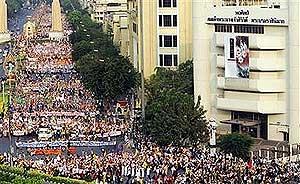
But it is a crisis borne by Thaksin's own governing incompetence, his bald attempts at personalising executive power towards neo-authoritarianism, deliberately fanning among Buddhists anti-Muslim sentiments in southern Thailand, charges that he has been sneakily undermining the king's authority, and questions of his morality in the face of growing allegations of family corruption. In a country whose people revere the Palace, it's this allegation against Thaksin which has split anti-government protestors at mass rallies in Bangkok, converging on Government House, from the list of other charges of crookedness.
Election boycott
Now word is that Thai voters are likely to mass boycott the polls on April 2. Thaksin called the election in a bid to cement his apparent democratic bent. Yet voters aren't being fooled by his sly. Still reverberating among many urban educated Thais is how Thaksin bought his way into power at the last poll by paying off poor villages in far-flung Thailand. But hinterland Thailand is only a little better off, purely because Thaksin put much of his political capital in aiding rural Thais in money-terms. But urban Thais see the insidious side of Thaksin; for one thing they re also turned off by Thaksin sanctioning trigger-happy, gun-totting Thai police to cold-bloodedly murder drug suspects in Bangkok s backstreets in what is nothing more than state-backed public execution.
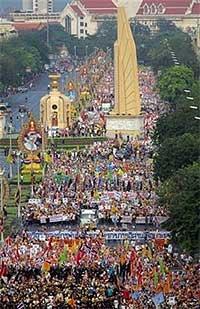 The last straw came when Thaksin, a billionaire businessman who inherited his father's wealth, sold his flagship family business, the giant telecommunications company Shin Corp, to the Singapore government owned Temasek Holdings for 74 billion baht and, incredibly, he's not liable to pay tax on this whopping profit. If Thais feel screwed, they're justified in taking their anger out at him and his bungling government and cabinet. Save for a handful of former ministers and senior bureaucrats, none in Thaksin's cabinet have had any morsel of morality and self-respect to cross the floor against their blustering, bullying boss.
Faced with growing anger in the Bangkok s streets by anti-government protestors, Thaksin on March 15 alluded to the idea that he may step aside while his business deal with Temasek Holdings is investigated, and if he ought to pay tax on the profit. So far he has vociferously defended the deal and refused to acknowledge that he ought to pay tax. He's able to defy gravity simply because many rural Thais still support him after he has cleverly marketed State benefits to them. And here s the rub: for the most part, it has been the Assembly of the Poor, the largest and most influential rural activist group, that has been at the heart of the oust-Thaksin campaign.
But don t think Temasek Holdings is at all affected by any morsel of morality by Thaksin's scandalous and disgraceful abuse of public office. Singapore's premier Lee Hsien Loong reckons the deal to buy Thaksin's Shin Corp was just that - a business deal. That's true. And don t expect Temasek Holdings to suddenly develop a sense of proportion and consciousness; it won t go back on the deal. It s far too important an investment: Singapore wants to become the regional hub for telecommunication, and it is slowly building an empire.
Refusing to bow
After all, to be fair, it was Thaksin and his family's decision to sell to a ready buyer, though private approaches had been made by Temasek Holdings, which has a seemingly bottomless pocket of cash. Yet this kind of bloody-mindedness is normal in Southeast Asia, where the Singapore government actively cavorts the brutal militarist dictatorship in Burma for lucrative business opportunities for Singapore Inc. That s despite world condemnation of the corrupt junta and its blatant, systematic abuse of human rights.
 On March 16, Thaksin had a change of heart: he decided he would be staying put in his job until a decision on his future is made on April 2. He said he would not bow to mob rule. Only a man who is out of his mind would bow to mob rule, he told his supporters. He declared that only one man could force him out of office, and that's the king, when he whispers in my ear.
The Nation
, Thailand's leading and gutsy daily, emblazoned the headline the very next day: 'The King whispers. Thaksin is still there'.
On March 16, Thaksin had a change of heart: he decided he would be staying put in his job until a decision on his future is made on April 2. He said he would not bow to mob rule. Only a man who is out of his mind would bow to mob rule, he told his supporters. He declared that only one man could force him out of office, and that's the king, when he whispers in my ear.
The Nation
, Thailand's leading and gutsy daily, emblazoned the headline the very next day: 'The King whispers. Thaksin is still there'.
What will it take to get rid of Thaksin and he has to go, given he hasn't the broad legitimacy of Thais to rule on their behalf? Thaksin won't also bow to the king. That's clear. But he'll have to bow to the ballot when it casts its vote on April 2. But Thailand is like Singapore: fundamentally a one-party state. The election will be a one-horse race. And unless rural Thais come out in force and unite with anti-Thaksin urban protestors, Thaksin will likely stay in office. He will be 57 in a few months, but geriatric dictators have a nasty habit of sticking around past their use-by dates. That's one number Thaksin can't seem to read, or won't, no matter how loudly the bell rings.
MANJIT BHATIA, an academician and writer, is also research director of AsiaRisk, a political, economic and risk analysis consultancy in Australia. He specialises in international economics and politics, with a focus on the Asia-Pacific.


