




Storm in the teh tarik cup
Umno Youth came into existence on March 2, 1947, a small unit or department of youth affairs under Umno. On Aug 26, 1949 incidentally the same year MCA was born - or three years after Umno was established - Umno Youth became a separate organisation.
Known then as the Perikatan Pemuda Umno and led by the late Hussein Onn (Malaysia's third prime minister), its main role was to encourage youth membership and help strengthen Umno.
In recent years, there has been the perception, rightly or wrongly especially among non-partisan Malaysians that the Umno Youth lacks a certain credibility.
Umno Youth came into existence on March 2, 1947, a small unit or department of youth affairs under Umno. On Aug 26, 1949 incidentally the same year MCA was born - or three years after Umno was established - Umno Youth became a separate organisation.
Known then as the Perikatan Pemuda Umno and led by the late Hussein Onn (Malaysia's third prime minister), its main role was to encourage youth membership and help strengthen Umno.
In recent years, there has been the perception, rightly or wrongly especially among non-partisan Malaysians that the Umno Youth lacks a certain credibility.
Recent incidents involving a small segment of 'firebrand' rank-and-file leaders were seen not only as lacking statesmanship but as tarnishing the entire movement. Umno Youth today is branded as "arrogant and a "promoter of provocation" in handling many national issues affecting non-bumiputera interests.
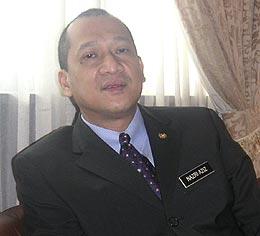 If Umno is widely regarded as the backbone of our political system and nucleus of the nation's administrative machinery, then Umno Youth naturally takes on the place as the nursery of future leaders.
In 1995, Mohd Nazri Abdul Aziz said in an interview in his capacity as acting Umno Youth chief, that "the Youth wing has no intention of playing critic or even a check and balance role".
He added that Umno Youth's role was primarily "helping the leadership implement government policies" in the capacity of "pendorong wawasan".
Quality of leadership
The recent episode involving Umno Youth Kelana Jaya division chief Abdul Halim's ultimatum to Kelana Jaya MP Loh Seng Kok over his speech in Parliament on religion and politics has triggered an avalanche of public criticism.
Many have asked about the role of Umno Youth. Should it be a party within a party? Is it politically correct for the Kelana Jaya Umno Youth to behave in such an arrogant and intimidating manner especially when the relevant issues were pertinently raised under the process of parliamentary democracy and privileges?
A critic did not mince his words: "I find Umno Youth to be the great perpetrator of race-based politics. If there is any danger of disharmony, it would probably be caused by these goons. It's time the Umno seniors clipped their wings."
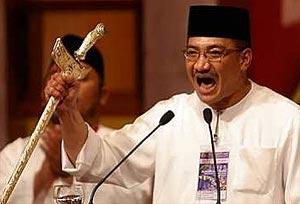 Other Malaysians were reminded of the 'keris' incident as a chief characteristic of today's Umno Youth leadership, thus disproving the claim that Malaysians have a short memory.
Following the heyday of Umno Youth's original aim to recruit and train future leaders, the movement had been perceived by outer circles as lacking an intellectual image and much in need of political maturity. Today, the quality of leadership has improved somewhat but pro-confrontational type of leaders occasionally rear their ugly heads and tarnish the entire movement's image.
Dr Baker Hamid of the Writers' Academy and a former sociology professor, in an interview in 1995, pointed out that the Dr Mahathir Mohamad administration had effectively pre-empted many issues that would had otherwise been championed by segments like Umno Youth.
"It leaves little room for manoeuvrethe fact that the top leadership was strong and focused," he said.
The Youth wing has once again been put into the spotlight of public scrutiny and criticism. Since its early days as the 'conscience of Umno, it has taken to confrontational approaches with critics labelling them 'troublemakers'.
In the 1970s, Youth leader Syed Jaafar Albar had tried his best to channel the radical energies of the movement into something more constructive, to fill the role of a 'ginger group' (meaning fiery to the tastebuds but good for health), as he called it.
In recent years, certain confrontational incidents instigated by some of its leaders made news headlines. Examples include a demonstration and threat to burn down the Chinese Assembly Hall in 1999 over the Chinese language issue, as well as the widely reported incident of an Umno Youth-led 'mob' storming into the Second Asia-Pacific Conference on East Timur in 1996.
Different directions
Political observers said this trend demonstrates a sad lack of synchrony between Umno Youth and Umno. The leadership seems to be pulling in opposite directions and its actions are divergent to those of its parent body.
The Umno-headed BN government, through its propagation of mantra-like rhetorical speeches on building national unity, civil society and empowerment of Malaysian citizens, is not reflective of overzealous politicking and confrontational behaviour by some Umno Youth leaders.
Public voices against such types of leaders with domineering arrogance and intolerance toward issues particularly affecting the interest of other communities are growing louder by the day. The confrontational approach and show of threats are outdated mindsets and incompatible to the call by Prime Minister Abdullah Ahmad Badawi to "work with" him.
Isn't raising relevant issues and pertinent concerns in Parliament a responsibility of an elected member to constituents?
By threatening to take action against another member of the BN family for raising pertinent issues in Parliament is tantamount to serving MCA with a 'summons'. This type of unilateral action should not be tolerated and Umno Youth candidates standing for the next general election should be reminded that they will be closely scrutinised by Malaysian voters.
They can no longer behave like chameleons changing their colour in cherishing hopes of being elected. Some past leaders have been accused of using the Youth wing as a vehicle to propel along their political ambitions.
"Umno Youth accomplishments were not achieved in an instance but through the sweat, tears and blood of past leaders. We are just the trusteesthe Umno Youth spirit and strength is still alive and we can be the main party leadership," remarked Hishammuddin Hussein Onn when he was acting Umno Youth Chief in 1999.
All said and done, Malaysian voters will judge the endorsed candidates against this remark at the next general election.
STANLEY KOH is a Buddhist Monk and works for a local think-tank.


Are you sure you want to delete this comment?
This action cannot be undone.