




Battle for Nepals soul
A sea-change of sorts is afoot in the Himalayan kingdom of Nepal, but if King Gyanendra, the archetypal monarchical despot who grabbed power in February last year via a coup, thinks the change will favour him, he's deluding himself.
His palace is under greater siege every day by Nepali who have formed a loose alliance against his abominably brutal and authoritarian rule. Gyanendra's fall is inevitable. But when? And will Gyanendra flee Nepal, as history's despots often do? Because he wouldn't want to be caught and flogged by his own people.
Apart from Gyanendra's staunch nationalist supporters, Nepalis in general are angry. They're incensed. The Nepali monarchy was never benevolent. Nepalis are sick and tired of a corrupt monarchy which, since 1960, has given its subjects uninterrupted economic and political stagnation.
A sea-change of sorts is afoot in the Himalayan kingdom of Nepal, but if King Gyanendra, the archetypal monarchical despot who grabbed power in February last year via a coup, thinks the change will favour him, he's deluding himself.
His palace is under greater siege every day by Nepali who have formed a loose alliance against his abominably brutal and authoritarian rule. Gyanendra's fall is inevitable. But when? And will Gyanendra flee Nepal, as history's despots often do? Because he wouldn't want to be caught and flogged by his own people.
Apart from Gyanendra's staunch nationalist supporters, Nepalis in general are angry. They're incensed. The Nepali monarchy was never benevolent. Nepalis are sick and tired of a corrupt monarchy which, since 1960, has given its subjects uninterrupted economic and political stagnation.
This has compounded and widened ethnic, caste, regional and social inequality and tensions. More, these conditions are fodder for armed Maoist rebels. Their militancy is finding new recruits and more political support, if only silently. Their drive towards the palace gates is gaining greater momentum. Worse for Gyanendra and his coterie of corrupt and incompetent ministers and bureaucratic elite, the Maoists are backed by a cross-section of powerful political and civilian forces.
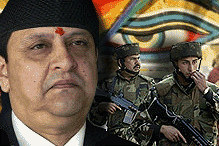 In macabre Macbeth-ian reincarnation, Gyanendra probably sees the writing is on the wall. Televised images of the anti-Gyanendra protests show these have turned more violent. And it's not the protestors who are being repelled but the security forces themselves who, curiously, are now resorting to urban guerrilla tactics of hit-and-run.
When it gets to this, as the late Ugandan military strongman Idi Amin would tell Gyanendra or Zimbabwean prime minister Robert Mugabe would quietly acknowledge, there's no chance to replay history to save the regime. Nepal's Panchayat democracy, a scurrilous model of Gyanendra's late king brother Mahendra, now lies in ruins, and regime change is only a matter of time.
So what was Gyanendra thinking when he assaulted Nepali democracy early last year, backed by the army? Simply: absolute monarchical power. He had used the Maoist insurgency as an excuse for his actions.
True, the Maoists have been no less brutal in their armed struggle to rid Nepal of the monarchy. And, true, monarchies are by and large derelicts of the past and bear no relevance whatsoever for a nation going forward. History has proven this repeatedly. But when Gyanendra started locking up democratic leaders, human rights activists and journalists, critics agreed he had gone too far. Or is loopy.
Diplomatic impotence
International condemnation of Gyanendra came swiftly. India and Britain immediately cancelled military aid to Nepal. The Bush administration sat on its hands. Fearing more criticism and being isolated, Gyanendra promised he would restore democracy within 100 days. He also said he would wipe out the Maoist rebels. All well and good, according to a gullible Washington. But when Gyanendra was pressed by his foreign critics and supporters, he offered this tarot-card clarification: There really was no plan. It was just something on the cards.
So now we know.
Fact is, the Maoist rebellion continues unabated. The economy is in shambles, probably in worse shape than Burma's and no better than that of Afghanistan's or Iraq's. Tourism, vital for Nepal's foreign currency revenue, is effectively dead. Political stagnation is a misnomer. Like Iraq, Nepal is verging on civil war.
In the villages, Gyanendra's royal army is fighting a pitched battle for supremacy against Maoist insurgents, but both are also directly competing with each other on who can perpetrate the vilest forms of human-rights abuses. At the same time the palace has been secretively recruiting and arming local militias no better than thugs to seek and destroy suspected Maoist sympathisers. Meanwhile, Gyanendra, like Macbeth, hides in the palace guarded by his royal troopers.
In April last year, Gyanendra lifted emergency rule, only to slam it back again. He moved swiftly to arrest the democratically-elected prime minister. And he has so far resisted moves to testify at a royal commission into corruption. He has continued to arbitrarily arrest political leaders and activists, including students. His Gestapo-like secret police has continued to intimidate journalists in their homes or at their desks.
Meantime, Gyanendra exacerbated the crisis by seeking to hold municipal elections. This move is self-aggrandisement at best: only his notoriously corrupt people will win seats in a poll that will no doubt be rigged.
Although Gyanendra had agreed last year to United Nations-led human rights abuse monitors, the situation has worsened. It again shows up the folly of the UN and its leadership, and the farce of the powers and legitimacy it claims to still hold. If it has any morsel of power left, it could have moved against the Nepali regime in ways that could bring it to its knees, critics say. That's easier said than done. As Iraq has shown in the face of sanctions, citizens will be hurt more than the regime.
The only way forward to resolving the crisis is if both Gyanendra and his chief enemy, the Maoists, agree to seek pathways to democratic and economic reforms. But while the Maoists have agreed to this time and again, Gyanendra has repeatedly weaseled out. Why? He fears the devolution of his powers as an absolute monarch, and very possibly being found that large-scale corruption starts and ends with the palace. That's not something the king can stomach.
In the absence of broader international pressure, the battle for Nepal's soul will continue increasingly in bloody form.
The bloodletting will only worsen, but since Nepal is of little or no strategic value to the world's major powers, it will be left fight out what will inevitably become a civil war. And the losers will be innocent Nepali men, women and children, their aspirations downed in their own blood.
MANJIT BHATIA, an academician and writer, is also research director of AsiaRisk, a political, economic and risk analysis consultancy in Australia. He specialises in international economics and politics, with a focus on the Asia-Pacific.


Are you sure you want to delete this comment?
This action cannot be undone.