




Betrayal in the dark corridors of power
The Malaysian political landscape has become a little different as soon as it was spoken out loud. It was none other than former premier Tun Dr Mahathir Mohamad known for his sharp tongue; an edged tool continues to grow keener with constant use.
Many were jolted by the latest episode of sharp criticisms directed at the current leadership while lapdog journalists and pro-Abdullah Ahmad Badawi's camp strategically overnight conducted themselves on a temporary defensive mode. Within 24 hours, obedient mainstream newspapers sanctioned to report the interview of Mahathir deliberately carried sensational captions read by millions of Malaysians across the nation.
The corridors of political power has once again become a national focus alongside the sideshow of the MIC party elections. Malaysians by now should be forgiven for concluding that there are two kinds of politicians - the one who makes it and the other, who endures it. But in the arena of politicking, technically there is little choice. Malaysians cannot practice the wise saying, 'Don't throw away the old bucket until you know whether the new one can hold water'.
The Malaysian political landscape has become a little different as soon as it was spoken out loud. It was none other than former premier Tun Dr Mahathir Mohamad known for his sharp tongue; an edged tool continues to grow keener with constant use.
Many were jolted by the latest episode of sharp criticisms directed at the current leadership while lapdog journalists and pro-Abdullah Ahmad Badawi's camp strategically overnight conducted themselves on a temporary defensive mode. Within 24 hours, obedient mainstream newspapers sanctioned to report the interview of Mahathir deliberately carried sensational captions read by millions of Malaysians across the nation.
The corridors of political power has once again become a national focus alongside the sideshow of the MIC party elections. Malaysians by now should be forgiven for concluding that there are two kinds of politicians - the one who makes it and the other, who endures it. But in the arena of politicking, technically there is little choice. Malaysians cannot practice the wise saying, 'Don't throw away the old bucket until you know whether the new one can hold water'.
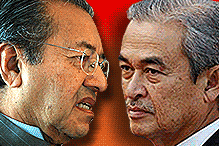 We are told never to cross the bridge until we come to it, but this world is owned by powerful politicians who have 'crossed bridges' in their imagination far ahead of the crowd. Not that Mahathir owns the world but he was once a powerful political leader and prime minister who called the shots.
At least he has imagined what type of successor he wanted before he actually retired. In 1997, during an interview by Cable News Network interactive news programme, he was asked this question: 'By setting the nation about 30 years ahead with Vision 2020, what kind of person do you see in a successor a visionary or a manager?' Mahathir replied: 'I should think we need managers more than visionaries. If people keep on looking into the future and do not do anything, we are not going to reach there and achieve what we have targeted for'.
The former prime minister now has admitted he has the habit of making 'wrong choices'. 'What happens to Malaysia after you are gone?' an e-mailer from England asked Mahathir during the 1997 interview. He replied, 'I don't think anything very radical will change just because I am not around. We have a very cooperative and cohesive leadership. In Malaysia for the past 40 years, we have had successions of leaders without any real upheaval. Now I have designated my successor. There should not be a problem.'
But with the benefit of hindsight, Mahathir's own vision of his version was largely off the track.
The tainted arena
Most sensible Malaysians may morally think that gratitude is a duty which has to be paid but according to some 'spin doctors' sympathetic to the incumbent leadership, no one has the right to expect.
The former prime minister may have learnt it the hard way now. The arena of political power is similar to the law of the jungle where the fittest survives. Despite widely publicised spiritual guidelines and lip service on building morals and integrity, it is a rare sign of practice in our Malaysian political culture especially when a leadership crisis takes place.
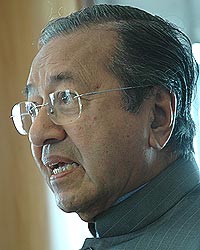 Principles become modified in practice. So do not blame the cynics for saying that a 'promising young man should go into politics so that he can go on promising for the rest of his life', especially if he is politically well-connected.
Universal values like gratitude and friendship are fleeting illusions because to survive in politics, actors have no eternal friends and no eternal enemies. It is said politicians often rise above their principles and the former prime minister should know like the back of his hand that it is 'normal' in the political arena for those he had helped in the past to betray him now.
Nothing lasts forever in the nature of politics. The negative characteristics of Man best exhibits in the tainted arena of politics.
Sir Winston Churchill once quipped that a politician needs the ability to foretell what is going to happen tomorrow, next week, next month and next year. He added, 'Especially the ability afterwards to explain why it did not happen'.
On Aug 31, 1997, a former MCA president presented his highest accolades to Mahathir at the party's 44th annual general assembly. 'These are Mahathir qualities strategy, compassion, fairness, tolerance, hardwork, determination, that ever-enquiring mind, that ability to communicate new and original ideas to the masses, social engineer par excellence. Sir, these should not remain Mahathir's qualities, but should become 'Malaysian Qualities' (MQ) that every Malaysian should aspire to have, every Malaysian should strive to acquire'.
The ants suffer
Hence, it is not surprising that this painted legacy of Mahathir's characteristics are currently being undermined by lapdog journalists and particularly by his former staunch supporters who had once adored him but are now accused of 'backstabbing' him.
The former prime minister is being psychologically dissected by certain quarters publicly to provide some logical reason for his outspoken behaviour. 'That Dr Mahathir legacy is being undone,' a lapdog journalist said. Some protagonists assisted by 'spin doctors' hoped that Mahathir will get a publicity backlash by whipping up public opinion to discredit him further.
Seasoned political observers agreed that there are only two forces that unite politicians. The answers are fear and instinct. The instinct of self-vested interests and political survival holds true for mediocre political leaders. No political subordinate dares to tell his political master in power that his face is dirty. Winning is not everything to the ordinary Malaysians but to the large majority of political actors already in their comfort zone, 'loyalty' to the incumbent power that feeds them is a Hobson's choice.
 Perhaps, Mahathir should take a leaf of advice from Richard Nixon. 'When I retire, I'm going to spend my evenings by the fireplace going through those boxes. There are things in there that ought to be burned,' the former American president said.
Or Mark Twain who said, 'If you pick up a starving dog and make him prosperous, he will not bite you. This is the principal difference between a dog and a man'. Not forgetting that to the unscrupulous politician, truth is not eternal but changeable and in the art of politics, confusing both truth and knowledge is only a matter of interpretation in the war of words.
In the animal kingdom, when elephants fight or make love, the ants suffer. Malaysians could do well to learn lessons from this episode. Firstly, nothing lasts forever in the arena of politics. Secondly, history always repeats itself, because we pay such little attention to it in the past. Thirdly, politicians always bury the hatchet but they always forget where they buried it. Fourthly, A government can be no better than the public opinion that sustains it.
Lastly, on this episode of 'politicking', all of us could take a lesson from our Malaysian weather. It pays no attention to criticism or leadership crises.
STANLEY KOH is a Buddhist monk and works for a local think-tank.


