




Temple row - a dab of sensibility please
 This man has just come out of a 'battle' with the Malaysian enforcement officers, trying to protect a Hindu temple which the authorities want demolished.
Sadly, this 'battle' is happening quite regularly all across Malaysia with the authorities going all out to bring down the number of unregistered temples. And with more such temples demolished, more disgruntled Indian Malaysians come to the fore - like this man.
If the government is not careful, it is in danger of breeding Hindu radicalism.
Before I go further, let's look at the temple situation in Malaysia. There are tens of thousands of temples here from the well-established and registered to the unregistered zinc-roofed and illegal sheds attached to some dwellings.
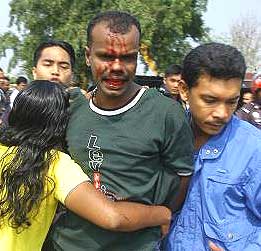 This man has just come out of a 'battle' with the Malaysian enforcement officers, trying to protect a Hindu temple which the authorities want demolished.
Sadly, this 'battle' is happening quite regularly all across Malaysia with the authorities going all out to bring down the number of unregistered temples. And with more such temples demolished, more disgruntled Indian Malaysians come to the fore - like this man.
If the government is not careful, it is in danger of breeding Hindu radicalism.
Before I go further, let's look at the temple situation in Malaysia. There are tens of thousands of temples here from the well-established and registered to the unregistered zinc-roofed and illegal sheds attached to some dwellings.
Some of the established and registered temples are better administered and do a good job as a place of worship for the community.
As for the second category of temples, these are usually places of worship founded in residential areas of the community and had, over the years, become popular not just with the locals but also with people from outside the area. Another feature of these temples is that they are usually found in former estate lands. After the plantation is sold to property developers, the temples become slated for removal. Usually these temples are old some a century or more - and popular.
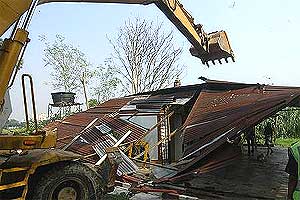 And the third category of temples the shed at the back of the house is an extension of these estate temples. These temples are created by people who moved out of the estates and in order to continue their daily prayers, they just resort to building a temple next to their houses.
The Malaysian Hindu Sangam is and has been for years trying to register all the temples in Malaysia. I support this move but not for the third category of temples. Backyard temples serve more like personal prayer rooms and should not be allowed to mushroom in residential areas. In their place, a common registered temple should be built for everyone in the community.
I believe temples should not just be a place for prayers but also a place for the community to gather, socialise and develop their cultural heritage and roots. I think many will agree with me.
But this is where the local authorities, state government and even the federal government fail to follow.
Better solution
As I see it, temples all categories of them are seen as a nuisance and eyesore in Malaysia. For example, the Selangor government apparently does not allow new temples to be built in the state. It does not even allow renovations to present temples.
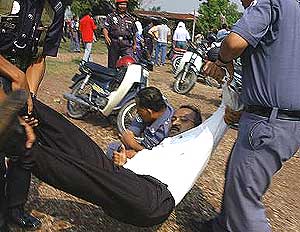 And Selangor is touted as the prime mover in demolishing former estate temples. In the past five years, I have personally covered news assignments of temples aging 100 years or more being demolished, and many times violently.
More often than not, the reasoning is that these temples are illegal, unregistered and public nuisance.
Well, they have become illegal because the landowners who gave the land to these temples have now sold the land for a profit to developers who want the temple removed from the residential project.
The temples remain unregistered because they are old and precede the registration requirement ruling. And they become a public nuisance because the authorities do not allow refurbishment to these temples.
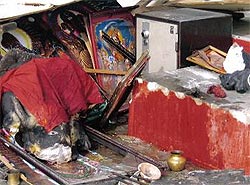 Instead of strictly sticking to the letters of the law, I think the authorities should be sensible in firstly allowing these temples time extensions to be registered and become legal. Then they should be allowed to be upgraded and finally the green light should be given for the construction of new temples in residential areas.
By doing so, in the long run, the government will see uniformity in Hindu temples in Malaysia, with even the old and unregistered temples becoming part of the process.
I think this will also solve the problems of shed temples mushrooming everywhere.
There are examples of sensible local authorities and developers who have helped turn an old, zinc-roofed temple into a proper place of worship. The temple at the Mid Valley Megamall in Kuala Lumpur is one such example.
K KABILAN is a member of the malaysiakini team. He is currently on a Chevening scholarship in the UK pursuing his Masters in Journalism.


